Best Artificial Tears Eye Drops for Sensitive Eyes
Six artificial tears listings compared on packaging, volume and dosing format. Refresh Plus leads on its 70 single-use vials, with a 10 mL preservative-free bottle and a pocket-sized Systane close behind.
The best artificial tears eye drops are the REFRESH PLUS Lubricant Eye Drops Preservative-Free, because 70 single-use containers at 0.01 fl oz each let you dose as often as you like without a preservative ever touching your eye. If you'd rather carry one bottle, the REFRESH TEARS PF Preservative-Free Artificial Tears puts the same preservative-free promise into a 0.33 fl oz multidose bottle. Most shoppers compare formulas here. That is the wrong comparison. The formulas in this set are all described in near-identical language, and what actually splits them is packaging.
Best artificial tears eye drops at a glance
| Pick | Volume | Format | Price |
|---|---|---|---|
| Best overall REFRESH PLUS Lubricant Eye Drops Preservative-Free |
0.01 fl oz per vial 70 vials |
Single-use, preservative-free | Check Price |
| Runner-up Systane UlTRA Lubricant Dry Eye Drops |
0.33 fl oz pack of 2 |
Multidose bottles | Check Price |
| Best minimal setup REFRESH TEARS PF Preservative-Free Artificial Tears |
0.33 fl oz 10 mL |
Multidose, preservative-free | Check Price |
| Best for pros TheraTears Dry Eye Lubricating Drops |
1 fl oz | Single large bottle | Check Price |
| Best budget pick Systane Ultra Lubricant Dry Eye Drops |
0.14 fl oz | Pocket multidose bottle | Check Price |
| Best for beginners GeriCare Artificial Lubricating Tears |
0.5 fl oz 15 mL |
Multidose bottle | Check Price |
How I screened these six listings
I set three criteria before ranking anything, weighted in this order.
- Dosing format, weighted heaviest. A single-use vial and a multidose bottle behave completely differently once you use drops more than twice a day. That gap is bigger than any difference in the marketing copy.
- Published volume, weighted second. Volume is the one figure every listing in this set states in the same unit, so it's the only genuinely comparable number here.
- Depth of published detail, weighted third. Some listings name a model number, a release year and a bottle mechanism. One names none of that.
Why those three and not formula chemistry? Because the input for these six products describes five of the formulas in interchangeable phrases: soothing, long-lasting, fast-acting, instant hydration. Those are the manufacturers' words, not measurements. TheraTears is the one exception, claiming a specific formula named OxyLytes with five electrolytes. Everything else is copy you cannot compare.
So I ranked on the things you can check on the box. Format, volume, and how much the maker was willing to put in print.
Does preservative-free actually matter for you?
Two of the six picks are stated as preservative-free: the REFRESH PLUS vials and the REFRESH TEARS PF bottle. Both are Refresh products. The other four listings say nothing about preservatives either way, which is not the same as containing them, but it does mean you cannot assume.
Here's the practical line. Preservatives exist so a bottle stays sterile after you open it. That's genuinely useful. The trade-off is that some people find repeated exposure irritating, and the more often you dose, the more exposure you get.
- Dosing once or twice a day? A standard multidose bottle is likely fine.
- Dosing four, six or more times a day? Preservative-free is worth the extra outlay.
- Wearing contacts for long stretches? Same answer.
- Eyes already stinging from the drops themselves? Switch format before you switch brand.
Refresh says the PLUS vials contain zero preservatives and are safe to use as often as needed. That is the company's claim, and it's the clearest statement of intent in this group. If your dosing is heavy, the best artificial tears eye drops for you are almost certainly the preservative-free ones.
1. REFRESH PLUS Lubricant Eye Drops Preservative-Free — Best overall
Seventy sealed 0.01 fl oz vials give you preservative-free dosing at any frequency, which no other pick here can offer.

Best for: anyone dosing several times a day or wearing contacts Skip it if: you want one bottle you can toss in a bag and forget
What separates this from the rest of the set is the count. Seventy containers, each 0.01 fl oz, each sealed until you twist it open. Nothing else here ships in more than two units. The whole carton weighs 4 oz and measures 4 x 3.75 x 7 in, so it lives in a bathroom cabinet rather than a pocket, and you carry a couple of vials out with you instead of the box.
Refresh describes it as an original-strength lubricating formula for mild dryness, made with zero preservatives, and says it's safe to use as often as needed. Those are the manufacturer's words. What I can verify is that the format supports that claim structurally: a fresh sterile vial every time removes the reason a preservative exists in the first place.
It also happens to be the pick buyers reach for most often in this group. The listing has been on the market since 2005 under model 403702, which is a long run for a product that gets reformulated as often as this category does.
The trade-off is real. This is the most expensive pick here, and it's the bulkiest. Vials also tend to hold more than one drop, so you either share the leftover across both eyes immediately or you throw liquid away.
Pros:
- 70 single-use containers, the highest count in this set
- Stated preservative-free, one of only two here
- Fresh sterile vial at every single dose
- Refresh says it's safe to use as often as needed
- On the market under one model since 2005
Cons:
- The most expensive pick in this group
- Box is 4 x 3.75 x 7 in, too big to carry
- Each vial holds more than a single drop, so some gets wasted
- No published warranty, and only two sellers list it
2. Systane UlTRA Lubricant Dry Eye Drops — Runner-up
Two 0.33 fl oz bottles is the most total liquid you can get in multidose form here, which makes it the sensible choice for a two-room household.

Best for: households that want a spare bottle in a second room Skip it if: you react to preserved drops
The pack of 2 is the point. Each bottle is 0.33 fl oz, so you're getting 0.66 fl oz total, and that's the largest multidose volume in this set once you count both bottles. One goes by the bed, one goes in the kitchen or the car. Nobody hunts for the bottle at 2am.
Systane's listing claims extended protection and says the drops reduce both the signs and symptoms of dry eye. The company also calls it a doctor-recommended brand of artificial tears, which is marketing copy on the box rather than something the listing substantiates, so read it as a claim and not a finding. The listing does specify room-temperature storage, which is worth noting if you keep drops in a car through a hot summer.
Against the winner, the gap is preservatives. This listing says nothing about them, and a multidose bottle you open and reuse for weeks generally needs some form of preservation. If your eyes are already sensitive, that's the reason it sits second rather than first.
The published detail is also thinner. Model 0065143141p, weight 1.4 oz, dimensions 4 x 6 x 5 in, and colour listed as multicolor. No release year, no mechanism described.
Pros:
- 0.66 fl oz total across two bottles, most multidose volume here
- Two bottles let you keep one in a second room
- Room-temperature storage stated on the listing
- Compact 1.4 oz bottles compared to a vial carton
Cons:
- Nothing published about preservatives
- Sits in the higher price territory of this set without a stated preservative-free formula
- "Doctor-recommended brand" is packaging copy, not evidence
- No release year or bottle mechanism described
3. REFRESH TEARS PF Preservative-Free Artificial Tears — Best minimal setup
One 10 mL bottle, stated preservative-free, with a double lockout system Refresh says keeps the drops sterile between doses.

Best for: one bottle, preservative-free, no vial clutter Skip it if: you share drops with another person
This is the interesting engineering problem in the whole category, and this bottle is the only pick here that attempts to solve it. Preservative-free formulas normally need single-use packaging. Refresh says this soft-squeeze multidose bottle uses a double lockout system to keep drops sterile, which is how you get 0.33 fl oz of preservative-free liquid in one container instead of 70 vials.
At 1.12 oz and 1.65 x 4.13 x 1.85 in, it fits a coat pocket. The winner's carton does not. That's a genuine daily-use advantage if you dose away from home.
Refresh calls it original strength for mild, occasional dry eye symptoms, fast-acting, and good for sensitive eyes. Note the word occasional in the company's own description. If your symptoms are constant rather than occasional, the vials give you more total capacity.
The trade-off against Refresh Plus is total volume and sharing. One 0.33 fl oz bottle holds far less than 70 vials combined, and a bottle you both touch is a bottle you both share. Vials avoid that entirely. It also sells slower than the winner, and the listing gives you a model number but no release year.
Pros:
- Stated preservative-free in a multidose bottle
- Double lockout system claimed to maintain sterility
- 1.12 oz body fits a pocket or a small bag
- Second-cheapest of the mid-priced picks here
Cons:
- Far less total liquid than the 70-vial winner
- Not practical to share between two people
- Refresh describes the target symptoms as mild and occasional
- Slower seller than either Systane pick in this set
4. TheraTears Dry Eye Lubricating Drops — Best for pros
At 1 fl oz this is the largest single bottle in the set, and the only formula here described with named ingredients rather than adjectives.

Best for: long-term dry eye management from one large bottle Skip it if: you need a preservative-free formula
One bottle, 1 fl oz. That's three times the volume of either 0.33 fl oz bottle here and it's the reason this earns the label. If you've settled into a routine and you know drops work for you, buying volume in one container beats buying two.
TheraTears is also the only listing in this group that names something in its formula. The company says it contains OxyLytes, described as the five vital electrolytes found in natural tears, and that an ophthalmologist created the formula after 18 years of research. That's the manufacturer's account of its own product, and it's more specific than the interchangeable soothing-and-hydrating copy on most of these boxes. The listing also states the purchase may be FSA or HSA eligible, subject to your plan.
The bottle itself is 4.25 x 1.9 x 1.25 in and 17 g, released in 2021 under model TTMD30. It sits in the same broad price territory as the Refresh PF bottle.
Two flags. Only one seller lists it, which is the thinnest supply position in this set. And a 1 fl oz multidose bottle you'll use for weeks says nothing about preservatives, which is the same gap that keeps the Systane two-pack out of first place.
Pros:
- 1 fl oz, the largest single container here
- Only formula in the set with a named ingredient system
- Listing notes possible FSA or HSA eligibility
- Compact 4.25 x 1.9 x 1.25 in body for its volume
Cons:
- Nothing published about preservatives
- Only one seller lists it, the thinnest availability of the six
- "Doctor-recommended" is a brand claim on the packaging
- A large open bottle stays open a long time
5. Systane Ultra Lubricant Dry Eye Drops — Best budget pick
The cheapest pick here and by far the smallest at 0.14 fl oz and 3.97 g, which is the whole reason to buy it.
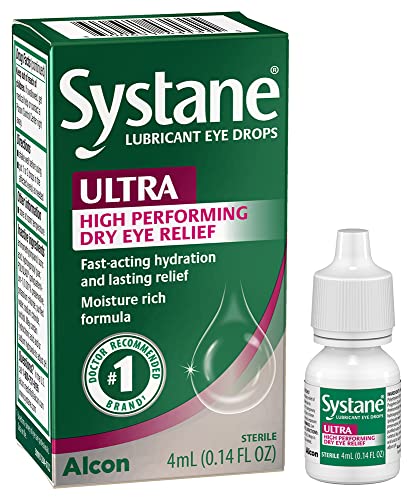
Best for: a pocket, a glovebox or a desk drawer Skip it if: you dose more than a few times a day
Weight is the standout figure. 3.97 g, in a body measuring 3.31 x 1.28 x 1.78 in. Nothing else in this comparison comes close to disappearing into a jeans pocket like this. It's also the cheapest of the six, which makes it the low-commitment way to find out whether Systane's formula suits you before buying the two-pack.
The claims match its bigger sibling exactly: extended protection, fast long-lasting relief, and a stated reduction in both the signs and symptoms of dry eye. Same brand, same copy, same formula family, released in 2017 under model 0065143131.
Now the honest arithmetic. At 0.14 fl oz, this holds under half of one 0.33 fl oz bottle from the two-pack. If you dose four or five times a day you'll be reordering constantly, and buying small repeatedly is rarely the cheaper path. Treat this as a second bottle rather than your only one.
Like the other Systane listing, it says nothing about preservatives. And it's the pick in this set with the least published specification detail besides GeriCare, with no stated colour and no described bottle mechanism.
Pros:
- Cheapest of the six picks
- 3.97 g and 3.31 x 1.28 x 1.78 in, genuinely pocketable
- Low-cost way to trial the Systane formula
- On the market under one model since 2017
Cons:
- 0.14 fl oz runs out fast under heavy dosing
- Nothing published about preservatives
- Buying repeatedly at this size adds up
- No described bottle mechanism or sterility feature
6. GeriCare Artificial Lubricating Tears — Best for beginners
A 0.5 fl oz bottle at the second-lowest price here, which makes it a cheap first attempt rather than a considered long-term choice.

Best for: a first bottle to find out whether drops help at all Skip it if: you want a formula with published detail behind it
The volume-to-price position is what earns this a spot. 0.5 fl oz, or 15 mL, at the second-cheapest price in the set. That's more liquid than either 0.33 fl oz bottle for less money, and if you've never tried artificial tears eye drops at all, it's a low-stakes way to learn whether they help your particular dryness.
GeriCare describes it as a long-lasting lubricating formula that closely mimics natural tears, in a bottle designed for precise, controlled dispensing. The company lists screen time, contact lens wear, environmental dryness and aging as the situations it's meant for. Read all of that as the manufacturer's positioning.
Here's where it falls behind. This is by a wide margin the slowest-moving pick in the group, well outside the range the other five occupy. Its listing is also the thinnest: colour and dimensions of 4 x 2 x 2 in, and nothing else. No model number, no release year, no described cap or dispensing mechanism, and no mention of preservatives.
Every other pick here tells you more about what you're buying. That's the trade you're making for the price.
Pros:
- 0.5 fl oz, more volume than either 0.33 fl oz bottle
- Second-cheapest of the six picks
- GeriCare claims controlled, precise dispensing
- Positioned for screen time and contact lens dryness
Cons:
- Slowest-moving pick in this set by a wide margin
- No model number or release year published
- Nothing stated about preservatives
- The least detailed listing of the six
Single-use vials or a multidose bottle?
This is the fork in the road, and it decides more than brand does. Five of these six picks are bottles. One is a box of 70 vials.
Vials win when:
- You dose more than three or four times a day
- Your eyes sting from the drops themselves
- Two people in the house use drops
- You want a sterile dose every time without relying on a cap mechanism
Bottles win when:
- You dose once or twice a day
- You need the drops in a pocket, not a cabinet
- You want maximum liquid for the outlay
- You'd rather not open a new container each time
The one hybrid here is REFRESH TEARS PF, which puts a preservative-free formula into a 0.33 fl oz bottle using what Refresh describes as a double lockout system. That's the company's design answer to the problem. Whether it suits you depends on whether you're sharing.
Volumes across the set, for reference: 0.14 fl oz, 0.33 fl oz, 0.33 fl oz in a pack of 2, 0.5 fl oz, 1 fl oz, and 70 vials of 0.01 fl oz each.
How much liquid are you actually buying?
Size figures in this category are quoted in three different ways, and it's easy to misread them. Here's the plain accounting.
The 1 fl oz TheraTears bottle is the biggest single container. The Systane two-pack totals 0.66 fl oz but arrives split across two bodies, which is a feature if you want a spare and a drawback if you'd rather carry one thing. GeriCare's 0.5 fl oz sits between them in a single bottle. The two 0.33 fl oz bottles from Refresh and Systane are the standard size in this category. The 0.14 fl oz Systane is a deliberate travel format.
The vials are the outlier and they don't compare cleanly. Seventy containers at 0.01 fl oz is a modest total volume on paper, but the number that matters is doses, not millilitres. Seventy sealed doses is a supply that lasts, especially if you're using drops on a schedule rather than a bottle you squeeze whenever your eyes tighten up.
Weights, for people watching bag space: 3.97 g for the small Systane, 17 g for TheraTears, 1.12 oz for the Refresh PF bottle, 1.4 oz for the Systane two-pack, and 4 oz for the Refresh Plus carton.
What the listings do not tell you
Four of these six listings say nothing whatsoever about preservatives. That silence is the biggest information gap in the category, and it's the one thing you'd most want on the front of the box.
There's a second gap. None of these six listings publishes a warranty, which is normal for a consumable, but it means the packaging and the seller are your only recourse if something arrives wrong. Availability is thin across the board too: TheraTears has a single seller, and the other five have two each.
Two listings lean on the phrase doctor-recommended brand. That phrase appears on packaging across this whole category, and neither listing tells you what recommendation, from whom, or measured how. Treat it as a marketing line, because that's what the listing gives you.
Finally, the qualifier in most search phrases for this category is about symptoms: dry eyes, itchy eyes, redness, screen fatigue. No listing here publishes a clinical figure you can match against your own symptoms. What each one does publish is a volume, a format, and in most cases a model number. Those are the facts you can shop on. Anything about how a formula performs for your specific eyes is a question for the person who examines them.
The verdict
Entry tier: the 0.14 fl oz Systane Ultra is the cheapest way in, and the GeriCare 0.5 fl oz bottle gives you more liquid for barely more outlay. Both are fine trial purchases. Both leave you guessing about preservatives, and both publish thin specification detail. Buy either to find out whether drops help you at all, then move up.
Middle tier: the REFRESH TEARS PF bottle and the TheraTears 1 fl oz bottle solve two different problems well. Refresh gives you a stated preservative-free formula in a pocketable 1.12 oz body with a claimed double lockout cap. TheraTears gives you three times the volume in one container and the only named ingredient system in this group. Pick on format, not brand.
Premium tier: the REFRESH PLUS 70-vial box wins the whole comparison. Seventy sealed doses at 0.01 fl oz each, stated preservative-free, and Refresh says you can use them as often as needed. That combination exists nowhere else in this set. The Systane two-pack is the premium alternative, and its exact advantage is 0.66 fl oz across two bottles you can station in two rooms. If you dose heavily, take the vials. If you dose lightly and want convenience, take the two-pack.
FAQ
Are the best artificial tears eye drops worth paying more for?
The best artificial tears eye drops worth paying more for are the preservative-free ones, and only if your dosing is frequent. Refresh Plus is the most expensive pick here, and the extra buys 70 sealed single-use vials rather than a stronger formula. If you use drops once a day, a 0.5 fl oz bottle serves you just as well for far less.
Is preservative-free worth it for occasional dry eyes?
Preservative-free is worth it mainly for heavy dosing, not occasional dryness. If you reach for drops once or twice a day, a standard multidose bottle like the 0.33 fl oz Systane or the 0.5 fl oz GeriCare covers you. Once you're dosing four or more times daily, or your eyes sting from the drops themselves, the 70-vial Refresh Plus box becomes the better call.
How many artificial tears eye drops does one bottle hold?
Artificial tears eye drops bottles here range from 0.14 fl oz up to 1 fl oz, and no listing states a drop count. Volume is your only guide. The Systane travel bottle holds 0.14 fl oz, both standard bottles hold 0.33 fl oz, GeriCare holds 0.5 fl oz or 15 mL, and TheraTears holds 1 fl oz. Refresh Plus ships 70 vials instead.
Refresh Plus vials or Refresh Tears PF bottle?
Refresh Plus vials or the Tears PF bottle comes down to sharing and portability. Both are stated preservative-free. The 70-vial box gives you a sterile dose every time and works for two people, but the carton is 4 x 3.75 x 7 in. The 1.12 oz Tears PF bottle fits a pocket and uses a claimed double lockout cap, but holds only 0.33 fl oz.
What mistake do first-time buyers make with eye drops?
The mistake first-time buyers make is choosing on brand copy instead of format. Five of these six listings describe their formulas in near-identical language: soothing, fast-acting, long-lasting. Those words don't distinguish anything. Decide first whether you need single-use vials or a multidose bottle, then how much volume your routine burns through, and let those two answers pick the product.
Start with your dosing frequency, not the shelf. Count how many times you reached for drops yesterday. Three or fewer, and a bottle is the right shape: the 0.5 fl oz GeriCare to test the waters, the 0.66 fl oz Systane two-pack if you want one in two rooms. More than three, and the REFRESH PLUS box of 70 vials is the pick that stops making you choose between convenience and comfort. That's the real case for it. Not a better formula, just a format that removes the trade-off everyone else in this set still asks you to accept.
Last updated: September 7, 2026. Product availability re-checked.
This page contains affiliate links. As an Amazon Associate we earn from qualifying purchases, at no extra cost to you.