Best Organic Prebiotic Fiber: MRM Leads the Field
A ranked look at seven prebiotic fiber supplements, judged on grams per serving, ingredient sourcing and daily format. Plus the pregnancy question no listing answers.
The best organic prebiotic fiber for pregnant women in this set is MRM Whole Food Organic Fiber with Enzymes & Prebiotics, because it publishes 6 g of soluble and insoluble fiber per scoop from USDA Organic whole-food sources with organic acacia and inulin. If you want a certified-organic powder from a three-source blend instead, the Peak Performance USDA Organic Prebiotic Fiber 3-in-1 is the runner-up. Read the pregnancy section first: the word "pregnant" is not on any of these labels, and that matters.
Best organic prebiotic fiber for pregnant women at a glance
| Pick | Fiber per serving | Format | Price |
|---|---|---|---|
| Best overall MRM Whole Food Organic Fiber |
6 g claim | Powder, 9.03 oz | Check Price |
| Best minimal setup Physician's CHOICE Fiber Gummies |
5 g claim (2 gummies) | Gummy, 60 count | Check Price |
| Best for pros Nature Made Probiotic + Prebiotic |
3 g claim (2 gummies) | Gummy, 50 count | Check Price |
| Best budget pick Micro Ingredients Vitality Fiber |
5 g claim | Powder, 1 lb, 90 servings | Check Price |
| Runner-up Peak Performance 3-in-1 Powder |
Not listed | Powder, 8.5 oz | Check Price |
| Best premium Hyperbiotics Vital Nutrient Powder |
Not listed (54 servings) | Powder, 13.23 oz | Check Price |
| Best for beginners Peak Performance 3-in-1 Capsules |
Not listed | Capsule, 120 count | Check Price |
How I narrowed the field to seven
I started with the disqualifications. Any prebiotic fiber that failed on ingredient transparency, format viability or serving size came out first, and what survived is the list above.
Three reasons a pick was cut. One, no clear prebiotic source named on the listing. If a product does not say what feeds the bacteria (inulin, chicory root, acacia, FOS, Jerusalem artichoke), it is not a prebiotic fiber pick, it is a fiber pick. Two, a serving size so small it stops mattering. If a product's own listing cannot commit to at least a few grams of fiber per serving, the daily habit will not move the needle. Three, opaque sourcing on an "organic" claim. If the brand says organic but does not describe which ingredients are organic and from what plant, the claim is doing marketing work rather than sourcing work.
What survived is seven products across three formats: four powders, two gummies, one capsule. Three products carry a USDA Organic or organic-branded label directly (MRM, Peak Performance powder, Peak Performance capsule, Hyperbiotics). Two lead with chicory root as the named prebiotic. One pairs a probiotic strain with prebiotic fiber in the same chew. All seven come from the Digestive Supplements aisle on Amazon, so the comparison is like-for-like.
What actually decides a prebiotic fiber pick
The obvious specification is grams of fiber per serving. It matters, but it is not what decides the best organic prebiotic fiber for pregnant women or anyone else who plans to take one daily. The real deciding criterion is whether you will still be taking it in six weeks.
That splits into three practical questions. First, does the format fit your morning? A powder needs a glass and a stir; a gummy needs a bottle on the counter; a capsule needs a swallow with water. Second, does the prebiotic source suit your gut? Chicory root inulin is common and cheap, but some people bloat on it, and acacia tends to be gentler. Third, does the label tell you what you are taking? A product that publishes 6 g of fiber per serving and names the plant sources is easier to trust than one that says "high bioavailable" without a figure.
Grams matter as a tiebreaker. On daily habit, MRM's 6 g claim from whole-food organic sources with acacia and inulin is the strongest published position in this set. On format flexibility, Physician's CHOICE Fiber Gummies wins because you cannot forget to mix it. On price, Micro Ingredients Vitality Prebiotic Fiber Powder holds the cheapest position at 90 servings per pouch.
1. MRM Whole Food Organic Fiber with Enzymes & Prebiotics — Best overall
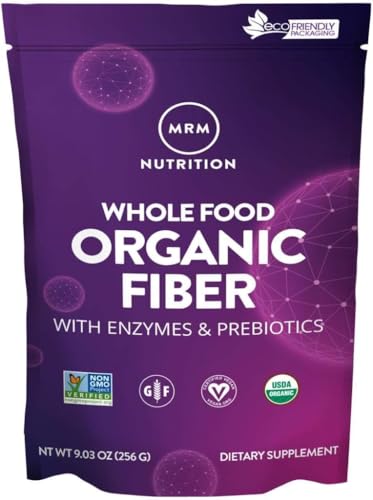
MRM leads the set on published fiber grams from named whole-food organic sources, and it does it in a scoop of powder that mixes into whatever you already drink.
Best for: someone who wants the highest published fiber dose from whole-food organic sources Skip it if: you refuse to mix a powder into anything
MRM says a single scoop delivers 6 g of soluble and insoluble fiber from whole-food sources, with organic acacia and inulin as the named prebiotics and added enzymes. That is the highest published gram figure in this set, and unlike the two Peak Performance products and Hyperbiotics, the fiber quantity is stated on the listing rather than implied. The powder is USDA Organic, vegan, gluten-free and non-GMO by MRM's description, and the tub is a 9.03 oz size holding 32 servings, released in 2017 under model 31052. Compared with the two gummies here, it commits to more fiber per day; compared with the 1 lb Micro Ingredients tub, it commits to whole-food sourcing rather than a chicory-and-FOS pair. The trade-off is honest: you have to open a tub, use the scoop and stir every day. The other trade-off is servings. At 32 per tub, it does not last as long as the Micro Ingredients 90-serving pouch or the Hyperbiotics 54-serving tub.
Pros:
- 6 g fiber per serving is the highest published figure here
- Whole-food organic sourcing with acacia and inulin named
- Added enzymes on top of the prebiotic blend
- USDA Organic, vegan, gluten-free, non-GMO by the label
- Compact 9.03 oz tub, easy to store
Cons:
- 32 servings is the shortest supply among the powders
- Requires a scoop and a drink every day
- No published pregnancy guidance on the listing
2. Peak Performance USDA Organic Prebiotic Fiber 3-in-1 Vegan — Runner-up
Peak Performance is the certified-organic powder alternative when you want a three-source blend rather than a whole-food single scoop.

Best for: a certified-organic powder from a three-source blend Skip it if: the manufacturer does not publish grams per serving you can verify
Peak Performance's 3-in-1 powder sits at the most expensive position of the two entry-tier powders in this set, and it earns a listen because of what it commits to on sourcing. Peak Performance says the powder is USDA Organic and vegan, free of soy, milk, egg, shellfish, corn, wheat, peanuts, gluten and preservatives, and the brand contrasts natural sources against "cheap, non-organic, insoluble bulking fibers" that fill some competitor tubs. That is exactly the ingredient conservatism a careful shopper wants. Where MRM commits to 6 g per serving, Peak Performance does not publish a gram figure on the listing, which is the reason it does not lead. The 8.5 oz tub is compact at 5.63 x 3.66 x 3.7 in, off-white powder, released in 2021 under model PPOPFB01. Against Hyperbiotics, Peak Performance is the smaller organic powder; against Micro Ingredients, it is the certified-organic alternative to a chicory-and-FOS budget blend. The trade-off is that you are trusting the "3-in-1" description without a published per-serving fiber number.
Pros:
- USDA Organic and vegan, with allergens named excluded
- Three-source prebiotic blend by the listing description
- Compact 8.5 oz size for kitchen storage
- Vitamin Angels donation match on every purchase
Cons:
- No fiber grams per serving on the listing
- The most expensive position of the two organic powders here
- Servings per container not published
3. Hyperbiotics Vital Nutrient Prebiotic Powder — Best premium
Hyperbiotics offers the largest organic powder tub in this set at 54 servings, with a three-plant prebiotic blend.

Best for: the largest organic powder tub in this set, at 54 servings Skip it if: you want the cheapest daily cost
At 13.23 oz and 54 servings, Hyperbiotics holds the biggest organic tub here, which makes it the pick for anyone who does not want to reorder every month. Hyperbiotics says the blend combines acacia fiber, Jerusalem artichoke and a third organic source, all food-based rather than synthetic. The brand says the powder is manufactured in an NSF-certified facility and is free from gluten, dairy, peanut, tree nut, fish, shellfish, soy, sesame, egg and active yeast. That is the longest allergen-free statement in the set. The tub measures 5.12 x 4.02 x 4.13 in with a beige powder inside. It sits at the most expensive price position of the seven, which is the premium name earned. Two honest trade-offs: no fiber grams per serving on the listing, and the model number XXPREBIOTICPOWDER is doing the work of a spec sheet you would prefer to see. Against MRM, Hyperbiotics wins on tub size and loses on published dose. Against Peak Performance powder, it wins on servings and named plant sources.
Pros:
- 54 servings in a 13.23 oz tub, the largest organic supply here
- Three-plant prebiotic blend with acacia and Jerusalem artichoke named
- Long allergen exclusion list on the listing
- NSF-certified facility by the manufacturer's statement
Cons:
- The most expensive position in this set
- No grams of fiber per serving on the listing
- Beige powder colour some drinkers dislike in clear glasses
4. Physician's CHOICE Fiber Gummies for GLP-1 Support — Best minimal setup
Physician's CHOICE is the pick when you want prebiotic fiber without any preparation, in a chew you keep on the counter.

Best for: anyone who will actually take a chewable but forgets a scoop Skip it if: you need more than 5 g of fiber per serving
Physician's CHOICE says a 2-gummy serving provides 5 g of prebiotic fiber from natural soluble chicory root, with a raspberry lemon flavour and no added sugar, sugar alcohols or artificial sweeteners. In this set, that 5 g claim is the highest published dose among the gummies, well ahead of Nature Made's 3 g claim for a two-gummy serving. The bottle holds 60 count and weighs 0.56 lb. The brand says the product is developed with doctors, third-party tested and made in a cGMP-certified facility. Against the powders, the trade-off is dose ceiling: even the strongest gummy here caps at 5 g while MRM commits to 6 g. Against Nature Made, it wins on fiber grams and loses on the added probiotic strain. The gummy is also the fastest-selling pick in this set by a wide margin, so shoppers voting with cart clicks are already choosing it over the powders. That does not verify a health effect, but it does verify appetite for the format.
Pros:
- 5 g fiber per 2-gummy serving, highest in the gummy category here
- Chicory root prebiotic named clearly
- No sugar added, no artificial sweeteners
- Third-party tested by the manufacturer's statement
- The one buyers choose most often in this set
Cons:
- 30-day supply per bottle at 2 per day
- Not a certified-organic label
- Chicory root inulin can bloat some gut types
5. Micro Ingredients Vitality Prebiotic Fiber Powder — Best budget pick
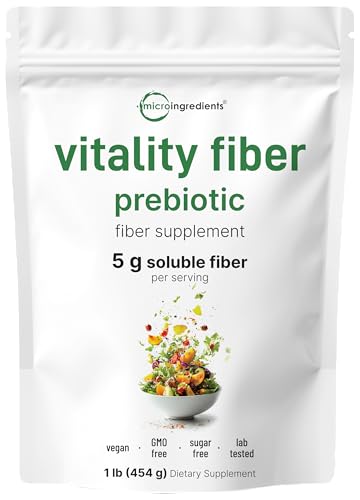
Micro Ingredients is the cheapest daily powder habit in this set, with 90 servings per pouch and a straightforward two-source prebiotic blend.
Best for: a daily powder habit at the lowest price position in this set Skip it if: you require a USDA Organic seal
Micro Ingredients holds the cheapest price position of the seven and pairs it with the longest supply: 90 servings in a 1 lb pouch. Micro Ingredients says the powder delivers 5 g of soluble fiber per serving from chicory root inulin and FOS, unflavored and vegan, with no fillers or sugars. That is a clean two-source formula at a working dose. The scoop is included, and the brand says every batch passes third-party lab tests. What it does not carry is a USDA Organic seal on the listing, which is why it sits below the organic-first picks and not above them. Against Peak Performance and Hyperbiotics, it is the budget alternative; against MRM, it is the volume alternative. Two honest trade-offs. First, chicory root plus FOS is the most fermentable prebiotic pair on this list, and sensitive guts feel that faster than gentler acacia. Second, the ingredient description is thinner on origin detail than MRM's or Hyperbiotics'. On daily cost of a fiber habit, though, nothing here matches it.
Pros:
- 90 servings in a 1 lb pouch, the longest supply here
- 5 g soluble fiber per serving, published
- Chicory root inulin and FOS both named
- Sugar free, vegan, unflavored, non-GMO
- Cheapest price position of the seven
Cons:
- No USDA Organic seal on the listing
- Chicory plus FOS is the most fermentable pairing here
- Origin detail thinner than the organic powders
6. Nature Made Probiotic + Prebiotic Fiber Gummies — Best for pros
Nature Made is the pick when you want a probiotic strain and prebiotic fiber in the same chewable, from a well-established supplement label.

Best for: someone stacking a probiotic strain with prebiotic fiber in one chew Skip if: you want a certified-organic label
Nature Made says the gummies deliver 3 g of prebiotic fiber per two-gummy serving alongside a clinically studied LactoSpore probiotic strain at 2 billion CFU. That is a synbiotic in one format, and it is the only pick in this set to combine both. The bottle holds 50 count and weighs 7.26 oz, measuring 2.68 x 4.96 x 2.72 in. Nature Made says the gummies are pectin-based with a mixed berry flavour, gluten free, with no artificial flavours or synthetic dyes and no refrigeration needed. Against Physician's CHOICE, Nature Made loses on fiber grams (3 g vs 5 g) and wins on the added probiotic. Against MRM, it loses on published fiber and organic sourcing. The trade-off is clear: this is a two-job supplement in a gummy, and the fiber portion is the smaller job. If you want prebiotic fiber as your primary target, one of the powders serves better. The 50-count bottle is a 25-day supply at two per day, which is short.
Pros:
- LactoSpore probiotic strain at 2 billion CFU per serving
- 3 g prebiotic fiber per two gummies
- Pectin-based, gluten-free, no refrigeration
- Mixed berry flavour without artificial flavours
Cons:
- 3 g fiber is the lowest published dose here
- Not a certified-organic label
- 25-day supply per bottle
- Newer 2025 formulation, limited track record
7. Peak Performance Organic 3-in-1 Prebiotic Fiber Vegan Capsules — Best for beginners
Peak Performance capsules are the pick for people who want prebiotic fiber but refuse both powders and gummies.

Best for: capsule takers who dislike both powders and gummies Skip it if: you want a high fiber dose in one or two pills
Peak Performance's capsule bottle holds 120 count in a compact 4.41 x 2.28 x 2.48 in size, weighing 4.16 oz. Peak Performance says the capsules use a three-source organic prebiotic blend, vegan and free of soy, milk, egg, shellfish, corn, wheat, peanuts, gluten and preservatives. Model PPPREBIOTICS, released in 2021. This is a real capsule option in a category dominated by powders and gummies, and that is the reason to consider it. What it cannot do is deliver fiber grams the way a scoop can. Capsules simply do not hold as much material as a scoop of powder, so any capsule-based fiber pick asks you to take several a day and still lands below a powder's per-serving figure. The listing does not publish a per-serving gram number, which makes verification harder. Against the powders here, this is the format compromise pick; against gummies, it is the sugar-free, flavour-free alternative for people who do not enjoy chewables.
Pros:
- Capsule format for people who avoid powders and gummies
- USDA Organic branding on the listing
- 120 count bottle, compact size
- Long allergen-exclusion statement
Cons:
- No fiber grams per serving published
- Capsules cannot match powder-scoop fiber doses
- Higher price position than the entry powders here
- Multiple capsules likely needed daily
Powder, gummy or capsule: which format wins?
Format is the argument, not grams. The best organic prebiotic fiber for pregnant women or anyone else is the one you will still be taking on day 42, so pick the format your morning tolerates.
Powders win on dose ceiling. A scoop simply holds more fiber than a chewable or a pill, which is why MRM can commit to 6 g and Micro Ingredients to 5 g, while the strongest gummy here caps at 5 g and the capsules do not publish a figure. If you drink coffee, tea or a shake every day, a powder disappears into it.
- Powders suit dose targets and price efficiency.
- Gummies suit habit reliability and no-prep mornings.
- Capsules suit taste avoidance at the cost of dose.
Gummies win on friction. Physician's CHOICE at 5 g of chicory root fiber per two gummies is the closest a gummy gets to a powder's dose, and gummies live on counters and desks in a way a powder tub does not. That matters more than a spec sheet if you are the kind of person who forgets a supplement the moment it needs a glass of water.
Capsules win only on preference. If you cannot stand powders and dislike sweetness, Peak Performance capsules are the only real option in the set, but you will not hit a powder-scale dose without swallowing several a day.
Is any of this safe during pregnancy?
Short answer: none of these seven listings carries pregnancy-specific dosing, and the search that surfaced them treats "pregnant women" as a loose qualifier, not a specification. Amazon returned prebiotic fibers marketed to general adults. That is a fact about the search, not a health claim about the products.
The best organic prebiotic fiber for pregnant women is a decision to make with a physician, midwife or dietitian who knows your history, not a decision to make from a listing. Two reasons. First, prebiotic fiber sources vary in how fermentable they are, and pregnancy already changes gut motility, so the same product can behave differently across trimesters. Second, added ingredients matter. A gummy with a probiotic strain, a powder with enzymes, or a capsule with a proprietary blend all raise questions the label alone cannot answer for a pregnant reader.
The practical steps look like this. Read the ingredient list on the product page. Take a screenshot. Bring it to your prenatal appointment. Ask about the specific plant sources: acacia, chicory root inulin, FOS, Jerusalem artichoke, and any added strains or enzymes. Ask about your current fiber intake from food, because supplementation is additive. If the answer is yes, start at half the label's serving and increase gradually, and stop if you notice a change you cannot explain. If the answer is no, whole-food fiber from oats, chia, berries and leafy greens covers the same ground.
How many servings does one container really give you?
Servings decide daily cost and reorder frequency, and the answers vary widely in this set. Here is what the listings publish:
- Micro Ingredients: 90 servings, 1 lb pouch
- Peak Performance capsules: 120 count, capsules per serving not stated
- Hyperbiotics: 54 servings, 13.23 oz tub
- MRM: 32 servings, 9.03 oz tub
- Physician's CHOICE: 60 count gummies, 30 servings at two per day
- Nature Made: 50 count gummies, 25 servings at two per day
- Peak Performance powder: servings not stated
Two takeaways. First, the gummies deliver the fewest servings per bottle. A 25-day supply from Nature Made or a 30-day supply from Physician's CHOICE means monthly reorders, which is the trade-off for the format's convenience. Second, Micro Ingredients' 90-serving pouch is roughly three times the supply of MRM and just short of double Hyperbiotics, which is a large part of why it holds the cheapest price position. Peak Performance's powder does not publish a serving count on the listing, and that is a real gap when you are budgeting a daily habit.
What the listings do not tell you about fiber grams
Every daily fiber supplement lives inside a bigger fiber picture, and the listings do not remind you of that. General adult fiber intake targets sit well above what a single supplement scoop delivers, so a 5 g or 6 g scoop is a top-up, not a replacement.
That reframes the pick. If you already eat oats, beans, chia, leafy greens and berries, an extra 3 g from a gummy might be all you need to close the gap on a busy day. If your diet leans toward white bread, meat and takeout, a 6 g powder scoop still leaves plenty of room to eat more plants. Neither is a failure of the product. The listings simply cannot know what else is on your plate.
Two habits help. Track a normal day's fiber from food once, on any calorie app, to see where you actually land. Add the supplement's contribution on top of that number rather than instead of it. And drink more water than usual on days you supplement, because prebiotic fiber pulls water into the gut, and that is where "bloating from fiber" often comes from.
The verdict
MRM Whole Food Organic Fiber with Enzymes & Prebiotics is the best organic prebiotic fiber for pregnant women, or anyone else, in this set. It commits to 6 g of fiber per serving from whole-food organic sources with acacia and inulin named, it carries USDA Organic branding, and it delivers all of that in a scoop of powder that mixes into any drink. No other pick here matches that combination of published dose, organic sourcing and format flexibility.
Two conditions flip the recommendation. If you will not use a powder, Physician's CHOICE Fiber Gummies is the runner-up format at 5 g of chicory root fiber per two-gummy serving with no added sugar, though it is not a certified-organic product. If you need the longest supply at the cheapest daily cost and you tolerate chicory root inulin, Micro Ingredients Vitality Prebiotic Fiber Powder holds 90 servings in a 1 lb pouch at 5 g per serving.
The pregnancy caveat is not optional. None of these listings publishes pregnancy dosing, so the actual best organic prebiotic fiber for pregnant women is the one your clinician approves after seeing the ingredient list. Start there, not with a cart.
FAQ
What is the best organic prebiotic fiber for pregnant women overall?
The best organic prebiotic fiber for a general adult, pregnant or otherwise, in this set is MRM Whole Food Organic Fiber with Enzymes & Prebiotics. It publishes 6 g of soluble and insoluble fiber per scoop from whole-food organic sources, names organic acacia and inulin, and carries USDA Organic branding. Any pregnant reader should still confirm the ingredient list with her clinician before starting a daily habit, because no listing here carries pregnancy-specific dosing.
Is a prebiotic fiber supplement worth it if I already eat fiber?
A prebiotic fiber supplement is worth it as a top-up, not a replacement for food. If your daily plate already carries oats, beans, berries, chia and leafy greens, a supplement adds 3 to 6 g on top of that baseline. If your diet is low in plants, the supplement narrows the gap but does not close it. Track your food fiber for a normal day first, then decide.
How does MRM compare with Physician's CHOICE Fiber Gummies?
MRM compares favourably on dose and sourcing, and Physician's CHOICE compares favourably on friction. MRM's powder publishes 6 g of fiber per scoop from whole-food organic sources with USDA Organic branding. Physician's CHOICE publishes 5 g from chicory root fiber per two gummies, no added sugar, but does not carry a certified-organic seal. Choose MRM for dose ceiling, Physician's CHOICE for a chew you will not forget.
What prebiotic fiber source is gentlest on the gut?
Prebiotic fiber sources vary by fermentability, and acacia is generally the gentlest of the common ones. Chicory root inulin and FOS are highly fermentable, which means faster gas and bloating for sensitive guts. Jerusalem artichoke sits in between. MRM leads with acacia and inulin, Hyperbiotics adds Jerusalem artichoke, and Physician's CHOICE and Micro Ingredients lean on chicory root. Start at half the serving if you are unsure.
What is the most common mistake with prebiotic fiber supplements?
The most common mistake with prebiotic fiber supplements is starting at the full serving on day one and drinking too little water. Prebiotic fiber pulls water into the gut and ferments in the colon, which produces gas as a normal side effect. Both effects are worse when you jump straight to the label dose. Start at half the serving for a week, drink more water than usual, then step up.
Prebiotic fiber is a slow-payoff supplement, so the pick you can actually keep taking wins over the pick with the best spec sheet. If you are a powder person, MRM's 6 g scoop from whole-food organic sources is the strongest daily habit here. If you are a chewable person, Physician's CHOICE at 5 g per two gummies is the closest a gummy gets to a powder's dose. Either way, take a screenshot of the ingredient list, bring it to your next appointment if you are pregnant, and start at half the label serving with more water than usual for the first week. That is how a supplement becomes a routine rather than a purchase.
Last updated: September 7, 2026. Product availability re-checked.
This page contains affiliate links. As an Amazon Associate we earn from qualifying purchases, at no extra cost to you.