Best Red Eye Eye Drops by Active Ingredient
Seven red-eye drops compared by active ingredient, bottle size and use case, with Lumify's brimonidine formula leading and clear alternates for allergy and dryness.
The best red eye eye drops are Lumify Redness Relief Eye Drops in the 0.08 oz bottle, because brimonidine is the only OTC active ingredient built to target redness without the rebound risk older decongestants carry. If your red eyes come with itching from pollen or pet dander, Opcon-A Allergy Eye Drops is the better buy: a two-pack of 0.51 fl oz bottles combining an antihistamine with a redness reliever.
Best red eye eye drops at a glance
| Pick | Active ingredient | Bottle size | Price |
|---|---|---|---|
| Best overall Lumify Redness Relief Eye Drops |
Brimonidine (Lumify claim) | 0.08 fl oz | Check Price |
| Best premium Lumify Redness Relief Eye Drops 0.25 oz |
Brimonidine (Lumify claim) | 0.25 fl oz | Check Price |
| Best for heavy use Opcon-A Allergy Eye Drops |
Antihistamine + redness reliever (Opcon-A claim) | 0.51 fl oz, pack of 2 | Check Price |
| Best upgrade Naphcon A Eye Allergy Relief Drops |
Naphazoline + antihistamine (Naphcon-A claim) | 15 mL | Check Price |
| Best for families Tyson 2.0 Mike Red Eye Drops |
Naphazoline 0.03% + glycerin 0.5% (Tyson 2.0 claim) | Listed as "Large" | Check Price |
| Most versatile Visine Red Eye Comfort |
Tetrahydrozoline 0.05% (Visine claim) | 0.5 fl oz | Check Price |
| Best budget pick Visine Advanced Relief |
Redness reliever (Visine claim) | 0.28 fl oz | Check Price |
How I narrowed the field to seven
I built this set around the active ingredient, because that is what decides how a red eye eye drops bottle works and who should use it. Anything without a stated ingredient class was cut. Anything with only lubricant claims and no redness reliever was cut. Anything sold in a form that could not be compared on volume was cut.
That left seven listings covering four active-ingredient families:
- Brimonidine. Two Lumify bottles, one 0.08 fl oz and one 0.25 fl oz, from the same brand at different sizes.
- Naphazoline plus antihistamine. Opcon-A in a two-pack of 0.51 fl oz bottles, and Naphcon A in a single 15 mL bottle.
- Naphazoline plus glycerin. Tyson 2.0 Mike Red Eye Drops, which pair a redness reliever with a lubricant.
- Tetrahydrozoline. Two Visine bottles, the 0.5 fl oz Red Eye Comfort and the 0.28 fl oz Advanced Relief.
The weightings that decided the ranking, in order:
- Match between the active ingredient and the cause of the redness. A pollen sufferer needs an antihistamine. Someone with late-night eye fatigue does not.
- Published bottle size. Six of the seven state the size in fl oz or mL. One does not.
- How the brand describes the mechanism. Lumify names brimonidine and calls it different from older redness relievers. Opcon-A and Naphcon A name the antihistamine pairing. Tyson 2.0 lists both percentages. Visine Advanced Relief publishes fewer feature details than any other pick here.
Seven survived. One winner earned the top slot on ingredient class alone.
1. Lumify Redness Relief Eye Drops — Best overall
Lumify in the 0.08 oz bottle is the best red eye eye drops for occasional use because brimonidine is the only OTC active ingredient designed to target redness selectively.

Best for: occasional redness in a 0.08 oz travel bottle Skip it if: your redness is driven by allergies
Lumify is the pick here on ingredient alone. Bausch and Lomb say Lumify is the only OTC drop to contain brimonidine, and that the ingredient selectively targets redness, alleviating some potential side effects associated with other redness relief drops. That is the brand's claim, not a measured verdict, but it is the reason this bottle sits apart from the three naphazoline and tetrahydrozoline formulas below it. Lumify also says the formula contains no bleach or dyes and is FDA approved.
The 0.08 fl oz size is 2.5 mL of liquid in a bottle measuring 3.44 x 1.69 x 1.06 in and weighing 13.6 g. It slips into a small bag. Against the rest of the best red eye eye drops set, it is the second-smallest bottle here, which is the trade-off: you get the ingredient story but the least product per bottle after the Visine Advanced Relief. If you use drops daily, the 0.25 oz Lumify below is the better buy. Sales rank of 62 makes it the one buyers choose most often here.
Pros:
- Brimonidine formula, unique among the seven picks
- Lumify says no bleach or dyes
- Compact 3.44 x 1.69 x 1.06 in bottle
- The one buyers choose most often in this set
Cons:
- Only 2.5 mL of product
- Not aimed at allergy-driven redness or itching
- Second-smallest volume in this comparison
2. Lumify Redness Relief Eye Drops 0.25 oz — Best premium
The 0.25 oz Lumify is the same brimonidine formula in a bottle three times the size of the winning pick.

Best for: steady users who want the larger 0.25 oz Lumify bottle Skip it if: you only need a bottle for the odd late night
If you already know Lumify works for you, this is the bottle to buy. It is the same brimonidine story: Bausch and Lomb say it is the only OTC drop containing the ingredient, and that it selectively targets redness. The difference is volume. 0.25 fl oz is 7.5 mL, roughly three times the liquid of the 0.08 oz bottle above, in a case measuring 3.81 x 2.38 x 1.38 in. That is the most expensive pick here on the price ranking, and it is the trade-off you accept for the ingredient.
Lumify names the redness triggers on the listing as eye fatigue, dryness, dust, overexposure to the sun, allergies and swimming. That covers most of what a home user hits. Where this bottle loses ground: the price position is the highest of the seven, and there is no antihistamine element for anyone whose redness rides with itching. Sales rank of 33 puts it ahead of the 0.08 oz Lumify on how often it moves, which suggests regular users default to the larger bottle. Keep it at the bedside rather than in a jacket pocket.
Pros:
- Same brimonidine formula as the winner
- Roughly triple the volume of the 0.08 oz size
- Covers a wide range of redness triggers
- Sells faster than the smaller Lumify in this set
Cons:
- The most expensive pick here
- Larger footprint than the travel-size version
- No antihistamine for allergy itch
3. Opcon-A Allergy Eye Drops — Best for heavy use
Opcon-A ships two 0.51 fl oz bottles and pairs an antihistamine with a redness reliever, which is the combination allergy-driven red eyes actually need.
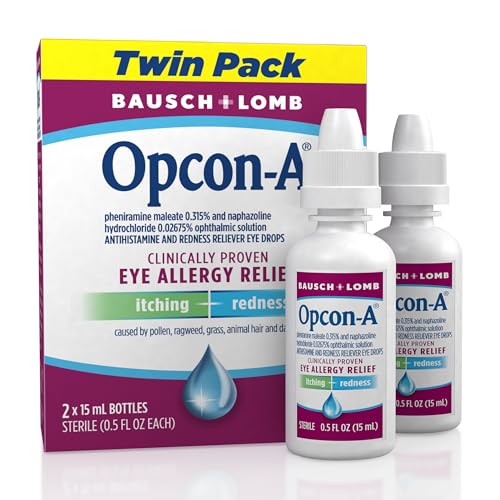
Best for: seasonal allergy sufferers who go through drops fast Skip it if: your redness has no itching or allergy trigger
Opcon-A is the pick for the reader whose eyes go red because pollen, ragweed, grass or pet dander is in the air. Bausch and Lomb say the formula combines an antihistamine with a redness reliever and is clinically proven to relieve redness and itching caused by allergens. That is a different mechanism from the brimonidine and tetrahydrozoline picks: an antihistamine blocks the reaction that produces the itch and redness, rather than only constricting the vessels.
You get two 0.51 fl oz bottles, weighing 2.08 oz together, in a package sized 3.4 x 2.6 x 1.1 in. That is more liquid than any of the single-bottle picks here, and Opcon-A sits in the entry price band as the second-cheapest of the six with a published price rank. The trade-off is fit. If your redness is not allergy-linked, an antihistamine is more medication than you need, and one of the brimonidine or tetrahydrozoline options will do the job with a simpler ingredient. The 2010 release date shows how long the formula has been on shelves.
Pros:
- Antihistamine plus redness reliever combination
- Two 0.51 fl oz bottles in the pack
- The second-cheapest of the six ranked picks
- Brand names specific allergens on the listing
Cons:
- Overkill if redness has no itch
- Larger package footprint than single-bottle picks
- Older release than most of the set
4. Naphcon A Eye Allergy Relief Drops — Best upgrade
Naphcon A puts the same decongestant-plus-antihistamine idea into one 15 mL bottle for readers who prefer a single larger container.

Best for: allergy redness in a single larger 15 mL bottle Skip it if: you'd rather have two smaller bottles to split between bag and desk
Naphcon A is the alternative allergy pick to Opcon-A. Alcon describes it as a decongestant and antihistamine combination: the decongestant narrows the blood vessels to reduce eye redness, and the antihistamine blocks histamine to help with watery, itchy eyes. That is the same two-pronged approach as Opcon-A, in a different bottle shape.
The size is 15 mL, or 0.51 fl oz, weighing 14.2 g, in a package of 1.3 x 3.7 x 2 in. Because it comes as a single bottle rather than a twin pack, you have one thing to keep track of instead of two. That is the trade-off working in reverse against Opcon-A: less redundancy, less to carry. It sits mid-range on price for this set, one step above Opcon-A. The listing is thinner than most of the field, with three feature bullets and no colour listed, which is why it earns the upgrade slot rather than a higher rank: everything you need is there, but nothing extra.
Pros:
- Decongestant plus antihistamine, per the brand
- Single 15 mL bottle
- Mid-range price position in this set
- Straightforward mechanism described on the listing
Cons:
- Only one bottle where Opcon-A gives two
- Thinner listing detail than most picks
- Not intended for redness without allergy involvement
5. Tyson 2.0 Mike Red Eye Drops — Best for families
Tyson 2.0 pairs naphazoline 0.03% with glycerin 0.5%, giving a household one bottle that acts as redness reliever and lubricant at once.

Best for: shared households wanting a lubricant plus redness reliever Skip it if: you need a published bottle size before you buy
The Tyson 2.0 listing is unusual for this category because it names both active percentages. The brand describes glycerin 0.5% as a lubricant to replenish moisture, and naphazoline HCl 0.03% as the redness reliever that reduces the look of red, tired eyes. That is a 3-in-1 framing: dryness, burning and redness in one bottle, useful in a shared bathroom where different family members turn up with different complaints.
The catch is what the listing does not publish. The size field reads "Large" and the colour reads "Clear", with no weight or dimensions. The full title lists 0.5 fl oz (15 mL), and that is the figure to go on, but you cannot cross-check it against the specification block the way you can with every other pick here. That places it as the second-most-expensive of the six ranked picks and the slowest seller of the set, which is why it earns the family label rather than a higher rank. If you want the redness plus dryness combination and don't mind the sparse specification data, this is a reasonable buy.
Pros:
- Names both active percentages on the listing
- Combines lubricant and redness reliever
- Brand covers common daily triggers explicitly
- Bottle size stated in the product title
Cons:
- No weight or dimensions in the specification block
- Size field reads "Large" rather than a number
- Slowest seller in this set
- Sits in the premium price band
6. Visine Red Eye Comfort Redness Relief Eye Drops — Most versatile
Visine Red Eye Comfort uses 0.05% tetrahydrozoline hydrochloride and, per the brand, works in 60 seconds for daily irritants.

Best for: quick daytime touch-ups from smoke, screens or pollutants Skip it if: you wear contacts and need brimonidine-based relief
Visine Red Eye Comfort is the third active-ingredient class in this set. Visine says the 0.05% tetrahydrozoline hydrochloride relieves redness of the eye due to minor eye irritations, and lists smoke, airborne pollutants and extended computer use as the triggers. The brand claims relief in 60 seconds and marks it FSA/HSA eligible on the listing. The dosing note on the listing is specific: adults and children 6 years of age and over, one or two drops in the affected eye or eyes, up to four times a day. Follow the listing and the packaging, not this article.
The bottle is 0.5 fl oz, weighing 27.2 g, measuring 3.75 x 1.06 x 1.77 in. That is the largest single-bottle volume in the set among picks with a published size that maps to fl oz. It is also the only pick where the offer count is 1: only one seller lists it. Against the Lumify picks the active ingredient is the older tetrahydrozoline class rather than brimonidine, and the price band is not stated, so use the Check Price link to place it against the rest.
Pros:
- Names the 0.05% tetrahydrozoline concentration
- 0.5 fl oz, the largest single-bottle volume with a published fl oz figure
- Brand covers a broad list of daily triggers
- FSA/HSA eligibility called out
Cons:
- Only one seller lists it
- Price band not published in the listing data
- Older active ingredient than the Lumify picks
7. Visine Advanced Relief Redness Reliever Eye Drops — Best budget pick
Visine Advanced Relief is the cheapest of the six ranked picks and does the basic redness-relief job Visine has built around for decades.

Best for: keeping a spare bottle in a desk drawer without overspending Skip it if: you want detailed feature information on the listing
Visine Advanced Relief is the entry-band pick and the cheapest of the six ranked picks. The bottle is 0.28 fl oz, weighing 9.07 g, sized 0.91 x 4.84 x 2.72 in, in Visine's red packaging. That is a smaller volume than the Red Eye Comfort bottle above and a lower position on the price rank.
The trade-off is transparency. The Visine Advanced Relief listing carries a single feature bullet stating a package weight of 0.022 kilograms, and no active-ingredient detail in the feature section. You are relying on the Visine name and the "redness reliever" descriptor rather than the ingredient story you get from Lumify or Tyson 2.0. That is fine for a spare desk bottle you use when your eyes look tired at the end of a day of screens. It is not the pick for a first-time buyer who wants to read exactly what is in the bottle before opening it. Weigh the low price against the thin feature listing before you commit.
Pros:
- Cheapest of the six ranked picks
- Recognisable brand and packaging
- Small 0.28 fl oz bottle fits a drawer
Cons:
- Only one feature bullet on the listing
- Ingredient class not detailed in the feature section
- Smaller volume than the Red Eye Comfort bottle above
Active ingredients: what actually gets the red out?
The reason most red eye drops guides go wrong is that they compare bottles on brand and size instead of on the drug. Four ingredient classes appear in this set, and each does a different job.
- Brimonidine. The active in both Lumify picks. Lumify says it is the only OTC drop that contains it, and that it targets redness selectively.
- Naphazoline. Present in Naphcon A, in Opcon-A alongside an antihistamine, and in Tyson 2.0 at 0.03% alongside glycerin. It is a vasoconstrictor: it narrows blood vessels, per the Naphcon A listing.
- Tetrahydrozoline. The active in Visine Red Eye Comfort at 0.05%, and the ingredient class Visine has built its redness reliever line on for years.
- Antihistamine pairings. Opcon-A and Naphcon A both pair a decongestant with an antihistamine, which is what handles the itch that rides with allergy redness.
That is why the best red eye eye drops pick depends on the cause. Occasional redness from a late night or dry air: brimonidine (Lumify). Allergy redness with itching: antihistamine plus decongestant (Opcon-A or Naphcon A). Redness plus dryness together: naphazoline plus a lubricant (Tyson 2.0). General daily irritants like smoke or screens: tetrahydrozoline (Visine).
Read the packaging every time, and follow the dosing instructions on the box. If your redness lasts more than a few days, or comes with pain or vision changes, stop the drops and see an eye doctor. Redness relievers treat the look of the eye. They do not diagnose the cause.
How long does a bottle really last?
Volume varies more than most buyers realise. Here is the set on published bottle size, smallest to largest:
- Lumify 0.08 fl oz — 2.5 mL
- Visine Advanced Relief 0.28 fl oz
- Lumify 0.25 fl oz — 7.5 mL
- Visine Red Eye Comfort 0.5 fl oz
- Naphcon A 15 mL
- Opcon-A 0.51 fl oz per bottle, pack of 2
- Tyson 2.0 — title lists 0.5 fl oz (15 mL); specification block says "Large"
For a light user reaching for drops once or twice a week, the 0.08 oz Lumify or the 0.28 oz Visine Advanced Relief will last the shelf life the packaging states. For a daily user, especially in allergy season, the two Opcon-A bottles or the 15 mL Naphcon A make more sense: more product per purchase, less repurchase friction. Check the expiry date and the "use by" window after opening on the box, since most eye drops carry a shorter in-use limit than their unopened shelf life.
Which drops suit contact lens wearers?
The listing data here does not confirm contact lens compatibility for every pick in the best red eye eye drops set, and this is one place where the modifier in the search does not map cleanly to the products. Compatibility depends on the ingredient, the lens type, and the preservative system, and none of those are fully detailed in the input.
The safe rule is to read the box before you drop. Most redness relievers say to remove soft contact lenses before use and wait a stated number of minutes before putting them back in. If your lenses are the reason your eyes go red, that is a fit or wear-time problem more than a drops problem, and an eye care professional is the better call than a bottle from the pharmacy aisle.
Mistakes that keep eyes red
Three patterns come up often, none of them fixed by a different bottle:
- Using redness relievers every day for weeks. Vasoconstrictors, including naphazoline and tetrahydrozoline, carry a rebound risk if overused. Read the packaging for how many days in a row the manufacturer recommends. Brimonidine, per Lumify, is designed differently, but the same "follow the box" rule holds.
- Treating allergy redness with a plain redness reliever. If your eyes itch, you need an antihistamine (Opcon-A or Naphcon A), not another vasoconstrictor. The itch is the tell.
- Ignoring the trigger. Screens, contact lens wear time, dry air, dust, smoke and swimming all show up in the manufacturer listings as causes. A humidifier at your desk, or a break from screens, can matter more than a drop.
Drops are for the look and the immediate feeling. Fixing what causes the redness is the longer job.
The verdict
The best red eye eye drops overall is Lumify in the 0.08 oz bottle, on the strength of brimonidine as the active ingredient. Bausch and Lomb say it is the only OTC drop that contains it, and that alone puts it in a different ingredient class from the Visine, Opcon-A, Naphcon A and Tyson 2.0 picks. It is the one buyers choose most often here, with the lowest sales rank in the set at 62.
Two conditions flip the recommendation. First, if your redness comes with itching from pollen, dust, grass or pets, Opcon-A is the better buy: two 0.51 fl oz bottles combining an antihistamine with a redness reliever, at the second-cheapest position on the price ranking. Second, if you use redness drops most days rather than occasionally, the 0.25 oz Lumify at 7.5 mL is worth the step up from the 0.08 oz travel bottle. It is the most expensive pick here, but it is the same ingredient story in triple the volume, and it sells faster than the smaller bottle in this set.
For a spare desk bottle where cost is the priority, Visine Advanced Relief at 0.28 fl oz is the cheapest of the six ranked picks. Anywhere else, the ingredient decides.
FAQ
Are the best red eye eye drops safe to use every day?
The best red eye eye drops carry dosing instructions on the packaging that cap how often and how long you use them. Vasoconstrictor drops like Visine and Naphcon A have a rebound risk with overuse. Lumify's brimonidine is designed to work differently, per Bausch and Lomb, but the same rule applies: read the box, follow the instructions, and see an eye doctor if redness lasts more than a few days.
Is Lumify worth it compared with older redness drops?
Lumify is worth it if the ingredient story matters to you. Bausch and Lomb say brimonidine is the only OTC active that targets redness selectively, unlike the naphazoline in Naphcon A and Opcon-A or the tetrahydrozoline in Visine. The 0.08 fl oz bottle is small at 2.5 mL, and the 0.25 fl oz version costs more, but the ingredient is what you are paying for.
What size bottle should I buy for allergy season?
For allergy season, buy the larger allergy-formulated bottles rather than the compact redness relievers. Opcon-A ships two 0.51 fl oz bottles, and Naphcon A gives one 15 mL bottle, both with antihistamine plus redness reliever combinations. The Lumify 0.08 fl oz at 2.5 mL will run out fast in heavy pollen weeks, and it is not built for the itch that comes with allergies.
Which is better, Opcon-A or Naphcon A?
Whether Opcon-A or Naphcon A is better depends on how you carry drops. Opcon-A gives two 0.51 fl oz bottles, so you can keep one at home and one in a bag. Naphcon A packages the same decongestant-plus-antihistamine idea in one 15 mL bottle. Opcon-A sits second on the price ranking. Naphcon A sits third. Pick on carry preference, not on formula.
Do red eye drops fix bloodshot eyes from contacts?
Red eye drops mask bloodshot eyes from contacts, they do not fix the cause. If your lenses are the trigger, the problem is fit, wear time, cleaning routine or lens material, and no bottle in this best red eye eye drops set will solve that. Read the packaging on any drop for contact lens instructions, remove lenses when the box says to, and see an eye care professional for repeated redness.
Start with the Lumify 0.08 oz bottle if your red eyes are the late-night, dry-air, screen-fatigue kind, and keep it in whatever bag you carry daily. Move to the 0.25 oz Lumify if you find yourself reaching for it more than once a week. Switch tracks to Opcon-A or Naphcon A the moment itching enters the picture, because that is a signal the ingredient class needs to change. The winner isn't the cheapest bottle or the biggest. It is the one built on the newest active ingredient in the aisle, sized for the way most people actually use redness drops: now and then, not every day.
Last updated: September 7, 2026. Product availability re-checked.
This page contains affiliate links. As an Amazon Associate we earn from qualifying purchases, at no extra cost to you.