Best Vegan Omega 3 for a Four-Person Household
Six algae-oil and plant-blend picks compared by DHA, EPA, softgel count and what the label actually delivers per serving. One winner, five conditions that flip it.
The best vegan omega 3 in this set is MAV Nutrition's Algae Oil, a 60-count bottle weighing 2 oz that keeps the plant-based DHA and EPA promise simple and the pack size honest. If your household burns through omega 3 fast, Micro Ingredients' 240-softgel pouch delivers 500mg DHA and 100mg DPA per three-softgel serving and lasts longer between reorders. Both skip fish, both skip carrageenan, and the differences below decide which one belongs on your counter.
Best vegan omega 3 at a glance
| Pick | DHA / EPA per serving | Softgels | Price |
|---|---|---|---|
| Best overall MAV Nutrition Vegan Omega 3 Algae Oil |
Plant DHA + EPA (claim) | 60 | Check Price |
| Best upgrade Micro Ingredients Vegan Omega 3 Algae Oil |
500mg DHA + 100mg DPA | 240 | Check Price |
| Best minimal setup Sports Research Vegan Omega-3 Algae Oil |
1020mg total omega-3 | 60 | Check Price |
| Best for pros Freshfield Vegan Omega 3 |
Algal DHA + DPA (claim) | 60 | Check Price |
| Best premium sapling Vegan Omega 3 Supplement |
300mg DHA + 150mg EPA | 60 | Check Price |
| Best budget pick Purity Products Omega 3-6-9 |
5-oil plant blend (claim) | 60 | Check Price |
How I screened the field down to six
Start with the shortlist logic, because the term "vegan omega 3" hides two very different products.
The first cut was the source. Algae oil goes in, fish oil comes out, and any bottle that talks about "plant omega" without naming algae, flaxseed, borage or a specific seed oil goes out too. Vague sourcing is a red flag on a supplement shelf.
The second cut was the shell. A vegan softgel with a gelatin capsule is not vegan, so I kept only listings that call out plant-based softgels: Sports Research names tapioca, Freshfield names tapioca, Micro Ingredients calls them veggie softgels. Carrageenan-free was a bonus that four of the six advertise.
The third cut was label transparency. A best vegan omega 3 pick should tell you how much DHA and EPA sit inside a serving. Some listings do (sapling: 300mg DHA, 150mg EPA), some publish DHA and DPA (Micro Ingredients: 500mg and 100mg), some rely on a total omega-3 figure (Sports Research: 1020mg), and one is a plant-blend that lists five oils instead. That spread is the whole story of this category, and it is why the picks below split the way they do.
What got cut:
- Fish-oil bottles labelled "plant-based" in error.
- Flax-only softgels sold as omega 3 without any DHA claim.
- Bulk pouches with no per-serving breakdown at all.
Algae oil versus plant-blend: which one is the real omega 3?
Most vegan omega 3 guides compare price and softgel count. That is not what decides it. The deciding question is whether the bottle delivers DHA and EPA directly, or whether it delivers ALA and asks your body to convert.
Algae oil delivers DHA directly. Four of the six picks are algae-based: MAV Nutrition, Micro Ingredients, Sports Research and Freshfield all name algae as the source, and sapling names algae with a stated 300mg DHA plus 150mg EPA per softgel. That matters because the human body converts ALA to DHA at a very low rate, and most listings that highlight flax as the star ingredient are really selling ALA.
Purity Products' 5-in-1 vegan omega 3-6-9 is the honest example of the other approach. Its blend of flaxseed, olive, borage, pomegranate and Sacha Inchi seed oil is a fatty-acid cocktail rather than a direct DHA product, and Purity's listing says so: it "helps you maintain healthy levels" of EPA and DHA while providing GLA and oleic acid. That is a different value proposition, not a worse one, and it is why Purity earns the budget slot rather than being cut. If you specifically want algae-derived DHA on the label, algae oil is the pick. If you want a plant-fat blend, Purity is what that looks like.
1. MAV Nutrition Vegan Omega 3 Algae Oil — Best overall
MAV Nutrition earns the top slot by being the least complicated way into algae-based omega 3, in a 60-count bottle small enough to keep on the kitchen counter.

Best for: a first algae-oil bottle without overcommitting to a giant pouch Skip it if: you want a multi-month supply in one pouch
At 2 oz and 60 softgels, this is the lightest bottle in the set, and the second-cheapest of the six. The listing keeps the promise narrow: plant-based DHA and EPA from sustainably sourced algae, non-GMO. There is no per-milligram breakdown published on the listing, and that is the honest weakness. What earns it the win is fit: a first-time vegan omega 3 buyer usually wants a small bottle they can finish before deciding whether the routine sticks, and 60 softgels is exactly two months at one a day.
Compared with the rest of the set, MAV trades label detail for approachability. Sports Research publishes 1020mg total omega-3 and sapling publishes 300mg DHA plus 150mg EPA, and both are useful figures if you already know your target. If you do not, MAV's small, clean bottle is the low-friction entry point, and the sales position in this set backs that up: it moves faster than four of the other five picks.
Pros:
- Smallest and lightest bottle here at 2 oz
- Second-cheapest of the six
- Non-GMO algae source stated on the listing
- 60 softgels equals a clean two-month run at one daily
Cons:
- No per-serving DHA or EPA milligram figure published
- No published warranty or third-party test claim
- Only two sellers listed
2. Micro Ingredients Vegan Omega 3 Algae Oil — Best upgrade
Micro Ingredients trades bottle size for a genuine multi-month pouch: 240 vegetarian softgels, 500mg DHA and 100mg DPA per three-softgel serving.

Best for: a household running two daily servings, or a single person on a three-softgel dose Skip it if: you want the smallest, lightest bottle on the shelf
This is the largest pack in the set at 240 count and 5 oz, and Micro Ingredients publishes the clearest label of the six. A three-softgel serving delivers 1,250mg plant-based algal oil, 500mg DHA, 100mg DPA, 80mg flaxseed oil, and 40mg ALA. That is the "full-spectrum" claim the listing makes, and it is the only pick here that pairs an algae DHA figure with a plant-based ALA figure on the same label.
The pouch measures 0.8 x 7 x 4 in, which is not a bottle-on-the-counter product; it is a drawer product. The listing calls out non-GMO, no soy, dairy, gluten, preservatives, colors or tree nuts, and says the product must pass third-party lab tests. This pick's real cost is commitment. If you already know algae oil is part of your routine, the 240-count pouch is the sensible refill size. If you are still testing whether the habit sticks, MAV's 60-count is the safer first buy.
Pros:
- 500mg DHA and 100mg DPA per serving, both stated
- 240 vegetarian softgels, the largest pack here
- Third-party lab testing claim on the listing
- Carrageenan-free and soy-free per the listing
Cons:
- The most expensive pick here after sapling
- Pouch format is bulkier than a bottle
- Three-softgel serving is more to swallow than one
3. Sports Research Vegan Omega-3 Algae Oil — Best minimal setup
Sports Research delivers 1020mg of total omega-3 per serving in a tapioca-shell softgel, and the whole idea is one softgel, one glass of water, done.
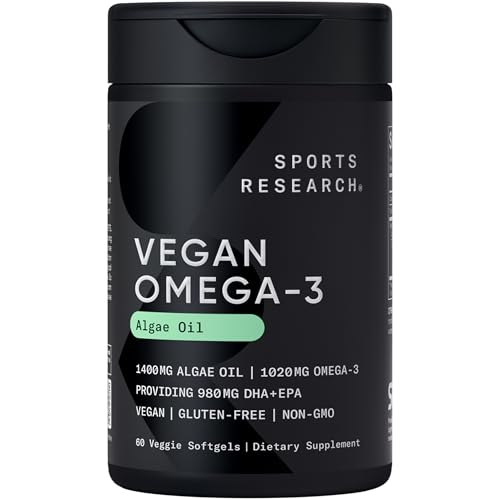
Best for: anyone who wants a single daily softgel with a stated total omega-3 figure Skip it if: you split doses through the day or want a per-nutrient breakdown
This is the pick I would hand to someone who hates supplement routines. The listing states 1020mg of omega-3 per serving from sustainable algae oil, encapsulated in a tapioca-based plant softgel with no carrageenan. The bottle is small at 2.6 x 2 x 2 in and 3.36 oz, and it is 3rd-Party Tested and Non-GMO Verified per the listing. Sports Research also plays up the "no fishy burps" angle, which is really the whole point of going vegan on omega 3 in the first place.
The trade-off is granularity. You get a total omega-3 figure, not the DHA-and-EPA breakdown that sapling publishes or the DHA-and-DPA breakdown that Micro Ingredients publishes. For someone who just wants to hit a daily omega-3 number without doing arithmetic on a serving of three softgels, that simplicity is the feature. This is also the fastest-moving pick in the set, which suggests the one-softgel format lands with a lot of buyers.
Pros:
- 1020mg total omega-3 per serving stated
- Tapioca-based plant softgel, no carrageenan
- Third-party tested and Non-GMO Verified per the listing
- Single small bottle, easy shelf footprint
Cons:
- DHA and EPA not split out on the listing
- Total figure hides which fatty acid dominates
- Only 60 softgels per bottle
4. Freshfield Vegan Omega 3 — Best for pros
Freshfield names its algae source explicitly, publishes a DHA-plus-DPA claim, and pitches a 1 to 2 softgel daily dose that stretches the bottle to a full two months.

Best for: readers tracking DHA and DPA specifically, and who want a flexible dose Skip it if: you need a published EPA figure on the label
Freshfield's listing is unusually direct: the DHA comes from microalgae, the shell is tapioca and carrageenan-free, and the recommended intake is one to two vegan softgels per day, which the company frames as a one-to-two-month supply. Freshfield calls out mercury as a fish-oil contaminant it avoids by not using fish, which is standard vegan-omega positioning done clearly.
The bottle is 2.4 oz with a lemon scent, and the algae is grown in controlled tanks. What earns Freshfield the pros slot is the combination of a stated DHA source, a stated DPA claim, and a flexible dosing range. That works for someone who has a target milligram figure and wants to hit it their own way. What holds it back from a higher spot in the ranking is the missing EPA figure: if EPA is what you care about, sapling publishes 150mg per softgel and Freshfield does not publish an EPA number at all. It also sells slower than three of the other picks in this set.
Pros:
- Algae source named explicitly, not just "plant-based"
- DHA and DPA both mentioned in the feature bullets
- Tapioca shell, carrageenan-free per the listing
- Flexible 1 to 2 softgel dose extends the bottle
Cons:
- No published EPA milligram figure
- Slower seller than three of the picks here
- Lemon scent will not suit every buyer
5. sapling Vegan Omega 3 Supplement — Best premium
sapling is the only pick here that publishes both DHA and EPA figures per softgel: 300mg DHA and 150mg EPA, from algae grown and bottled in the United States.

Best for: buyers who want both DHA and EPA quantified in one softgel Skip it if: 300mg DHA per serving is below your daily target
sapling's listing is the most specific of the six on the fatty-acid split. Each softgel contains a total of 550mg of omega-3s, 300mg DHA, and 150mg EPA. The listing also makes the correct point that other plant oils, such as flaxseed, do not contain DHA or EPA at all. The bottle is 2.89 oz at 4.06 x 2.24 x 2.24 in and comes with a peppermint-oil scented pack. The listing states the algae is grown in the United States and the product is bottled in a GMP-certified and FDA-registered facility.
This is the most expensive pick in the set, and that price position is what keeps it out of the overall winner slot. If you are working from a specific DHA and EPA target, the granularity is worth it. If you are not, MAV Nutrition and Sports Research cover the same core need for less. The tree-planting angle is a real product decision, not a marketing throwaway, though it should not be the reason you buy.
Pros:
- 300mg DHA and 150mg EPA both published per softgel
- Only pick in this set with a stated EPA figure
- Algae grown and bottled in the United States per the listing
- GMP-certified facility claim on the listing
Cons:
- The most expensive pick in this set
- 60 softgels only, no larger pack option
- Peppermint scent pack may not suit everyone
6. Purity Products Omega 3-6-9 — Best budget pick
Purity Products is not an algae oil. It is a five-oil plant blend that covers omega 3, 6 and 9 in one softgel, and it is the cheapest pick in this set.

Best for: a plant-blend that covers omega 6 and 9 alongside omega 3 Skip it if: you specifically want algae-derived DHA and EPA on the label
Purity's Vegan Omega 3-6-9 delivers a blend of flaxseed oil, extra virgin olive oil, borage oil, pomegranate oil and Sacha Inchi seed oil per serving. The listing is honest about what that means: the blend "helps you maintain healthy levels" of EPA and DHA while also providing GLA and oleic acid. This is a different product than the five algae oils above, and treating it as if it were an algae DHA competitor would be a category mistake.
Where Purity earns its place is the budget slot and the wider-spectrum brief. If you already eat plenty of ALA-rich foods and you want the extra omega 6 and 9 fatty acids that fish oil does not carry, this is the shelf-friendly plant blend to try. The bottle is 3.84 oz at 2.5 x 4.5 x 2.5 in, and the listing calls out the LemonLock freshness system and a cGMP-compliant, FDA-inspected facility. Buy this instead of an algae oil only if you are clear that you are buying a plant-fat blend, not an algae DHA product.
Pros:
- Cheapest pick in this set
- Covers omega 6 and 9 as well as omega 3
- LemonLock antioxidant freshness claim on the listing
- cGMP-compliant facility claim per the listing
Cons:
- Not an algae oil, so no direct DHA source
- EPA and DHA levels not quantified on the listing
- Different product category than the other five picks
How to read a vegan omega 3 label without getting fooled
The label is where most vegan omega 3 buyers get sold something they did not mean to buy. Here is the trick.
- Find the source line first. If the bottle says "algae" or "microalgae", it is an algae oil and it should carry a DHA figure. If it says "flaxseed" or lists a plant blend, it is an ALA product, and any EPA or DHA number will be low or absent.
- Look for a per-serving milligram figure, not a total oil weight. "1,250mg plant-based algal oil" is oil weight. "500mg DHA" is the fatty acid. Micro Ingredients publishes both. Many listings publish only one.
- Check the softgel shell. Vegan softgels are usually tapioca or a similar plant starch. Sports Research and Freshfield both name tapioca on the listing. Gelatin capsules are not vegan.
- Count the serving size. A "500mg DHA" claim on a three-softgel serving is different from the same claim on one softgel. This decides how long the bottle really lasts.
- Match source to goal. For direct DHA and EPA, pick an algae oil. For a wider fatty-acid blend, a product like Purity's 3-6-9 is the honest option.
A quick definitional summary: DHA is a long-chain omega-3 fatty acid. EPA is another long-chain omega-3. ALA is a shorter-chain omega-3 that the body converts to DHA and EPA at a low rate. DPA is a related long-chain omega-3 that sometimes appears in algae-oil labels. Algae oil is the plant source that produces DHA and EPA directly. Flaxseed oil is a plant source of ALA, not DHA.
How long does one bottle actually last?
Five of the six picks are 60-count bottles, and Micro Ingredients breaks the pattern at 240 count. But softgel count alone does not tell you how long a bottle lasts, because the serving sizes differ.
- Sports Research: one softgel per serving, so 60 softgels equals 60 days at a single daily dose.
- MAV Nutrition: the listing does not specify a serving size in the data available, but 60 softgels at one daily is a two-month run.
- sapling: one softgel delivers the full 300mg DHA plus 150mg EPA claim, so 60 softgels covers about two months.
- Freshfield: the listing recommends 1 to 2 softgels daily, which stretches a 60-count bottle from one month to two.
- Purity Products: 60 softgels of the 3-6-9 blend.
- Micro Ingredients: a three-softgel serving, so 240 softgels is roughly 80 servings, or nearly three months at one daily serving.
The practical lesson is simple. A larger bottle is not automatically better value if the serving size is bigger too. In this set, Sports Research delivers its stated 1020mg omega-3 in one softgel, and Micro Ingredients spreads its 500mg DHA claim across three. Both are legitimate design choices, and which one suits you depends on whether you would rather swallow one softgel or three.
What the listings do not tell you
Every listing here leaves gaps a buyer eventually cares about. Naming the gaps is more useful than pretending they do not exist.
- No shelf-life or expiry data. Omega 3 oxidises. None of these six listings publishes an expiration window in the data supplied.
- No standardised third-party test document. Micro Ingredients and Sports Research both make third-party testing claims, but the actual certificates of analysis are not linked from the listing.
- No warranty on any pick. This is consumable, so that is expected, but if a bottle arrives damaged you are relying on the marketplace return policy, not a manufacturer warranty.
- No dosage recommendation in every listing. Freshfield states 1 to 2 softgels daily. Others leave the serving to the label on the bottle.
- Only two sellers on every pick. That is a thin marketplace, and it is worth checking the seller identity before buying.
None of these gaps disqualifies a pick. They are the reality of buying supplements from a marketplace listing rather than a specialist retailer, and they should factor into what you spend rather than which pick you choose.
The verdict
If you want an algae-based omega 3 in a small bottle you can finish in two months, MAV Nutrition's 60-count Algae Oil is the pick. It is the second-cheapest of the six, the lightest at 2 oz, and it names the algae source and the plant-based DHA and EPA claim without piling on extras. The trade-off is a lack of published milligram detail, which is why it is a starter bottle rather than a spec sheet.
If your household runs through omega 3 fast, or you want the clearest label in this set, Micro Ingredients' 240-count pouch is the better buy. It publishes 500mg DHA and 100mg DPA per three-softgel serving, states carrageenan-free and non-GMO sourcing, and makes a third-party test claim. The cutoff is roughly one bottle every two months: if that is you, buy MAV. If you are refilling more often, or you want both algae DHA and a plant-based ALA figure on the same label, buy Micro Ingredients.
sapling is the pick if EPA specifically matters to you; it is the only listing here that quantifies both 300mg DHA and 150mg EPA per softgel.
FAQ
What is the best vegan omega 3 for someone starting out?
The best vegan omega 3 for a first-time buyer is MAV Nutrition's Algae Oil. Sixty softgels is a two-month trial at one daily, the 2 oz bottle takes almost no shelf space, and the algae source is stated on the listing. Once you know the habit sticks, a larger pouch like Micro Ingredients' 240-count is a sensible refill step.
Is vegan omega 3 worth it compared with fish oil?
Vegan omega 3 is worth it if you want DHA and EPA without the marine sourcing chain. Algae oil is where fish get their DHA from originally, and it avoids the mercury and dioxin contaminants that some listings, including Freshfield's, call out as fish-oil risks. Sports Research pitches the "no fishy burps" angle for the same reason. It is a legitimate substitute, not a compromise.
How many milligrams of DHA per serving should a vegan omega 3 supply?
Milligrams of DHA per serving is exactly the number you want on the label. In this set, sapling publishes 300mg DHA per softgel and Micro Ingredients publishes 500mg DHA per three-softgel serving. Sports Research publishes a total omega-3 figure of 1020mg without splitting DHA out, and MAV Nutrition does not publish a milligram figure at all. Pick a listing that quantifies what you are targeting.
MAV Nutrition versus Micro Ingredients: which one wins?
MAV Nutrition versus Micro Ingredients comes down to bottle size and label detail. MAV is smaller, cheaper and simpler at 60 softgels and 2 oz, and it wins if you are new to algae oil. Micro Ingredients is the household pick at 240 softgels with 500mg DHA and 100mg DPA per serving stated, and it wins if you are refilling more than once every two months.
What is the biggest mistake people make buying vegan omega 3?
The biggest mistake people make buying vegan omega 3 is confusing an ALA plant blend with an algae DHA supplement. Flaxseed oil is ALA. Algae oil is DHA. The body converts ALA to DHA at a low rate, so a flax-based bottle is not a direct replacement for a fish oil. Purity's 3-6-9 is honest about being a blend; know which product you are buying.
Six vegan omega 3 picks, one clear split: five algae oils and one plant blend. Start with MAV Nutrition if you have never bought algae oil before, because sixty softgels in a 2 oz bottle is the smallest commitment that still gets you a real algae source on the label. Move up to Micro Ingredients when you know the routine is sticking and you want the 500mg DHA and 100mg DPA per serving in writing. Pick sapling when EPA is what you are counting, and reach for Purity only when you specifically want the wider omega 3-6-9 blend. Match the pick to the label, not the label to the pick.
Last updated: September 7, 2026. Product availability re-checked.
This page contains affiliate links. As an Amazon Associate we earn from qualifying purchases, at no extra cost to you.