Best Chewable Prebiotic Fiber: Benefiber Leads
Grams of fiber per serving is the number that decides this category, and it swings from 3 g to 6 g across these seven picks. Here's which one fits your routine, and which one to skip.
The best chewable prebiotic fiber is the Benefiber Chewable Prebiotic Fiber Tablets bottle, because 100 sugar-free tablets in three flavours cover a long stretch of daily use at the second-cheapest price position in this set. If you want the most fiber in a single serving, the Micro Ingredients Fiber Gummies claim 6 g per serving across 120 gummies and cost the least here. The number that decides this category is grams of fiber per serving, and it swings from 3 g to 6 g across these seven bottles. Count on the front of the bottle hides that swing completely.
Best chewable prebiotic fiber at a glance
| Pick | Fiber per serving | Count | Price |
|---|---|---|---|
| Best overall Benefiber Chewable Prebiotic Fiber Tablets |
Not published | 100 tablets | Check Price |
| Best budget pick Micro Ingredients Fiber Gummies with Probiotics |
6 g claim | 120 gummies | Check Price |
| Best for beginners Physician's CHOICE Fiber Gummies for GLP-1 Support |
5 g claim | 60 gummies | Check Price |
| Best premium Metamucil Fiber Gummies for Adults |
5 g claim | 120 gummies | Check Price |
| Runner-up Nature Made Probiotic + Prebiotic Fiber Gummies |
3 g claim | 50 gummies | Check Price |
| Best minimal setup Benefiber Prebiotic Fiber Supplement Gummies |
Not published | 81 gummies | Check Price |
| Best for pros Generic Daily Fiber Supplement Chewable Tablets |
Not published | 90 tablets | Check Price |
How I screened this category down to seven
I weighted three criteria, then ranked against them. Here's the order and why.
- Published fiber per serving, weighted heaviest. A chewable that names a figure is a chewable you can compare. Four of these seven publish one. Three do not, and that gap decides more of the ranking than any flavour claim.
- Servings per bottle, weighted second. Fiber only works as a daily habit. A bottle that runs out in under a month sets you up to stop.
- Ingredient transparency, weighted third. Sugar-free, gluten-free, plant-based source named: chicory root, inulin, corn fiber, pectin. Vague wording lost points.
Why those weights? Because fiber is a dose game. You are trying to close a gap between what you eat and what your gut wants, and grams are the unit of that gap. Flavour matters only in that it decides whether you take the thing tomorrow.
What I did not weight: brand recognition. Two Benefiber bottles are in this set and only one of them ranks near the top.
A note on the searches that bring people here. Plenty of people looking for the best chewable prebiotic fiber are also looking for a specific health outcome, and the listing data here does not support outcome claims. What it supports is grams, counts, and named ingredients. That's what I've used.
Why grams per serving beats count on the label
Count is the number printed largest. It's also the number most likely to mislead you.
Look at the spread. Metamucil and Micro Ingredients both put 120 pieces in the bottle. But Micro Ingredients claims 6 g of fiber per serving and Metamucil claims 5 g. Nature Made ships 50 gummies at a claimed 3 g per two-gummy serving, which the brand describes as a 25-day supply. Same category, half the daily fiber, a fifth of the pieces.
Serving size is the hidden multiplier. Benefiber's tablet directions say chew three tablets up to three times daily for those 12 and above. That's up to nine tablets a day out of a 100-tablet bottle. Physician's CHOICE and Nature Made both work on two gummies a day. Micro Ingredients states its 6 g figure per serving without publishing the piece count in that serving.
So the arithmetic you actually want runs:
- Grams per serving, from the label
- Pieces per serving, from the directions
- Pieces in the bottle
- Days of coverage that produces
Three of these seven do not publish enough to complete that sum. That is a real strike against them, and it's why the best chewable prebiotic fiber for most people is the one with a big enough bottle to absorb an uncertain serving size.
Tablet or gummy: which chewable prebiotic fiber suits you?
Two of these are tablets. Five are gummies. The split matters more than the flavour list.
Tablets in this set come from Benefiber and the Generic bottle, both sugar-free, both in assorted fruit flavours. They chew firm. Benefiber's directions ask for three at a time, which is a mouthful, and the payoff is a bottle that runs long.
Gummies dominate the rest. Nature Made uses a pectin base and states no artificial flavours and no synthetic dyes. Physician's CHOICE is vegan with no added sugar, no sugar alcohols and no artificial sweeteners. Metamucil is orange with no sugar added. Micro Ingredients is peach cherry, sugar-free, non-GMO, and free from soy, dairy, gluten, wheat and tree nuts.
The practical difference is dose density. A gummy carries a stated 5 g or 6 g in two pieces. A tablet spreads its dose across three pieces, three times a day. Neither is better in the abstract. If you keep a bottle at your desk and take it once, gummies win. If you'd rather split the fiber across a day, the tablet format is built for exactly that.
Storage is the quiet gummy risk. Nature Made says no refrigeration required, which is the only pick here that addresses heat at all.
1. Benefiber Chewable Prebiotic Fiber Tablets — Best overall
A sugar-free, gluten-free tablet in three fruit flavours, with 100 tablets in a 6.13 x 2.75 x 2.75 in bottle at the second-cheapest price position in this set.

Best for: someone who wants a sugar-free chew and a bottle that lasts
Skip it if: you dislike chewing three tablets at a time
What separates this one inside the set is coverage. It ships 100 tablets, the largest tablet count of the two tablet picks, and it sits second-cheapest of the seven. That combination is why it wins. You get a long runway at a low entry cost, which is the shape a daily fiber habit actually needs.
The flavour spread is three: orange, lemon and wildberry, and Benefiber states the tablets are sugar free and gluten-free. Directions on the listing say to chew three tablets up to three times daily for those 12 years and above, which is the most specific dosing instruction of any pick here. Benefiber also says its daily prebiotic fiber supports digestive health by nourishing good bacteria in the gut. That's the manufacturer's claim, not a measured result.
The model number is 116949 and the listing dates to 2019, making this the oldest formula in the group. Two sellers stock it.
The trade-off is dose transparency. Benefiber doesn't publish grams of fiber per serving on this listing, so you can't line it up against the 6 g and 5 g figures elsewhere in this set. You're buying count and format, not a number.
Pros:
- Largest tablet count here at 100 tablets
- Second-cheapest price position of the seven
- Sugar free and gluten-free per Benefiber
- Three flavours: orange, lemon, wildberry
- Clearest published dosing directions in the set
Cons:
- No grams-per-serving figure published
- Three tablets per dose, up to three times daily
- Oldest listing here, dating to 2019
- Only two sellers stock it
2. Micro Ingredients Fiber Gummies with Probiotics — Best budget pick
The highest published fiber figure in this set, 6 g per serving, plus 2 billion CFU, across 120 gummies at the lowest price position of the seven.

Best for: the highest fiber per serving at the lowest price position here
Skip it if: you want a name you already recognise
This is the only pick that pairs the top published fiber figure with the bottom price position. Micro Ingredients states 6 g of fiber per serving and 2 billion CFU of probiotics from Bacillus coagulans, in a bottle of 120 peach cherry gummies weighing 4 oz. Nothing else here claims 6 g.
The formula runs 2-in-1: prebiotic fiber plus probiotics, which the brand says work together to balance the blend. Two picks in this set take that approach, and this is the cheaper of the two. Micro Ingredients also states non-GMO ingredients, a cGMP compliant facility, third-party lab testing for safety, purity and potency, and no soy, dairy, gluten, wheat or tree nuts. The gummies are sugar free.
Here's the trick with this pick. It publishes the fiber figure but not the pieces per serving, so you can't calculate how many days 120 gummies covers. If a serving is two gummies, that's 60 days. If it's three, it's 40.
The honest weakness is obscurity. This is the slowest-selling of the four gummies here that publish a fiber figure, and it's the least established brand among them. You're trading recognition for grams.
Pros:
- Highest published fiber figure here at 6 g per serving
- Lowest price position of all seven picks
- 2 billion CFU probiotics from Bacillus coagulans
- 120 gummies, tied for largest count in the set
- Third-party lab tested per the brand
Cons:
- Pieces per serving not published
- Least recognised brand in this comparison
- Sells more slowly than the other high-fiber gummies here
- No dimensions or flavour variants listed
3. Physician's CHOICE Fiber Gummies for GLP-1 Support — Best for beginners
A two-gummy serving delivering a claimed 5 g of chicory root fiber, vegan and with no added sugar, in a 60-count bottle.

Best for: a first-timer who wants two gummies and a short label
Skip it if: you need a big bottle for a household
The reason this suits a beginner is the completeness of the dosing maths. Physician's CHOICE publishes both halves: 5 g of prebiotic fiber per 2-gummy serving. Do the sum and 60 gummies is 30 servings, a clean month. Only one other pick in this set lets you finish that calculation.
The fiber source is named: natural soluble chicory root. The brand says it helps feed beneficial probiotic bacteria to support healthy digestion and comfortable regularity. Flavour is raspberry lemon, described as refreshingly tart. The formula is vegan and plant-based, with no added sugar, no sugar alcohols, no artificial sweeteners and no artificial flavours, which is the strictest exclusion list of any pick here. Physician's CHOICE also states the gummies are developed with doctors, third-party tested, and made in a cGMP-certified facility.
Bottle weight is 0.56 lb. It sells briskly, second-fastest in this set.
The cost of that clean month is size. At 60 gummies it's the second-smallest bottle here, half the count of Metamucil or Micro Ingredients, at the middle price position. If two people in the house take it, you're reordering every fortnight.
Pros:
- Complete dosing maths: 5 g per 2-gummy serving
- Chicory root fiber source named on the label
- Strictest exclusion list here: no sugar alcohols or artificial sweeteners
- Vegan and plant-based formula
- Clean 30-serving bottle at 60 gummies
Cons:
- Second-smallest count in the set at 60
- Mid price position for a one-month bottle
- Single flavour only
- No dimensions published
4. Metamucil Fiber Gummies for Adults — Best premium
A 120-gummy bottle claiming 5 g of blended plant-based fiber per serving, with the fiber sources named and no sugar added.

Best for: an orange-flavour loyalist who wants 120 gummies at once
Skip it if: you object to paying the most in this set
This is the one buyers choose most often in this group, and the ingredient detail explains part of why. Metamucil doesn't just say "fiber": it names a blend, with inulin credited for feeding good bacteria and soluble corn fiber, listed as Fibersol, credited for supporting digestive health. Two named sources totalling a claimed 5 g per serving is more specificity than most listings here offer.
The bottle holds 120 gummies, tied with Micro Ingredients for the largest count of the seven. Flavour is orange with no sugar added, which is the Metamucil house flavour and a genuine reason to pick it if that's what you already like. Two sellers stock it.
Where it stumbles is the price position. This is the most expensive pick here, and the published capability doesn't obviously outrun the field. Micro Ingredients claims a full gram more fiber per serving, 6 g against 5 g, with the same 120-gummy count, at the lowest price position in this set. That's a hard comparison for Metamucil to win on paper.
Published specifications are also thin. Beyond count and a 4.54 g figure, there are no dimensions, no flavour alternatives and no serving-size detail, so the days-per-bottle sum stays open.
Pros:
- Two fiber sources named: inulin and Fibersol soluble corn fiber
- 120 gummies, tied for largest count here
- 5 g claimed plant-based fiber per serving
- No sugar added orange formula
- The pick buyers choose most often in this group
Cons:
- Most expensive pick in this comparison
- Beaten on claimed fiber per serving by a cheaper 120-count bottle
- Serving size in gummies not published
- No dimensions or flavour options listed
5. Nature Made Probiotic + Prebiotic Fiber Gummies — Runner-up
The only pick here that names its probiotic strain and states a supply length: LactoSpore at 2 billion CFU, 3 g of prebiotic fiber, 25 days.

Best for: someone who wants probiotics and fiber in one chew
Skip it if: a 25-day supply feels too short
Nature Made is the most fully documented listing in this set, and that earns it the runner-up slot. It publishes count at 50 gummies, weight at 7.26 oz, dimensions at 2.68 x 4.96 x 2.72 in, the serving size at two gummies daily, the fiber at 3 g per serving, and the supply at 25 days. Nobody else fills in that many boxes.
It also names its probiotic. LactoSpore at 2 billion CFU per serving, which Nature Made describes as clinically studied and says helps relieve occasional gas, bloating, burping and abdominal discomfort. That's the brand's claim. The gummy is pectin based, gluten free, mixed berry flavoured, with no artificial flavours and no synthetic dyes, and it needs no refrigeration.
It sits at the entry price position, third-cheapest of the seven.
The problem is the dose. At 3 g per serving this is the lowest published fiber figure in the set, half of what Micro Ingredients claims. And 50 gummies is the smallest count here, which is why the supply reads 25 days rather than a month. You're paying an entry price for under four weeks of the smallest dose in this comparison.
Pros:
- Most complete published specifications of any pick here
- Names its probiotic strain: LactoSpore, 2 billion CFU
- States a 25-day supply outright
- Pectin based, no artificial flavours or synthetic dyes
- No refrigeration required
Cons:
- Lowest published fiber figure in the set at 3 g
- Smallest count here at 50 gummies
- Under four weeks per bottle
- Fiber source not named beyond "prebiotic fiber"
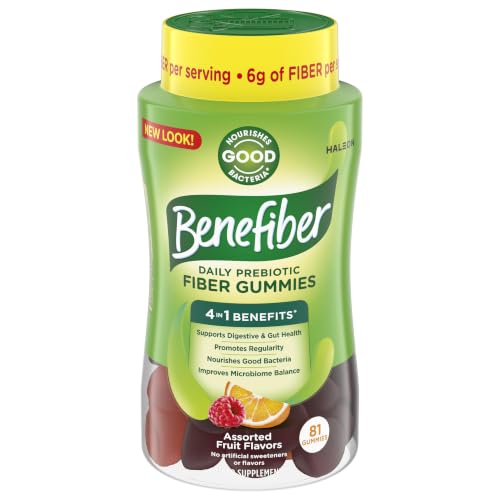
6. Benefiber Prebiotic Fiber Supplement Gummies — Best minimal setup
An 81-gummy inulin formula in assorted fruit flavour, made with natural fruit flavours and naturally sourced colours, in a 4 x 6 x 4 in bottle.
Best for: a simple inulin gummy from a familiar brand
Skip it if: you compare grams per serving before you buy
This is the shortest label in the group, and for some shoppers that's the appeal. One plant-based prebiotic ingredient, inulin, in a gummy Benefiber says strengthens and nourishes good bacteria to support gut health. Natural fruit flavours, naturally sourced colours, assorted fruit. No probiotic blend, no multi-source fiber stack, nothing extra to read.
The bottle holds 81 gummies, weighs 0.86 lb and measures 4 x 6 x 4 in, making it the second-heaviest pick here. The listing dates to 2025, so this is one of the newer formulas in the set, and it moves quickly: third-fastest seller of the seven. Two sellers stock it.
Now the hard part. This sits at the premium end of the price range, second-most expensive of the seven, and it publishes no grams-per-serving figure and no serving size. So the one number that decides this category is missing, on a bottle priced above five of the six alternatives. Its own stablemate, the Benefiber tablet at position one, delivers 19 more pieces for less.
If you want a Benefiber product and you prefer gummies to tablets, this is the pick. Otherwise the arithmetic points elsewhere.
Pros:
- Single named fiber source: plant-based inulin
- Natural fruit flavours and naturally sourced colours
- Full dimensions published at 4 x 6 x 4 in
- Newer 2025 formula from a familiar brand
- Third-fastest seller in this group
Cons:
- No grams-per-serving figure published
- Second-most expensive pick in the set
- Fewer pieces than the cheaper Benefiber tablet bottle
- Serving size not stated anywhere on the listing
7. Generic Daily Fiber Supplement Chewable Tablets — Best for pros
A sugar-free chewable tablet in strawberry, grape and green apple, 90 count, from the only listing here with a single seller.

Best for: a sugar-free tablet chew in three fruit flavours
Skip it if: you want published numbers before you commit
I'm calling this one for experienced buyers because it takes some interpretation. This is one of only two tablets in the set, and the flavour list is the most specific of any pick: strawberry, grape and green apple. It's sugar-free, and the listing says it contains prebiotic fiber that supports the balance of helpful bacteria in the digestive tract.
The bottle holds 90 tablets and weighs 0.79 lb. The listing describes it as a fiber and probiotic supplement made with prebiotic fiber, though unlike Nature Made and Micro Ingredients it doesn't name a strain or a CFU count. It also uses the phrase "high fiber content" without attaching a number to it, which is exactly the kind of wording that makes a like-for-like comparison impossible.
Only one seller lists it, the sole single-seller pick in this group.
The honest position: this asks the most of you and publishes the least. It sits at the premium end, second-most expensive alongside the Benefiber gummy, with no grams per serving, no serving size, no dimensions and no named fiber source. It's also the slowest seller of the seven by a wide margin. The Benefiber tablet gives you 10 more tablets, three named flavours and clear directions, for less.
Pros:
- Most specific flavour list here: strawberry, grape, green apple
- Sugar-free tablet format
- 90 tablets, second-largest tablet count in the set
- Listing states prebiotic fiber for digestive tract balance
Cons:
- No grams per serving, serving size or fiber source published
- Premium price position with the thinnest specifications here
- Only one seller lists it
- Slowest-selling pick of the seven
How long does one bottle of chewable prebiotic fiber last?
This is the question nobody answers on the front of the label, and it's the one that decides whether you stick with the habit.
Only two picks here let you work it out cleanly:
- Nature Made states it outright: 50 gummies, two daily, 25 days.
- Physician's CHOICE gives you both halves: 60 gummies, two per serving, so 30 servings.
Everything else leaves a hole. Benefiber's tablet bottle publishes dosing, three tablets up to three times daily, but that range spans three tablets a day to nine. At nine, 100 tablets lasts 11 days. At three, it lasts a month. That's an enormous gap to leave open.
Metamucil, Micro Ingredients, the Benefiber gummy and the Generic tablet publish counts of 120, 120, 81 and 90 with no serving size attached. You cannot convert those to days.
My advice: buy on count when the serving size is missing. A 120-piece bottle absorbs an uncertain dose better than a 50-piece one. It's a blunt rule, but it's the only one the published data supports.
What the labels leave out
Four things these seven listings don't tell you, and how to handle each.
- Fiber grams, on three of seven picks. Benefiber's tablets, Benefiber's gummies and the Generic tablets publish no figure. Assume nothing about how they compare to the 5 g and 6 g claims.
- How the fiber gets to that number. Metamucil names inulin and Fibersol soluble corn fiber. Physician's CHOICE names chicory root. Benefiber's gummy names inulin. The other three don't name a source at all.
- What happens when you start. Fiber supplements are ramp-up products. None of these listings publishes a starting protocol, and the manufacturer claims about gas and bloating relief are claims, not results.
- Interaction with anything else you take. No listing here addresses it. That's a conversation for whoever prescribes for you, not a spec sheet.
One more thing worth naming honestly. Several of these listings reference GLP-1 support: Benefiber on both products, Physician's CHOICE in its product name. Those are marketing lines with asterisks attached. Nothing in this data lets me tell you which chewable prebiotic fiber does or doesn't do anything for that, and I won't pretend otherwise. Judge that claim yourself, and treat the fiber figures as the part you can actually verify.
When a different pick wins
The winner isn't the winner for everyone. Three thresholds flip it.
If you need more than 5 g of fiber in one serving, the Benefiber tablet can't confirm it and Micro Ingredients claims 6 g. Take the Micro Ingredients bottle. It's also the cheapest here, so there's no penalty for the swap.
If you take two or fewer pieces a day and want the maths to close, go to Physician's CHOICE. Two gummies, 5 g, 30 servings, chicory root named. The Benefiber tablet asks for three at a time and won't tell you the grams.
If you already trust one brand's flavour and won't switch, brand loyalty is a legitimate criterion and Metamucil's orange formula names two fiber sources. You'll pay the most in this set, but you'll take it every day, which is the whole point.
If you want a probiotic in the same chew, two picks qualify. Nature Made names LactoSpore at 2 billion CFU with 3 g of fiber. Micro Ingredients claims 2 billion CFU from Bacillus coagulans with 6 g. The dose gap decides it unless you specifically want the named strain.
The verdict
At the entry tier, the Benefiber Chewable Prebiotic Fiber Tablets bottle is the default. It's the second-cheapest of the seven, it holds 100 sugar-free tablets in three flavours, and it publishes the clearest dosing directions here. That combination of low cost and long runway is what a daily habit needs, and it's why this is the best chewable prebiotic fiber for most shoppers. Alongside it, Micro Ingredients sits at the lowest price position with the highest published figure in this comparison, 6 g per serving across 120 gummies.
At the middle tier, Physician's CHOICE earns the money. Its exact advantage over the winner is arithmetic: 5 g per 2-gummy serving, 60 gummies, 30 servings, chicory root named as the source. Nothing else in this set lets you close that calculation with a named ingredient attached.
At the premium tier, Metamucil is the honest choice for orange-flavour loyalists who want 120 pieces and two named fiber sources. But the Benefiber gummy and the Generic tablets both sit at premium positions while publishing no fiber figure at all, and I can't recommend paying more for less information.
The cutoff is simple. If a bottle won't tell you grams per serving, it needs to be cheap or hold a lot. Two of these fail both tests.
FAQ
Is chewable prebiotic fiber worth it compared with powder?
Chewable prebiotic fiber is worth it if the format is what keeps you consistent. Powders mix into liquid and can carry larger doses; chewables need no water, no shaker and no measuring. Micro Ingredients puts it plainly, calling gummies an easy-to-consume alternative to powder or capsules. The trade-off is dose ceiling. The highest claim here is 6 g per serving.
Which is the best chewable prebiotic fiber for the money?
The best chewable prebiotic fiber for the money is Micro Ingredients. It holds the lowest price position of these seven while claiming the highest fiber figure, 6 g per serving, across 120 gummies with 2 billion CFU of Bacillus coagulans. Benefiber's 100-tablet bottle is the close second, sitting one step up in price with the largest tablet count here.
How many grams of fiber do these picks actually contain?
Grams of fiber per serving are published on four of the seven. Micro Ingredients claims 6 g, Metamucil claims 5 g in a plant-based blend, Physician's CHOICE claims 5 g per two gummies, and Nature Made claims 3 g per two gummies. Both Benefiber products and the Generic tablets publish no figure, so you cannot compare them on dose.
Benefiber tablets or Physician's CHOICE gummies: which should I buy?
Benefiber tablets or Physician's CHOICE gummies comes down to bottle size against dose clarity. Benefiber gives you 100 tablets at a lower price position, with directions for three tablets up to three times daily, but no gram figure. Physician's CHOICE gives you 60 gummies, a stated 5 g per two-gummy serving and chicory root named as the source. Pick clarity if you're new to fiber.
What's the most common mistake when buying fiber chewables?
The most common mistake is buying on the count printed on the bottle. Count without a serving size tells you nothing about days of coverage. Nature Made ships 50 gummies and states a 25-day supply; Metamucil ships 120 and states no serving size at all. Check whether the listing publishes both grams per serving and pieces per serving before you commit.
Start with the arithmetic, not the flavour. Pull up the listing for whichever bottle tempts you and look for two numbers: grams of fiber per serving, and pieces per serving. If both are there, you know exactly what a month costs you. If either is missing, ask whether the count is large enough to cover the uncertainty. The Benefiber tablet bottle wins here because 100 tablets at the second-lowest price position forgives a lot of unknowns, and a fiber habit you can afford to keep beats a precise dose you abandon in three weeks.
Last updated: September 7, 2026. Product availability re-checked.
This page contains affiliate links. As an Amazon Associate we earn from qualifying purchases, at no extra cost to you.