Best Gluten Free Powder Fiber Supplement by Fiber Type
Six fiber powders, one deciding question: which fiber source suits your gut and your drink. Benefiber leads on dissolving clear, but the runner-up wins on capacity.
The best gluten free powder fiber supplement is Benefiber Prebiotic Fiber Supplement Powder in the 250-teaspoon tub, because it dissolves clear and taste-free into any non-carbonated drink while carrying a gluten-free, sugar-free label. If you'd rather have a bigger tub and a flavored scoop, Metamucil 4-in-1 in the 15 oz size is the better buy. The real split here is fiber source. Wheat dextrin, psyllium husk, guar gum, and soluble corn fiber behave differently in your glass and your gut, and that choice decides more than the brand name on the front.
Best gluten free powder fiber supplement at a glance
| Pick | Fiber source | Size | Price |
|---|---|---|---|
| Best overall Benefiber Prebiotic Fiber Supplement Powder |
Wheat dextrin | 1.1 lb, 250 tsp | Check Price |
| Best large-capacity Metamucil 4-in-1 Psyllium Husk Fiber |
Psyllium husk | 15 oz, 72 tsp | Check Price |
| Best budget pick Benefiber Prebiotic Fiber Supplement Powder |
Wheat dextrin | 8.7 oz, 124 tsp | Check Price |
| Best premium Physician's CHOICE Easy Mix Fiber |
Corn + guar fiber 6g claim |
7.3 oz | Check Price |
| Best for pros Healthy Origins Healthy Fiber Powder |
Guar gum (PHGG) 6g claim |
7.9 oz | Check Price |
| Best minimal setup Nutricost Prebiotic Fiber Unflavored |
Prebiotic fiber 7g claim |
1.01 lb, 57 servings | Check Price |
How I narrowed the field to six
I lined up every unflavored and flavored fiber powder in the digestive supplement listings, then read the published labels side by side. The three criteria I weighted, in order: the fiber source and how it mixes, the gluten-free status on the label, and the size you get per tub. Those three do the most to separate a powder you'll keep using from one that sits in the cupboard.
I cut anything without a gluten-free claim on the listing, because that's the whole point of this search. I cut capsule and gummy formats, since a powder mixes into more drinks and meals. And I cut anything where the fiber source wasn't named at all, because you can't judge how a mystery blend will sit with you.
What survived is a spread of the four soluble fibers that matter here:
- Wheat dextrin, the taste-free workhorse in both Benefiber tubs
- Psyllium husk, the thickening fiber in Metamucil
- Guar gum (PHGG), the clinically studied fiber in Healthy Origins
- Soluble corn and guar blend, the smooth mix in Physician's CHOICE
Nutricost rounds out the group as the plainest unflavored option. Six picks, four fiber sources, one clear winner.
Which fiber source actually decides it?
Most guides compare grams of fiber per serving. That's the obvious number, and it's nearly a wash here: the labels cluster at 6 to 7 grams. The fiber source is what actually decides your experience, and it's the spec most shoppers skim past.
Wheat dextrin, the fiber in both Benefiber tubs, dissolves clear and adds no grit. Benefiber says it mixes completely into non-carbonated drinks and food without changing taste. That makes it the easiest to hide in coffee or water.
Psyllium husk, the fiber in Metamucil, thickens as it sits. Metamucil markets four benefits from psyllium: digestive health, heart health by lowering cholesterol, blood sugar support, and appetite control. The trade-off is texture, since psyllium can gel if you drink it slowly.
Guar gum, the fiber in Healthy Origins, is a partially hydrolyzed form (PHGG). It's well understood by people who already use it, but it's less familiar as a first fiber.
- Want zero grit and zero taste? Wheat dextrin (Benefiber).
- Want the widest benefit claims? Psyllium husk (Metamucil).
- Want a smooth soluble blend for a GLP-1 routine? Corn plus guar (Physician's CHOICE).
Pick the source first. The brand follows from that.
1. Benefiber Prebiotic Fiber Supplement Powder — Best overall
Benefiber's 250-teaspoon tub wins because wheat dextrin dissolves clear and taste-free, so you can add fiber to anything without noticing it.

Best for: someone who wants a clear, taste-free powder in any drink Skip it if: you want a large orange-flavored tub for less
What sets this pick apart in the group is the combination of a neutral fiber and a big tub. It holds 1.1 lb, roughly 250 teaspoons, in a 7.63 x 4.28 x 4.28 in canister. That's the highest teaspoon count here, which means fewer reorders. Benefiber describes wheat dextrin as a plant-based prebiotic that nourishes good gut bacteria, and says the powder is grit-free and dissolves completely into non-carbonated drinks and food.
The label reads sugar free, gluten free, and low calorie, with no artificial flavors. That's the exact profile this search wants. Benefiber also frames it as GLP-1 support for closing a fiber gap, a claim I'd read as marketing rather than a proven effect.
It sits near the top of the price positions in this set, and it's the one buyers here choose most often. The trade-off against Metamucil is scope: Benefiber's wheat dextrin does one thing cleanly, while psyllium markets a wider benefit list. If pure, invisible mixing is your goal, this is the pick.
Pros:
- Wheat dextrin dissolves clear and taste-free
- Largest teaspoon count in this set, 250 tsp
- Sugar-free, gluten-free, no artificial flavors
- The pick buyers here choose most often
Cons:
- Near the top of the price positions here
- GLP-1 fullness claim is unproven marketing
- No third-party testing mentioned on the listing
2. Metamucil 4-in-1 Psyllium Husk GLP-1 Friendly Fiber — Best large-capacity
Metamucil packs the widest benefit claims into a 15 oz tub, making it the value play if orange flavor doesn't bother you.
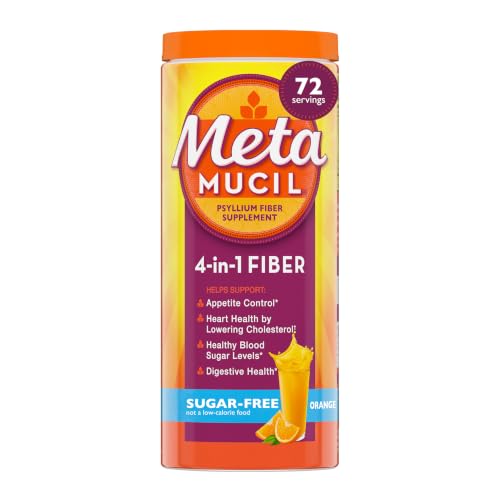
Best for: anyone stacking digestive and heart benefits in one scoop Skip it if: you dislike orange flavor or want grit-free clear mixing
Metamucil is the only psyllium husk pick here, and that's its whole identity. The tub holds 15 oz, roughly 72 teaspoons, in a 7.55 x 3 x 3 in canister at 0.94 lb. It's the second-cheapest in this set, so you get a lot of servings for the price position.
Metamucil markets four benefits from psyllium: digestive health, heart health through lowering cholesterol, healthy blood sugar, and appetite control. It's sugar-free and orange-flavored, which is the flip side of the coin. Where Benefiber vanishes into water, Metamucil tastes like orange and thickens as it sits.
Psyllium is a gelling fiber, so drink it promptly. That texture is the main reason someone chooses wheat dextrin instead. Against Benefiber, Metamucil trades invisible mixing for a broader claim list and a lower price position. If you want the most benefits per scoop and don't mind flavor, it's the smart buy, and it's one of the faster sellers in this category.
Pros:
- Largest ounce weight here at 15 oz
- Second-cheapest pick in this set
- Four marketed benefits from psyllium husk
- Sugar-free with a refreshing orange flavor
Cons:
- Orange flavor won't suit every drink
- Psyllium thickens and gels if left to sit
- Fewer teaspoons than the top Benefiber tub
3. Benefiber Prebiotic Fiber Supplement Powder — Best budget pick
The smaller Benefiber tub gives you the same clear-mixing wheat dextrin as the winner, at the cheapest price in this set.

Best for: first-timers testing whether fiber powder suits them Skip it if: you already know you want a bigger tub
This is the same formula as the overall winner in a smaller pack. It holds 8.7 oz, roughly 124 teaspoons, and weighs 0.55 lb. That's half the teaspoon count of the 250-teaspoon tub, which is exactly what a first-timer wants: a low-commitment way to see whether wheat dextrin sits well before you buy the big canister.
Benefiber describes the same clear, grit-free mixing and the same plant-based prebiotic wheat dextrin. The label is sugar-free and gluten-free. This version also notes HSA and FSA eligibility on the listing, which can matter if you're spending from a health account.
It's the cheapest of the six, so the barrier to trying it is low. The trade-off is simple math: you'll reorder twice as often as with the 250-teaspoon tub, and the cost per serving is usually worse on a small pack. If you already know fiber powder works for you, size up. If you're testing the water, start here.
Pros:
- Cheapest pick of the six
- Same clear-mixing wheat dextrin as the winner
- HSA and FSA eligible per the listing
- Low-commitment 124-teaspoon size
Cons:
- Half the teaspoons of the larger tub
- Cost per serving usually higher on small packs
- No third-party testing mentioned on the listing
4. Physician's CHOICE Easy Mix Fiber for GLP-1 Support — Best premium
Physician's CHOICE pairs a smooth corn-and-guar blend with doctor development and third-party testing, for buyers who want the paperwork.

Best for: GLP-1 users who want a smooth, no-grit soluble fiber Skip it if: you count cost per serving above all else
This is the most expensive pick here, and the case for it is the fiber blend plus the quality story. Physician's CHOICE lists 6 grams of fiber per serving from soluble corn fiber and soluble guar fiber, two sources it calls clinically studied. The pack is 7.3 oz, one of the smaller sizes in this group.
The brand says the powder dissolves clear in hot or cold drinks without changing taste, and that it stays smooth where psyllium husk can thicken into sludge. It also states the product is developed with doctors, made in cGMP-certified facilities, and third-party tested for safety, purity, and potency. That testing language is the clearest of any pick here.
The GLP-1 framing is marketing, not a measured result, so treat it as such. Against the two Benefiber tubs, this trades a lower cost and bigger size for a documented sourcing story and a two-fiber blend. If you value the third-party testing note and want a smooth soluble powder, the premium is buying that assurance.
Pros:
- Clearest third-party testing note in this set
- Smooth corn-and-guar blend, no grit claim
- 6 grams of soluble fiber per serving claimed
- Dissolves clear in hot or cold drinks
Cons:
- Most expensive pick in this set
- Smallest tub at 7.3 oz
- GLP-1 support framing is unproven
5. Healthy Origins Healthy Fiber Powder 7.9 oz — Best for pros
Healthy Origins builds around Sunfiber PHGG, a guar-gum fiber that suits people who already know they tolerate it well.

Best for: people who already know they tolerate guar gum fiber well Skip it if: you have never used a soluble fiber and want a gentler start
This pick is for someone who knows their fiber. Healthy Origins uses Sunfiber, a partially hydrolyzed guar gum, and lists 6 grams of fiber per scoop. The canister is 7.9 oz, 6.75 x 3.5 x 3.5 in, at 0.66 lb. It sits mid-range for price in this set.
The brand calls the fiber clinically studied and describes it as unflavored and versatile, mixing into water, juice, coffee, smoothies, or meals without changing taste or color. It also markets the powder as free from artificial colors, flavors, and additives. That clean, single-ingredient approach is the appeal for experienced users.
PHGG is less familiar than wheat dextrin or psyllium, which is why I've framed it for people who already tolerate guar-based fiber. If you've never used soluble fiber, one of the Benefiber tubs is a gentler on-ramp. Against those, Healthy Origins trades broad name recognition for a focused, single-source guar formula. Know your fiber, and it earns a spot; brand-new to powder, and it's not where I'd start.
Pros:
- Single-source Sunfiber PHGG, clinically studied claim
- Unflavored, mixes without changing color
- Free from artificial colors, flavors, additives
- Mid-range price position in this set
Cons:
- Guar gum less familiar than wheat dextrin
- Not the gentlest first fiber to try
- Smaller tub than the top two picks
6. Nutricost Prebiotic Fiber Unflavored — Best minimal setup
Nutricost is the plainest tub here: unflavored prebiotic fiber with a GMP and third-party testing note, and little else to fuss over.

Best for: someone who wants a plain, no-frills unflavored tub Skip it if: you want the most published detail behind your purchase
Nutricost keeps it simple, and that's the pitch. The container holds 1.01 lb of prebiotic fiber powder, which the brand lists as 57 servings at 7 grams of fiber each. That 7-gram figure ties for the highest per-serving claim in this group. The tub measures 5.7 x 3.34 x 3.34 in and weighs 1.18 lb.
The brand says the powder is unflavored, gluten-free, and non-GMO, made in a GMP-compliant facility and third-party tested for quality and purity. That's a solid quality note for a mid-price pick. It's the second-cheapest of the tubs sized around a pound.
The catch is detail. The listing names the fiber only as prebiotic fiber, without specifying the exact source the way Benefiber names wheat dextrin or Metamucil names psyllium. It also sells slower than the rest of this set, which tells you it's less established. Against the two Benefiber tubs, Nutricost offers a higher fiber-per-serving claim and a testing note, but less clarity on what the fiber actually is. Fine for a plain daily powder; short on paperwork if you want specifics.
Pros:
- Highest per-serving fiber claim, 7 grams
- Non-GMO and third-party tested per listing
- Full pound with 57 servings
- Unflavored and gluten-free label
Cons:
- Exact fiber source not named on the listing
- The slowest seller of the six here
- Less established than the name brands
How does gluten-free stack up across these picks?
Gluten-free is the search term, so it's worth being honest about how the picks handle it. Amazon's search here treats the qualifier loosely, so I read each label rather than trusting the filter. Check the listing yourself before you buy, because a manufacturer can change a formula without changing the photo.
Here's what the listings state:
- Benefiber (both tubs): label reads sugar free and gluten free, though the fiber is wheat dextrin, a wheat-derived ingredient.
- Nutricost: listing states gluten-free and non-GMO.
- The others: Metamucil, Physician's CHOICE, and Healthy Origins don't foreground a gluten-free claim in the same way, so verify their labels directly.
The wheat dextrin point matters. Benefiber is made from wheat but marketed gluten-free, because the gluten protein is removed during processing. If you have celiac disease, that distinction is one to confirm with the current label and, ideally, a certification mark. A powder that's "gluten-free" by claim is not the same as one carrying a certified seal, and the listings don't all specify which they are.
How long does one tub really last?
Serving counts decide how often you reorder, and they vary more than the tubs look. Here's the picture from the published sizes and serving claims.
- Benefiber 250 tsp (1.1 lb): the highest teaspoon count, so the fewest reorders.
- Metamucil 15 oz (72 tsp): the largest ounce weight, roughly 72 teaspoons of flavored powder.
- Nutricost (1.01 lb): listed at 57 servings, a full pound of plain powder.
- Benefiber 124 tsp (8.7 oz): half the teaspoons of the big tub, built for trying it out.
- Healthy Origins (7.9 oz): a compact canister for a known-fiber user.
- Physician's CHOICE (7.3 oz): the smallest pack, so the shortest run between orders.
The lesson is to match size to certainty. If you know a fiber suits you, buy the biggest tub of it to cut cost per serving and reorder hassle. If you're testing, the small Benefiber tub is the low-risk entry. A big canister of a fiber your gut rejects is a waste no price tag fixes.
What to watch on the label before you buy
The listing photo won't answer everything. Before you commit, run down this short checklist so a product you didn't shortlist can still be judged on the same terms.
- Named fiber source. A good label names it: wheat dextrin, psyllium husk, guar gum, or soluble corn fiber. "Prebiotic fiber" alone tells you less.
- Grams per serving. These picks cluster at 6 to 7 grams. Higher isn't automatically better if your gut needs to ramp up slowly.
- Flavored or unflavored. Metamucil is orange; the rest are unflavored. Flavor decides which drinks work.
- Testing language. Physician's CHOICE and Nutricost both mention third-party testing. That's a mark in their favor.
- Gluten-free wording. A stated claim is not the same as a certified seal. Read carefully if you're celiac.
Two habits save regret. First, start with a smaller serving than the label suggests and build up, because soluble fiber can cause bloating if you jump in fast. Second, drink plenty of water with any of these, especially the psyllium in Metamucil, which gels as it hydrates. The best powder is the one you'll actually keep taking, so pick for taste and texture as much as grams.
The verdict
If you want a fiber powder that disappears into any drink, Benefiber Prebiotic Fiber Supplement Powder in the 250-teaspoon tub is the pick. It uses clear-mixing wheat dextrin, carries a sugar-free and gluten-free label, and holds the most teaspoons in this set, so you reorder least. It's near the top of the price positions here, and it's the one buyers in this group reach for most.
If your priority is servings for the money and you don't mind orange flavor, Metamucil 4-in-1 in the 15 oz tub is the better buy. Its exact advantage is scope and value: psyllium husk backs four marketed benefits, from digestive to heart health, and it's the second-cheapest pick. The cutoff is texture. Wheat dextrin stays clear and thin; psyllium thickens and gels if you leave it sitting.
Two other splits are worth naming. If you want the clearest third-party testing note and a smooth soluble blend, Physician's CHOICE is the premium call despite being the most expensive here. If you already know guar gum suits you, Healthy Origins' Sunfiber PHGG is a clean, focused option. Match the fiber to your gut and your glass, and the right tub picks itself.
FAQ
Is the best gluten free powder fiber supplement worth the money?
The best gluten free powder fiber supplement earns its cost if you'll take it daily. Benefiber's 250-teaspoon tub spreads its price across the most servings in this set, lowering cost per use. A powder you abandon after a week is the real waste. Buy a small tub first to confirm it suits you, then size up once you know it works.
Which fiber source mixes without grit or flavor?
The fiber source that mixes cleanest is wheat dextrin, used in both Benefiber tubs. The brand says it dissolves clear and grit-free into non-carbonated drinks and food without changing taste. Physician's CHOICE makes a similar smooth-mixing claim for its corn-and-guar blend. Psyllium husk, the fiber in Metamucil, thickens as it sits, so it needs to be drunk promptly.
How long does a tub of fiber powder last?
A tub of fiber powder lasts as long as its serving count allows. Benefiber's 250-teaspoon tub runs longest here, followed by Metamucil at roughly 72 teaspoons and Nutricost at a listed 57 servings. The small Benefiber tub holds 124 teaspoons. Match size to certainty: buy big when you know a fiber suits you, small when you're still testing it.
Benefiber or Metamucil for gluten-free fiber?
Benefiber or Metamucil comes down to texture and flavor. Benefiber uses wheat dextrin that dissolves clear and taste-free, with a gluten-free label, and holds more teaspoons per tub. Metamucil uses orange-flavored psyllium husk, markets four benefits including heart health, and costs less per tub. Pick Benefiber for invisible mixing, Metamucil for value and broader claims.
What is the biggest mistake buying gluten free fiber powder?
The biggest mistake buying gluten free fiber powder is trusting the search filter over the label. Verify the gluten-free wording yourself, since a stated claim differs from a certified seal, and Benefiber's fiber is wheat-derived. The second mistake is starting at a full dose. Ramp up slowly and drink plenty of water to avoid bloating, especially with gelling psyllium.
Start by deciding your fiber source, not your brand. If you want a powder you'll never taste in your coffee, buy a small Benefiber tub of wheat dextrin, confirm it sits well, then move up to the 250-teaspoon canister for the lowest cost per serving. If servings-per-dollar and a wider benefit list matter more, Metamucil's 15 oz tub does that job, orange flavor and all. The winner isn't the flashiest label. It's the one that mixes clear, carries the gluten-free claim you came for, and lasts long enough that you actually keep the habit.
Last updated: September 7, 2026. Product availability re-checked.
This page contains affiliate links. As an Amazon Associate we earn from qualifying purchases, at no extra cost to you.