Best Eye Drops for Contacts Dry Eyes: Refresh Wins
Seven contact-friendly formulas, ranked by what the labels actually claim. Refresh Contacts leads for everyday rewetting, with six alternates for screen fatigue, gel-thick relief, and preservative-free routines.
The best eye drops for contacts dry eyes are Refresh Contacts Comfort Drops, a 0.4 fl oz rewetter with a stated compatibility list that covers soft and rigid gas permeable lenses. If your dryness peaks at night or after screen marathons, Blink GelTears in the 0.34 fl oz bottle is the better pick because its gel-weight formula stays put longer than a thin rewetter. Everything below is matched to a specific trigger.
Best eye drops for contacts dry eyes at a glance
| Pick | Bottle size | Contact-safe claim | Price |
|---|---|---|---|
| Best overall Refresh Contacts |
0.4 fl oz | Soft and RGP lenses | Check Price |
| Best minimal setup Opti-Free Puremoist |
0.4 fl oz | Silicone hydrogel and soft lenses | Check Price |
| Best upgrade Blink GelTears |
0.34 fl oz | Dry eye relief, gel weight | Check Price |
| Most versatile Biotrue Hydration Boost for Contacts |
0.33 fl oz | Preservative-free multi-dose | Check Price |
| Best for pros Biotrue Hydration Boost PF |
0.33 fl oz | Preservative-free, general dry eye | Check Price |
| Best lightweight Refresh Relieva for Contacts |
0.27 fl oz | Contact lens wearers, CMC + HA claim | Check Price |
| Best premium Blink Triple Care |
10 mL | Moderate to severe dry eye | Check Price |
Who should skip contact drops entirely?
Before the picks, one honest caveat. Amazon's search returned seven bottles for the phrase "best eye drops for contacts dry eyes", and only four of them carry a listing statement that explicitly names contact lens use: Refresh Contacts, Refresh Relieva for Contacts, Biotrue Hydration Boost for Contacts, and Opti-Free Puremoist. Blink GelTears, Blink Triple Care, and the preservative-free Biotrue Hydration Boost are marketed as general dry eye drops. If "safe with my lenses in" is your hard requirement, keep to the four with the contacts callout on the label and check the packaging text before you dose.
If you have a medicated drop from an eye doctor, a prescription regimen for dry eye disease, or symptoms that persist for weeks, none of what follows replaces that. This piece is about the over-the-counter shortlist for lens-related dryness.
Two categories of shopper should skip this list entirely. First, anyone whose dryness is diagnosed and treated by a specialist. Second, anyone whose problem is not really the lenses. If you're dry when the lenses are out too, the fix is a full artificial tear routine, not a rewetter.
How I screened seven bottles down to the shortlist
I lined up every product in the set on four data points from the listings: bottle size, whether the label explicitly names contact lens use, whether the formula is preservative-free, and what the manufacturer claims about the active mechanism. Nothing here is a test result. It's a comparison of what each brand puts in writing.
Three things got weight in the ranking:
- Explicit contact-lens compatibility on the listing. A product marketed for contacts, not repurposed from a general dry-eye line, sits higher for this keyword.
- A stated ingredient story. "Hydration" as a word means nothing. Hyaluronate, CMC, glycerin, HydroCell, or a named electrolyte blend means the manufacturer is committing to something.
- Bottle size relative to how the drops are used. A rewetter you dose twice a day drains faster than one you use once. The 0.27 fl oz Refresh Relieva runs out sooner than a 0.4 fl oz Refresh Contacts.
Cut from consideration during scoring: brand loyalty, packaging design, and any claim about being the top-selling contact drop. Those don't survive contact with the listing data.
Rewetter, artificial tear, or gel: what's the difference?
Three product types share this shelf and the labels blur together. The distinction matters because it decides which bottle actually helps your problem.
- A rewetter is designed to be dosed onto lenses that are already in your eyes. Refresh Contacts and Opti-Free Puremoist sit here.
- An artificial tear for contacts is a hybrid. It rewets the lens surface and adds a lubricant film. Refresh Relieva for Contacts and Biotrue Hydration Boost for Contacts are in this group.
- A gel drop is thicker, sits on the ocular surface longer, and is typically marketed for moderate to severe dry eye. Blink GelTears and Blink Triple Care fall here, and neither headlines "for contacts" on the listing.
Choose by the pattern of your dryness. Occasional midday scratch: rewetter. Screen fatigue that builds through the afternoon: contact-labeled artificial tear. Evening burn or overnight dryness: gel, dosed when lenses are out.
1. Refresh Contacts Comfort Drops — Best overall
The clearest contact-lens rewetter in the set, with an explicit compatibility statement covering soft and rigid gas permeable lenses.

Best for: daily soft or RGP lens wearers who need a simple midday rewetter Skip it if: you want a preservative-free multi-dose bottle
Refresh earns the top slot because the listing does what most others in this set don't: it names the lens types the drops are meant to work with. The manufacturer states the formula lubricates and rewets both soft and rigid gas permeable lenses, and calls out silicone acrylate and fluorosilicone acrylate RGP materials specifically. That level of detail matters for the best eye drops for contacts dry eyes because rigid lens wearers get thin advice everywhere else. The bottle is 0.4 fl oz, weighs 11.3 g, and measures 3.6 x 1.15 x 1.8 in, so it's not the smallest in the rotation but it's not a bathroom-only bottle either. Refresh says you can keep contacts in during application, which is the whole point of a rewetter. The trade-off against the newer picks: this is the cheapest of the seven and it isn't marketed as preservative-free, so heavy users who dose many times a day should look at the Biotrue picks below.
Pros:
- Explicit soft and RGP compatibility in the listing
- 0.4 fl oz bottle, tied for largest in the set
- Straightforward rewetter use case
- The most affordable pick here
Cons:
- Not marketed as preservative-free
- No hyaluronate ingredient claim
- Original formula dates back further than newer picks in this set
2. Opti-Free Puremoist Rewetting Drops — Best minimal setup
A rewetter that adds a debris-removal claim to the standard moisture hit.

Best for: silicone hydrogel wearers who want a no-fuss rewetter that also lifts debris Skip it if: your dryness is severe or lasts into the evening
Opti-Free comes at the problem from a slightly different angle. Alcon markets Puremoist for all silicone hydrogel and soft contact lenses, and the listing bullet flags two functions: adding moisture and removing the particles that cause irritation. That's useful if your dryness comes with the gritty feeling of trapped debris, not just a lack of lubricant. The bottle holds 0.4 fl oz at 13.6 g, so it's the heaviest of the seven by a small margin, and it measures 3.88 x 1.25 x 1.75 in. The model dates from 2015. Where Puremoist gives ground: there's no hyaluronate story on the label, no gel-weight formula for evening use, and the listing does not mention RGP lenses. It sells more slowly than the Refresh pick above it, which is worth noting if you like the reassurance of a well-worn bottle. The trade-off is honest. This is a rewetter, and rewetters do rewetting well and nothing else.
Pros:
- Explicit silicone hydrogel compatibility
- Debris-removal claim on the listing
- 0.4 fl oz bottle at entry price
- Straightforward two-function formula
Cons:
- No mention of RGP lenses
- No hyaluronate or preservative-free claim
- The slowest seller of the seven picks
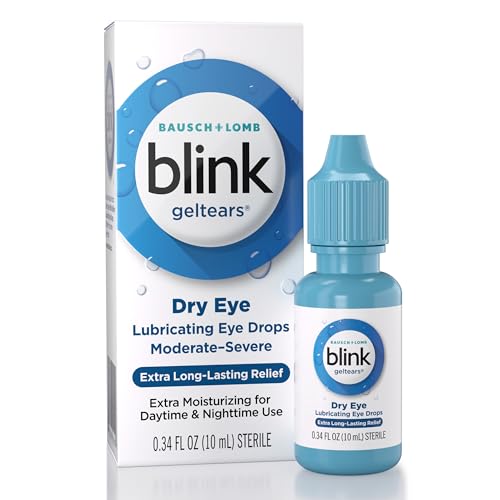
3. Blink GelTears — Best upgrade
A gel-weight drop that steps up when a thin rewetter runs out of staying power.
Best for: wearers whose dryness peaks at night or after long screen sessions Skip it if: you need to apply drops with lenses in mid-shift
GelTears is the pick if your dryness has an evening curve. It's a gel, not a thin rewetter, and Blink positions it for severe dry eye symptom relief with a hyaluronate hydration story on the listing. The 0.34 fl oz bottle measures 4.27 x 1.26 x 2.09 in, taller than the two rewetters above it. Blink says the formula is designed for day and night use and cites an ocular lubricant comfort questionnaire without publishing the full result. The important caveat for this keyword: the listing does not explicitly call out contact lens compatibility the way Refresh Contacts and Opti-Free do. If you want a gel for lens-in dosing, verify that on the packaging before you commit. Most gel users take lenses out first anyway, dose, then wait before reinserting, and that's the workflow this bottle suits best. Against the rewetters in this set, GelTears trades the simple lens-in convenience for real staying power.
Pros:
- Gel-weight formula for extended relief
- Hyaluronate ingredient claim
- Day and night use per the label
- One of the two picks released in 2025
Cons:
- No explicit contact lens compatibility on the listing
- Taller bottle than the rewetters here
- Not designed for quick lens-in dosing
4. Biotrue Hydration Boost for Contacts — Most versatile
The only bottle in the set that pairs contact-lens labeling with a preservative-free multi-dose format.

Best for: contact wearers who want a preservative-free formula they can dose often Skip it if: you prefer a rewetter with a documented RGP compatibility statement
This is the versatile pick because it does two things at once. Bausch + Lomb markets it as a contact lens rewetter and, per the listing, positions it as the first preservative-free multi-dose contact lens drop. If you dose more than a few times a day, a preservative-free format is meaningful. The formula bullets name hyaluronan, an antioxidant, and an electrolyte, and the manufacturer claims up to 8 hours of moisture based on a laboratory study. That's a lab claim, not a real-world guarantee, but it's the most specific staying-power figure in this shortlist. The 0.33 fl oz bottle measures 3.39 x 1.07 x 1.75 in, so it slots into a work bag easily. The gap against Refresh Contacts is what the listing doesn't say: RGP wearers won't find their lens type spelled out here. Soft lens wearers who want a drop they can use often lose nothing by starting here.
Pros:
- Preservative-free multi-dose format
- Hyaluronan, antioxidant, and electrolyte on the label
- 8-hour lab moisture claim
- pH-balanced per the listing
Cons:
- No RGP-specific compatibility statement
- Smaller bottle than the top two picks
- Premium price position for the contact-drop bracket
5. Biotrue Hydration Boost Preservative-Free — Best for pros
The one bottle to run when you're in and out of lenses all day and don't want two products on the desk.

Best for: screen-heavy workers who take lenses in and out and want one bottle for both Skip it if: you only ever wear lenses and never dose bare-eyed
This is the same Biotrue formula family as the pick above, but marketed as a general dry-eye drop for screen and environmental stress rather than as a contact rewetter. That's a subtle difference and it matters. The listing does not carry the "for contacts" callout of the sibling product, so use it lens-in only if the packaging confirms it. Where this one earns its slot: if you wear lenses part of the day and take them out to work or read, one preservative-free bottle covers both moments. The specs match: 0.33 fl oz, hyaluronan plus antioxidant plus electrolyte, pH-balanced, preservative-free, multi-dose. It sells faster than any other pick in this set, which is a useful data point when you're deciding between the two Biotrue bottles. It's also the mid-priced pick, cheaper than its contact-labeled sibling. Trade-off: you have to check the packaging for lens-in dosing rather than trust the listing headline.
Pros:
- Preservative-free multi-dose format
- Same hydration ingredient story as the contacts version
- Mid-priced against the premium contact-labeled picks
- The fastest seller of the seven
Cons:
- Not headlined for contact lens use
- Requires packaging check for lens-in dosing
- Smaller bottle than the top rewetters
6. Refresh Relieva for Contacts — Best lightweight
A pocket-sized contact drop with the most detailed ingredient story in the set.

Best for: travelers and bag-carriers who want the smallest bottle in the rotation Skip it if: you burn through a bottle in under a month
Relieva is the lightweight of the set at 7.65 g and 3.5 x 1.13 x 1.75 in, in a 0.27 fl oz bottle. It's the smallest bottle you can buy here, which is either a feature or a bug depending on how often you dose. The formula story is where it earns notice. The listing states Relieva is the only artificial tears product for contact lens wearers that combines carboxymethylcellulose, glycerin, hyaluronic acid, and Allergan's HydroCell technology. That's a real ingredient list, not a marketing shrug. Refresh markets it for lubricating and wetting contact lenses instantly, and says it's safe to use as often as needed. The catch is the volume. At 0.27 fl oz, this bottle drains fastest of the seven, and it sits at the top of the price ladder. The best eye drops for contacts dry eyes are the ones you'll actually carry, and this bottle fits a jacket pocket where Puremoist won't.
Pros:
- Smallest and lightest bottle in the set at 7.65 g
- Named ingredient stack including CMC, glycerin, and HA
- Explicit contact lens wearer positioning
- Safe for frequent dosing per the label
Cons:
- Smallest bottle by volume, drains fastest
- The highest price position of the seven picks
- No preservative-free claim
7. Blink Triple Care — Best premium
A three-mechanism dry eye formula for wearers whose problem stretches past a normal rewetter's brief.

Best for: moderate-to-severe dry eye sufferers who currently wear contacts part-time Skip it if: the listing's contact compatibility is what you need spelled out
Triple Care is the highest-priced pick in this set and the one aimed at the most difficult symptoms. Blink describes it as a lubricating eye drop for moderate to severe dry eye, with hyaluronate as the headline ingredient and extended-relief positioning. The bottle holds 10 mL and measures 4.08 x 1.3 x 0.79 in, so it's a slim shape that pockets well. What earns it a place here despite the missing "for contacts" headline: many contact wearers have dry eye that gets worse with age, screen work, or medication side effects, and a general-purpose dry eye drop for lenses-out dosing belongs in the rotation. What loses it the top slot: this piece is specifically about drops for people wearing contacts, and Triple Care's listing doesn't commit to lens-in safety. Use it before you put lenses in or after you take them out. Against Refresh Contacts, this trades convenience for potency.
Pros:
- Aimed at moderate to severe dry eye
- Hyaluronate ingredient story
- Slim bottle profile at 4.08 x 1.3 x 0.79 in
- Extended-relief positioning
Cons:
- No explicit contact lens compatibility on the listing
- The highest price position of the seven
- Not intended as a quick rewetter
How to read a contact lens drop label
Four things on the box actually matter. Everything else is decoration.
- "For use with contact lenses" or a specific lens-type list. If this phrase isn't there, treat the bottle as lenses-out only, no matter what the shelf tag says.
- Preservative status. A preservative-free formula tolerates frequent dosing better. Look for "preservative-free" on the front, not just in the fine print.
- The active ingredient. Hyaluronate, carboxymethylcellulose, glycerin, and polyethylene glycol behave differently. If a bottle relieved your dryness once, look for the same active on your next purchase.
- Volume. A 0.27 fl oz bottle at four doses a day empties much faster than a 0.4 fl oz bottle at two doses a day. Do the math before you buy.
If a bottle carries all four callouts clearly, it's a serious product. If it hides any of them, keep looking.
What the listings do not tell you about "for contacts"
Amazon's search matched "for contacts dry eyes" only partially against this set. Three of the seven picks are general dry-eye drops that surfaced because the algorithm reads "dry eyes" strongly and "for contacts" weakly. That's a real gap for shoppers.
A drop marketed for contacts commits, in writing, to lens-in safety. A drop marketed for general dry eye may still be lens-safe, but the burden shifts to you to confirm it on the packaging. This shortlist keeps both types in the mix because contact wearers with real dry eye often need both: a rewetter for the lens-in hours and a heavier drop for the lens-out ones.
Three practical rules follow. First, keep two bottles if your symptoms vary. Second, don't dose a gel with lenses in unless the box says so. Third, if a listing goes quiet on lens compatibility, take that silence seriously.
The verdict
If your dryness shows up as an occasional midday itch and you wear soft or rigid gas permeable lenses, Refresh Contacts is the right default. It's the pick with the most explicit lens compatibility statement in the seven, it comes in a 0.4 fl oz bottle at the entry price, and it does exactly what a rewetter is supposed to do without asking you to relearn a routine. That's the case for winner.
The cutoff between the winner and the runners-up is symptom duration. Below a few hours of dryness a day, or dryness that clears with a single dose, Refresh Contacts handles it. Above that, or into evening burn and screen fatigue that builds through the afternoon, Blink GelTears takes over because the gel weight holds longer than any thin rewetter can. If you dose many times a day, the preservative-free Biotrue Hydration Boost for Contacts avoids the accumulation problem that comes with preserved formulas. And if your dryness is real dry eye disease that happens to include lens wear, the Blink Triple Care sits in your rotation for the lenses-out hours. One bottle rarely covers every pattern of lens-related dryness, and the shortlist above assumes you'll pick two.
FAQ
Are eye drops for contacts dry eyes safe to use with lenses in?
Eye drops for contacts dry eyes are safe with lenses in only when the label explicitly says so. In this shortlist, Refresh Contacts, Refresh Relieva for Contacts, Biotrue Hydration Boost for Contacts, and Opti-Free Puremoist carry that statement. Blink GelTears, Blink Triple Care, and the preservative-free Biotrue Hydration Boost are marketed as general dry-eye drops, and their listings don't commit to lens-in dosing. Always verify on the packaging.
Is a preservative-free formula worth paying more for?
A preservative-free formula is worth paying more for if you dose often. Preservatives in multi-dose bottles help the product stay shelf-stable, but repeated exposure can bother sensitive eyes and dry-eye sufferers specifically. If you use drops twice a day, a preserved bottle like Refresh Contacts is usually fine. If you're at four or more doses daily, the preservative-free Biotrue Hydration Boost formats earn their price position.
What's the difference between Refresh Contacts and Refresh Relieva for Contacts?
The difference between Refresh Contacts and Refresh Relieva for Contacts is formula and bottle size. Refresh Contacts is a 0.4 fl oz rewetter with an original strength formula covering soft and RGP lenses. Refresh Relieva is a 0.27 fl oz artificial tear built around a named ingredient stack of carboxymethylcellulose, glycerin, hyaluronic acid, and HydroCell technology. Contacts is the simpler daily rewetter; Relieva is the pocket-carry formula for wearers who want more ingredients on the label.
How long does a 0.33 fl oz bottle of Biotrue Hydration Boost last?
How long a 0.33 fl oz bottle lasts depends entirely on your dosing frequency. At two doses per eye per day, most contact drop bottles in this size range last several weeks. At six doses a day for chronic dryness, the same bottle empties much faster. The preservative-free multi-dose format means you can dose as needed without cross-contamination worries, which is why heavy users pay the premium for this pick.
Can I use Blink GelTears instead of a specific contact rewetter?
Using Blink GelTears instead of a specific contact rewetter isn't recommended for lens-in dosing, because the listing doesn't commit to contact lens compatibility. GelTears is a gel-weight dry-eye drop meant for extended relief, ideally applied before you put lenses in or after you take them out. Pair it with a lens-labeled rewetter like Refresh Contacts if you need both midday touch-ups and evening staying power in the same routine.
The shortlist here isn't a bottle-of-the-year exercise. It's a matching problem. Refresh Contacts is the default because it does the one thing every contact wearer needs done, and it commits in writing to the lens types you're wearing. Everything else in the shortlist earns its spot by solving a specific version of the problem better: gel weight for evenings, preservative-free for heavy dosing, small format for travel. Start with the winner, add a second bottle when your pattern demands it, and treat any drop whose label goes quiet on contact lens use as a lenses-out product until the packaging tells you otherwise.
Last updated: September 7, 2026. Product availability re-checked.
This page contains affiliate links. As an Amazon Associate we earn from qualifying purchases, at no extra cost to you.