Best Eye Drops for Contacts and Red Eyes That Work
Redness drops and contact rewetters are two different products, and mixing them up can ruin a lens. Here is which of six picks does what, and when each one is the right buy.
The best eye drops for contacts red eyes are the Opcon-A Allergy Eye Drops, a clinically proven antihistamine and redness reliever sold in a 0.51 fl oz two-pack. If your redness comes from dry lenses rather than allergens, the Refresh Contacts rewetting drops in a 0.4 fl oz bottle are the safer buy. Here is the deciding specification most guides skip: whether a drop actually treats redness or only rewets a lens. Those are two different products, and only two of these six do both.
Best eye drops for contacts red eyes at a glance
| Pick | Type | Contact-safe? | Price |
|---|---|---|---|
| Best overall Opcon-A Allergy Eye Drops |
Antihistamine + redness | Remove lenses first | Check Price |
| Best budget pick Refresh Contacts Comfort Drops |
Rewetting only | Yes, keep lenses in | Check Price |
| Best for pros Visine Red Eye Hydrating Comfort |
Redness + lubricant | Check with your eye doctor | Check Price |
| Runner-up Opti-Free Puremoist Rewetting Drops |
Rewetting only | Yes, all soft lenses | Check Price |
| Best for beginners Tyson 2.0 Mike Red Eye Drops |
Redness + lubricant | Check with your eye doctor | Check Price |
| Best premium Blink Contacts Lubricating Drops |
Rewetting only | Yes, soft and RGP | Check Price |
Redness drops and rewetting drops are not the same thing
This is the whole ballgame. Buyers type "eye drops for contacts red eyes" as if one product does both jobs. It rarely does.
A redness reliever uses a vasoconstrictor to shrink the tiny blood vessels on the surface of your eye. Visine lists 0.05% tetrahydrozoline HCl. Tyson 2.0 lists 0.03% naphazoline HCl. Opcon-A pairs a redness reliever with an antihistamine. These make the white of your eye look whiter, fast.
A rewetting drop does the opposite kind of work. It lubricates the lens and the eye surface so a dry contact stops feeling gritty. Refresh Contacts, Opti-Free Puremoist and Blink Contacts are all rewetters. None of them contains a vasoconstrictor.
Here is the trap. Most redness relievers are not labelled for use with lenses in your eyes. A vasoconstrictor can be absorbed into a soft lens, and overuse can cause rebound redness, where the eye gets redder the moment the drop wears off. Rewetting drops are built to sit in your eye with a lens in place.
So the honest answer to "which drop fixes red eyes and works with contacts?" is: it depends on why your eyes are red.
- Red and itchy from allergies? You want an antihistamine.
- Red because your lenses are drying out? You want a rewetter.
- Red from a long screen day or short sleep? A redness reliever helps, lenses out.
1. Opcon-A Allergy Eye Drops — Best overall
Opcon-A is the only pick here that treats both the redness and the itch behind it, which is what most red-eye complaints in contact wearers actually are.
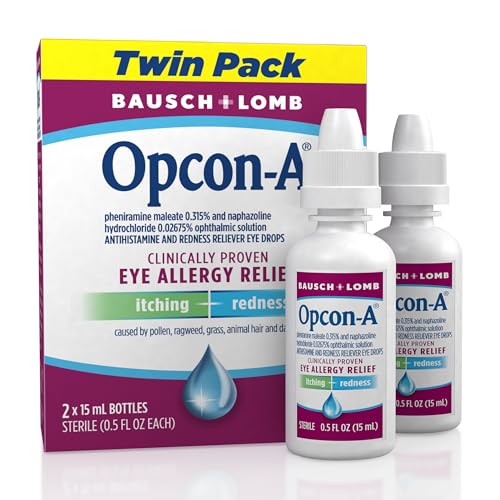
Best for: allergy sufferers whose red eyes come with itching Skip it if: your redness is from dry contacts, not allergens
Opcon-A wins because it targets the root cause of most red, irritated eyes rather than just the symptom. The brand says it combines an antihistamine with a redness reliever, and calls the formula clinically proven for relief of redness and itching from allergens like pollen, ragweed, grass and animal dander. No other pick in this set does both jobs in one bottle.
It also gives you the most product. You get a 0.51 fl oz two-pack, the largest total volume here, in a box weighing 2.08 oz. The model is AB55299, and it comes from Bausch + Lomb, a company the listing notes has focused on eye care for over 150 years. It sells faster than every other pick in this group.
The trade-off is real. This is an allergy drop, not a contact rewetter. You should remove your lenses before using it and wait before reinserting them. If your eyes are red purely because your contacts dried out mid-afternoon, a rewetter will serve you better and cost less.
Pros:
- Only pick treating both redness and itch
- Antihistamine plus redness reliever in one
- Largest total volume, 0.51 fl oz two-pack
- Clinically proven claim from a 150-year eye brand
- The one buyers reach for most in this set
Cons:
- Remove contacts before use
- Overkill if redness is from dryness alone
- Not the cheapest option here
2. Refresh Contacts Contact Lens Comfort Drops — Best budget pick
Refresh Contacts is the cheapest way to keep both soft and rigid gas permeable lenses comfortable without ever taking them out.

Best for: keeping soft or RGP lenses comfortable through the day Skip it if: you need something to whiten visibly red eyes
Refresh Contacts is the cheapest of the six and the most straightforward. It is a rewetting drop in a 0.4 fl oz (12 mL) bottle, weighing 11.3 g, and its whole job is to lubricate and cushion a lens that has dried out. The brand says you can keep your contacts in during application, which is the point of a rewetter.
What sets it apart in this set is compatibility. The listing says it works on soft lenses and on rigid gas permeable (RGP) lenses, specifically silicone acrylate and fluorosilicone acrylate types. Most rewetters here target soft lenses only, so if you wear RGPs, this is one of the few clearly labelled for them.
Understand what it does not do. There is no redness reliever in it. If your eyes look bloodshot, this drop will make them feel better but will not make the white look whiter. It treats the dryness that often causes the redness, not the redness itself. Against Opti-Free, it is older, released in 2005, and ships as a single bottle rather than a larger pack.
Pros:
- Cheapest pick in the group
- Safe to use with lenses in
- Labelled for soft and RGP lenses
- Simple single-purpose rewetting formula
Cons:
- No redness reliever at all
- Single bottle, not a multi-pack
- Oldest formula here, from 2005
3. Visine Red Eye Hydrating Comfort — Best for pros
Visine is the fastest visible redness fix here, with a labelled active ingredient and a claim of relief in 30 seconds.

Best for: fast redness relief after screen time or short sleep Skip it if: you want to dose while lenses are in your eyes
Visine is the pick for someone who knows exactly why their eyes are red and wants it gone quickly. The listing states the formula contains 1% polyethylene glycol 400 and 0.05% tetrahydrozoline HCl, and claims redness relief in 30 seconds. It targets minor irritation from smoke, lack of sleep and extended screen time. That transparency about the active ingredient is why it earns the pro pick.
It is the second-cheapest of the six and comes as a two-pack, with two 0.28 fl oz bottles, weighing 1.28 oz together. The compact 2.94 x 0.88 x 1.75 in bottle is easy to carry. It was released in 2020, making it one of the newer formulas here.
The catch is important. This is a redness reliever built around a vasoconstrictor, and the listing does not present it as a contact rewetter. Check with your eye doctor before using it with lenses in, and do not lean on it daily, because vasoconstrictors can cause rebound redness with overuse. Against Opcon-A, it treats the redness but not the itch, so allergy-driven eyes will keep itching.
Pros:
- Names its active ingredients on the label
- Claims redness relief in 30 seconds
- Second-cheapest pick, sold as a two-pack
- Compact bottle, easy to carry
- One of the newer formulas, from 2020
Cons:
- Vasoconstrictor, risk of rebound redness
- Not labelled to dose with lenses in
- No antihistamine for itch
4. Opti-Free Puremoist Contact Lens Rewetting Drops — Runner-up
Opti-Free Puremoist is the rewetter to pick if you wear silicone hydrogel lenses and want a moisture burst mid-day.

Best for: silicone hydrogel wearers who want a moisture burst Skip it if: you need active redness reduction
Opti-Free Puremoist is the runner-up because it does the rewetting job well while naming the lens type most modern wearers actually use. The listing says it is for all silicone hydrogel and other soft contact lenses, and describes a refreshing burst of moisture for added comfort. It also claims to remove particles that cause irritation and to help prevent deposit build-up, which a plain lubricant does not always address.
It sits in the middle of the group on price. The bottle is 0.4 fl oz (12 mL), weighs 13.6 g, and measures 3.88 x 1.25 x 1.75 in. The model is 65019231, and it was released in 2015, newer than the Refresh bottle it competes with directly.
Here is the honest limit. It is a rewetter, full stop. There is no redness reliever inside, so if your goal is whiter-looking eyes, this is the wrong tool. It also targets soft lenses, so RGP wearers are better served by Refresh Contacts. Against the budget Refresh pick, it costs more and does not clearly cover rigid lenses, so you pay for the deposit-prevention claim and the silicone hydrogel wording.
Pros:
- Labelled for silicone hydrogel and soft lenses
- Claims to remove irritating particles
- Claims to help prevent deposit build-up
- Newer formula than the budget rewetter
Cons:
- No redness reliever
- Soft lenses only, not RGP
- Costs more than the Refresh bottle
5. Tyson 2.0 Mike Red Eye Drops — Best for beginners
Tyson 2.0 is the simplest one-bottle answer, pairing a lubricant with a redness reliever so a first-time buyer does not have to choose.

Best for: one bottle covering both dryness and redness Skip it if: you want a documented warranty or full spec sheet
Tyson 2.0 earns the beginner pick because it removes the decision. The brand calls it a 3-in-1 eye relief drop and lists two actives: glycerin 0.5% as a lubricant and naphazoline HCl 0.03% as a redness reliever. That means one bottle addresses both the dry, burning feeling and the visible redness, which is exactly the confusion new buyers run into. The listing says it targets redness and minor irritation from dryness, smoke, dust, wind and pollen.
It comes in a 0.5 fl oz (15 mL) size and a clear colour. That is most of what the listing tells you, which is the drawback.
The gaps matter here. There is no weight, no dimensions, no model number and no release date on record, so it is the thinnest spec sheet in this group. It sits near the top of the price range too. And like any drop with a vasoconstrictor, the redness reliever is not something to use every day, and it is not presented as a lens rewetter. Against Opcon-A, it lacks an antihistamine, so it will not calm allergy itch.
Pros:
- One bottle for dryness and redness
- Names both active ingredients
- Generous 0.5 fl oz (15 mL) size
- Targets everyday irritants like dust and smoke
Cons:
- Thinnest published spec sheet here
- Near the top of the price range
- Contains a vasoconstrictor, limit daily use
- No antihistamine for allergy itch
6. Blink Contacts Lubricating Eye Drops — Best premium
Blink Contacts is the premium rewetter, built around a hyaluronate hydration booster for lenses that dry out early.

Best for: hyaluronate hydration for lenses that dry out fast Skip it if: you are trying to spend the least
Blink Contacts is the most expensive pick here, and what you pay for is the formula story. The brand says it uses a hyaluronate hydration booster to instantly moisturize dry lenses and keep them refreshed. It also claims electrolytes similar to those in natural tears, plus gentle in-eye cleaning. The listing describes comfort lasting till the end of the day, aimed squarely at people whose contacts feel dry by mid-afternoon.
The bottle is listed at 0.34 fl oz in one place and 0.5 fl oz in another, so the exact volume is inconsistent on the page. It covers both soft and RGP lenses, which puts it alongside Refresh for rigid-lens wearers.
Two things hold it back. First, it is a rewetter, so there is no redness reliever inside. If bloodshot eyes are your actual problem, this treats the dryness behind them, not the colour. Second, only one seller lists it, and it moves the slowest of any pick here. Against Refresh Contacts, which covers the same lens types for far less, you are paying a premium for the hyaluronate and electrolyte claims rather than a different job.
Pros:
- Hyaluronate hydration booster claim
- Electrolyte formula likened to natural tears
- Covers soft and RGP lenses
- In-eye cleaning claim
Cons:
- Most expensive pick here
- No redness reliever
- Listed volume is inconsistent
- Only one seller stocks it
How I screened these six down
I compared the published specifications and labelled ingredients across all six listings, then sorted them by the one thing a red-eye-plus-contacts buyer needs to know: what the drop actually does. My screen ran in three cuts.
- Job first. I split the field into redness relievers and rewetters, because they solve different problems and cannot be swapped.
- Ingredient transparency. I gave weight to drops that name their actives on the listing, like Visine's 0.05% tetrahydrozoline and Tyson's 0.03% naphazoline, over vague comfort claims.
- Lens compatibility. I noted which drops the listing says you can use with lenses in, and which name RGP or silicone hydrogel lenses specifically.
That is why Opcon-A leads. It is the single pick that treats redness and itch together, and most contact-wearer redness that is not simple dryness is allergy-driven. Rewetters ranked on volume, lens coverage and the strength of their moisture claims. Redness relievers ranked on ingredient clarity and how the label frames lens use.
Can you put redness drops in with contacts?
Can you put redness drops in with contacts? Usually not without removing the lenses first. Redness relievers like Opcon-A and Visine use vasoconstrictors, which a soft lens can absorb. The safe routine for most of them is: take the lenses out, dose, wait, then reinsert. Rewetting drops are the exception, since Refresh, Opti-Free and Blink are all designed to go in with a lens in place.
What to check on the label before you buy
The listing tells you more than the marketing does, if you read the right lines. Before you buy, scan for these:
- Active ingredient. A vasoconstrictor like tetrahydrozoline or naphazoline means redness relief and a rebound risk. Glycerin or hyaluronate means lubrication.
- "Keep contacts in" wording. Only rewetters say this. If the label is silent, treat it as lenses-out.
- Lens type named. Look for "soft," "silicone hydrogel," or "RGP." Refresh and Blink name RGP; Opti-Free names silicone hydrogel.
- Total volume. Opcon-A's 0.51 fl oz two-pack and Tyson's 0.5 fl oz are the largest; the rewetters run around 0.4 fl oz.
- Antihistamine. Only Opcon-A lists one, and it is what separates allergy relief from plain redness relief.
Read those five lines and you can place any of the best eye drops for contacts red eyes into the right box on your own, even a product I did not cover here.
If your eyes are red from allergies vs. dryness
The cause decides the drop. Match yours to the right column below.
- Allergies: red, itchy, watery, often seasonal. You want the antihistamine. Opcon-A is the pick, lenses out.
- Dryness: red, gritty, worse late in the day or on screens. You want a rewetter. Refresh, Opti-Free or Blink, lenses in.
- Fatigue or irritants: red after short sleep, smoke or wind, no itch. A redness reliever like Visine or Tyson works, lenses out.
If two of these describe you, treat the itch first, because an antihistamine addresses a cause a lubricant never touches.
The verdict
If your red eyes come with itching, Opcon-A Allergy Eye Drops are the buy. It is the only pick in this set that pairs an antihistamine with a redness reliever, it gives you the most product at 0.51 fl oz across a two-pack, and it is the drop buyers here reach for most often. Remove your lenses to use it.
If your red eyes come from dry contacts instead, the Refresh Contacts Comfort Drops win. They are the cheapest of the six, they are safe to use with lenses in, and they cover both soft and RGP lenses in a 0.4 fl oz bottle. That is the whole decision for most people.
The cutoff is the cause. Itch means allergy, and allergy means Opcon-A. Grit and dryness mean a rewetter, and Refresh does that job for the least money. If you specifically want fast, visible whitening after a long screen day with no itch, Visine names its 0.05% tetrahydrozoline and claims relief in 30 seconds, at the second-lowest price here. Just do not use any vasoconstrictor daily.
FAQ
Are these the best eye drops for contacts red eyes if I wear soft lenses?
The best eye drops for contacts red eyes with soft lenses depend on cause. For dryness while lenses are in, Opti-Free Puremoist names silicone hydrogel and soft lenses on its label, and Refresh covers soft lenses too. For itchy, allergy-driven redness, Opcon-A treats both the itch and the redness, but you remove your soft lenses first.
Is Opcon-A worth it over a cheaper rewetting drop?
Whether Opcon-A is worth it comes down to why your eyes are red. It is not the cheapest pick, and it is not a rewetter. But it is the only one here with an antihistamine plus a redness reliever, so it treats allergy itch that a lubricant like Refresh cannot touch. If itch is your problem, yes; if pure dryness is, no.
What active ingredient does Visine Red Eye use?
The active ingredient in Visine Red Eye Hydrating Comfort is listed as 1% polyethylene glycol 400 as a lubricant and 0.05% tetrahydrozoline HCl as the redness reliever. The tetrahydrozoline is a vasoconstrictor, which is why the listing claims redness relief in 30 seconds. Because of that ingredient, avoid daily use and check with your eye doctor about wearing lenses during application.
Opcon-A vs. Tyson 2.0: which handles red eyes better?
Opcon-A vs. Tyson 2.0 splits on the cause of redness. Opcon-A combines an antihistamine with a redness reliever, so it calms allergy itch as well as redness. Tyson 2.0 lists glycerin 0.5% and naphazoline HCl 0.03%, pairing lubrication with redness relief but no antihistamine. Choose Opcon-A for itchy allergy eyes, Tyson for dry, tired eyes without itch.
What is the biggest mistake buying eye drops for red eyes?
The biggest mistake buying eye drops for red eyes is using a vasoconstrictor daily. Redness relievers like Visine and Tyson can cause rebound redness, where eyes get redder as the drop wears off, pushing you to use more. The fix is matching the drop to the cause: a rewetter for dryness, an antihistamine for allergy, and vasoconstrictors only occasionally.
Start by naming why your eyes are red, then buy the drop that matches. Itch points to Opcon-A, and its antihistamine-plus-redness formula is the reason it is the safest default for contact wearers whose redness is not just dryness. Grit and end-of-day dryness point to a rewetter you can dose with lenses in. Whatever you land on, read the label for the active ingredient and the "keep contacts in" line before your first drop, and keep any vasoconstrictor for the occasional bad day rather than the daily routine.
Last updated: September 7, 2026. Product availability re-checked.
This page contains affiliate links. As an Amazon Associate we earn from qualifying purchases, at no extra cost to you.