Best Redness Relief Eye Drops for Daily Wearers
Five redness relief drops compared on active ingredient, bottle size and what each one is actually built to treat. The winner uses an ingredient none of the others contain.
The best redness relief eye drops are the 0.08 oz Lumify bottle, because it's the only pick here built on brimonidine, an ingredient no other drop in this set uses. If you go through drops weekly, the 0.25 oz Lumify bottle holds roughly three times the fluid in a 3.81 x 2.38 x 1.38 in package. Most shoppers compare bottle size and brand name. Neither one decides this. The active ingredient does, and the five picks here split across three completely different ones. That split changes how fast the redness fades, how often you can dose, and whether the drop treats the itch underneath.
Best redness relief eye drops at a glance
| Pick | Active ingredient | Bottle size | Price |
|---|---|---|---|
| Best overall Lumify Redness Relief Eye Drops |
Brimonidine (claim) | 0.08 fl oz 2.5 mL |
Check Price |
| Best premium Lumify Redness Relief Eye Drops |
Brimonidine (claim) | 0.25 fl oz 7.5 mL |
Check Price |
| Best budget pick Opcon-A Allergy Eye Drops |
Antihistamine + redness reliever (claim) | 0.51 fl oz pack of 2 |
Check Price |
| Most versatile Tyson 2.0 Mike Red Eye Drops |
Naphazoline 0.03% + glycerin 0.5% (claim) | 0.5 fl oz 15 mL |
Check Price |
| Best upgrade Visine Red Eye Comfort |
Tetrahydrozoline 0.05% (claim) | 0.5 fl oz | Check Price |
Three reasons picks got cut
I started from a much wider pool of drops in the Eye Health and Allergy Eye Drops categories, then cut on three grounds before ranking anything.
- No stated redness ingredient. Plenty of listings say "soothing" and "refreshing" without naming a redness reliever at all. Those are lubricants. A lubricating drop can help a dry eye look calmer, but it isn't a redness reliever, and mixing the two categories is how shoppers end up disappointed.
- No published bottle volume. Volume decides cost per use and how long a bottle survives before it hits its post-opening limit. A listing that won't tell you whether you're getting 2.5 mL or 15 mL is hiding the number that matters most.
- Redundant duplicates. I kept two Lumify bottles because the volume gap between them (0.08 fl oz against 0.25 fl oz) genuinely changes who should buy which. I cut near-identical repackages of the same formula where nothing but the carton differed.
What survived is five drops spanning three active ingredients and four brands, across a volume range from 2.5 mL up to a two-pack of 0.51 fl oz bottles. One important limit: none of these listings publish an ingredient list you can read in full, a preservative disclosure, or dosing instructions beyond what Visine states. I'll flag where that gap bites.
Which active ingredient is in your best redness relief eye drops?
This is the real deciding criterion, and it's the one the product photos won't tell you. Three different mechanisms sit in this set.
- Brimonidine, in both Lumify bottles. Bausch + Lomb says it's the only over-the-counter drop containing it, and that it selectively targets redness. That's the company's claim, not an independent measurement, but it's a genuinely different molecule from the other two here.
- Naphazoline HCl 0.03%, in the Tyson 2.0 drop, paired with glycerin 0.5% as a lubricant. Two jobs in one bottle.
- Tetrahydrozoline HCl 0.05%, in Visine Red Eye Comfort. The listing claims redness relief within 60 seconds from a single drop.
- An antihistamine plus a redness reliever, in Opcon-A. This is the only pick here that treats itch as well as red.
Why does this matter more than brand? Because it decides what problem you're solving. If your eyes are red and itchy after mowing the lawn, a pure redness reliever leaves the itch untouched. If your eyes are red from an eight-hour screen day, an antihistamine adds nothing. Pick the mechanism that matches your trigger, then pick the bottle size.
1. Lumify Redness Relief Eye Drops — Best overall
The smallest bottle here, built on the one active ingredient nothing else in this set contains.

Best for: occasional users who want the newer active ingredient in a small bottle Skip it if: you need volume for daily allergy season use
Lumify's differentiator is chemical, not cosmetic. Bausch + Lomb says this is the only over-the-counter drop containing brimonidine, and that the ingredient selectively targets redness. The company also states the formula contains no bleach and no dyes. Every one of those is a manufacturer claim, so treat them as such, but the ingredient itself is genuinely absent from the other four picks.
The bottle is tiny. At 0.08 fl oz, or 2.5 mL, it holds the least fluid of anything here, in a 3.44 x 1.69 x 1.06 in carton weighing 13.6 g. That's a purse or laptop-bag size rather than a bathroom-cabinet size. It's also the second-cheapest of the five, which makes it a low-commitment way to find out whether brimonidine suits your eyes before you buy volume.
Two sellers list it, and it sells faster than every pick here except its own bigger sibling. Released in 2018, so it's the newest chemistry in the group by some margin.
The trade-off is straightforward. You're paying near the bottom of this set's range for the least product, and if you use drops more than a couple of times a week you'll be reordering constantly. The 0.25 oz version exists for exactly that reason.
Pros:
- Only pick here using brimonidine, per the brand
- No bleach or dyes, per the listing
- Smallest footprint at 3.44 x 1.69 x 1.06 in
- Second-cheapest of the five picks
- Newest formula in this set, released 2018
Cons:
- Least fluid of any pick at just 2.5 mL
- No antihistamine, so itch goes untreated
- No full ingredient or preservative list published
- Only two sellers stock it
2. Lumify Redness Relief Eye Drops — Best premium
Same brimonidine formula as the winner, in a bottle holding three times the fluid.

Best for: regular users who empty small bottles too fast Skip it if: you only reach for drops a few times a month
This is the pick buyers choose most often across the whole set, and the reason is arithmetic. At 0.25 fl oz, or 7.5 mL, it carries three times the fluid of the 2.5 mL bottle for a single purchase. If redness is a daily rather than occasional problem, that ratio settles the decision quickly.
The formula story is identical to the smaller bottle. Bausch + Lomb states brimonidine as the active, describes it as the only over-the-counter drop containing it, and lists eye fatigue, dryness, dust, sun exposure, allergies and swimming among the causes of redness it addresses. The listing does not claim it treats infection or injury, and neither should you.
Physically it's the largest carton among the Lumify pair at 3.81 x 2.38 x 1.38 in, and the listed weight of 7.09 g looks like it refers to the bottle rather than the packaged product. It's the most expensive pick here.
Against the others, the compromise is money and portability. You pay the top of this range, and the carton is bulkier than the pocket-sized version. There's also no antihistamine, so if your redness travels with itching, Opcon-A does a job this bottle can't.
Pros:
- Three times the fluid of the 0.08 oz Lumify at 7.5 mL
- Same brimonidine active as the overall winner
- The one buyers choose most often in this set
- Addresses fatigue, dust and sun redness, per the brand
Cons:
- The most expensive pick here
- Bulkier carton than the travel bottle
- No itch relief in the formula
- No preservative details published
3. Opcon-A Allergy Eye Drops — Best budget pick
The only pick that pairs an antihistamine with a redness reliever, and it arrives as two bottles.
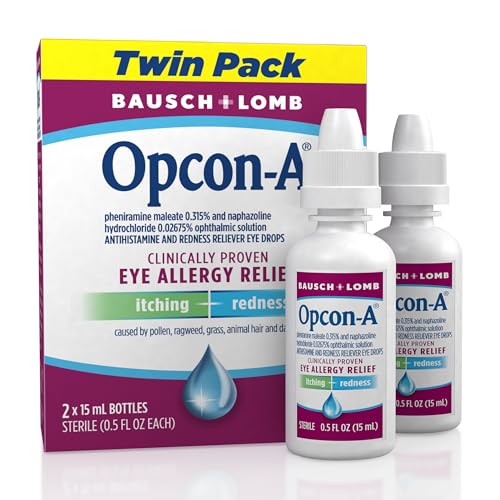
Best for: seasonal allergy sufferers whose eyes itch as well as redden Skip it if: your redness has nothing to do with allergens
Opcon-A is the cheapest of the five and the only one that treats two symptoms. Bausch + Lomb describes the formula as an antihistamine combined with a redness reliever, clinically proven to relieve redness and itching caused by allergens. The listing names pollen, ragweed, grass, animal hair and dander specifically. That's a precise brief, and no other pick here matches it.
You get 0.51 fl oz across a pack of two, weighing 2.08 oz total, in a 3.4 x 2.6 x 1.1 in package. Two bottles means one can live in the car through pollen season while the other stays home. It's also the oldest formula in the set at 2010, which for an allergy drop is more reassurance than drawback.
It's the slowest seller of the four picks with a category ranking anywhere near the top, which surprised me given the price position. My read is that most people shopping this category type "redness" rather than "allergy", and this drop sits in the allergy aisle.
The trade-off: it's built for allergen-driven redness. Red eyes from a late night, chlorine or ten hours of spreadsheets aren't the brief here, and the listing doesn't claim they are.
Pros:
- Cheapest pick in this set
- Only option combining antihistamine and redness reliever
- Two bottles per pack, 0.51 fl oz total
- Names specific allergens including ragweed and dander
Cons:
- Aimed at allergen redness, not screen or fatigue redness
- Sells more slowly than the Lumify pair
- No brimonidine, the newer redness active
- Antihistamine strength not published on the listing
4. Tyson 2.0 Mike Red Eye Drops — Most versatile
Redness reliever and lubricant in one 15 mL bottle, with the thinnest published specifications here.

Best for: long screen days when eyes feel dry and look red at once Skip it if: you want a listing with full published specifications
This is the only pick that names both of its actives with concentrations. The brand lists naphazoline HCl 0.03% as the redness reliever and glycerin 0.5% as the lubricant, describing the result as a 3-in-1 that eases dry, burning eyes while visibly reducing redness. Whether it lives up to that is the company's claim, but the disclosure itself is more than the Lumify listings give you.
The size is 0.5 fl oz, or 15 mL, which ties it with Visine for the largest single bottle here. The listing points at long days, late nights, smoke, dust, wind and pollen as triggers. That combination of moisture plus redness relief is a real fit for anyone whose eyes are simultaneously gritty and bloodshot after a screen marathon.
Here's the honest problem. The specification block is nearly empty: size is given as "Large" rather than a measurement, colour as "Clear", and there's no weight, no carton dimensions, no model number and no release year. It also ranks well down the sales list, far behind the Lumify bottles and Opcon-A.
Against the rest of the set, you're accepting a much thinner paper trail in exchange for the dual-action formula and a generous bottle.
Pros:
- Names both actives with concentrations, per the listing
- Largest bottle size in the set at 15 mL
- Glycerin 0.5% adds lubrication, per the brand
- Targets dryness and redness in one bottle
Cons:
- Almost no published dimensions, weight or model number
- Size listed vaguely as "Large"
- Slowest seller among the four ranked picks
- Sits in the more expensive half of this set
5. Visine Red Eye Comfort Redness Relief Eye Drops — Best upgrade
The only pick that publishes actual dosing instructions, including a minimum age.

Best for: households wanting one bottle usable by kids over six Skip it if: you want the newest redness ingredient available over the counter
Visine is the only listing in this group that tells you how to use the product. It states tetrahydrozoline hydrochloride 0.05% as the active, and gives a regimen: adults and children six and over, one or two drops in the affected eye up to four times a day, with children under six requiring different handling. For a household bottle, that published limit is worth more than any marketing line.
The size is 0.5 fl oz in a slim 3.75 x 1.06 x 1.77 in carton weighing 27.2 g, and the brand claims relief in 60 seconds from a single drop. It names smoke, airborne pollutants and extended computer use as triggers, and mentions FSA and HSA eligibility. Released in 2020, which makes it the second-newest formula here.
Two things count against it. Only one seller lists it, so availability is thinner than any other pick. And it sells far more slowly than the rest of this set, by a wide margin.
Weighed against the others, you're choosing published dosing guidance and an older, well-established active over the brimonidine chemistry that makes both Lumify bottles distinctive.
Pros:
- Only pick publishing a dosing limit and minimum age
- Names tetrahydrozoline 0.05% as the active
- Slim 3.75 x 1.06 x 1.77 in carton for a bag
- Claimed relief in 60 seconds, per the brand
Cons:
- Only one seller lists it
- Slowest-selling pick of the five
- No lubricant or antihistamine in the formula
- No price position established in this set
How long does one bottle of best redness relief eye drops last?
Volume varies more here than in most categories, and it's the difference between one reorder a year and one a month.
- 2.5 mL — the 0.08 oz Lumify. Smallest here by a wide margin.
- 7.5 mL — the 0.25 oz Lumify. Three times the small bottle.
- 15 mL — the Tyson 2.0 drop and the Visine bottle. Largest single bottles in this set.
- 0.51 fl oz across two bottles — Opcon-A. Split across two containers rather than one big one.
The two-bottle structure of Opcon-A matters if you dose seasonally. Open one, leave the second sealed until next spring. A single large bottle has to survive from opening to empty, and every drop bottle carries a post-opening limit printed on its carton. None of these listings publish that limit, so check the box.
My rule of thumb: buy the smallest bottle first. Redness relievers vary in how well they suit an individual eye, and finding out with 2.5 mL costs less than finding out with 15 mL.
Can you use these with contact lenses?
None of these five listings state whether the drop is safe to use while wearing contact lenses. That's a real gap, and it's the single most common question about this category, so I'd rather say so plainly than guess.
What the listings do give you:
- Opcon-A and both Lumify drops come from Bausch + Lomb, whose listing text references contact lenses and solutions among its broader product range. That's a company description, not a compatibility statement about these bottles.
- Visine publishes dosing limits and an age floor, but says nothing about lenses.
- Tyson 2.0 describes daily irritants including smoke and dust, again with no lens guidance.
Check the printed carton, and check with the person who fitted your lenses. Redness relievers work by narrowing blood vessels in the eye surface, and lens wear changes how a drop sits and drains. That's the kind of question a package insert answers and a marketplace listing does not.
What the listings leave out
Reading these five listings side by side, the same blanks show up repeatedly. Worth knowing before you commit.
- Preservatives. Only the Lumify listings mention what's absent (no bleach, no dyes), and none of the five name a preservative or state that they're preservative-free. If you're sensitive to benzalkonium chloride, the listing won't help you.
- Rebound redness. Vasoconstrictor drops have a well-documented tendency to make eyes look redder once the drop wears off if used heavily. No listing here addresses this, and none publishes a maximum duration of use.
- Dosing frequency. Visine is the only pick that publishes a limit of up to four times a day. The other four say nothing, which means you're relying entirely on the printed carton.
- Post-opening shelf life. Not stated on any of the five.
- Full ingredient lists. All five name actives in marketing copy at best. Inactives are absent across the board.
None of that makes these bad products. It does mean the box teaches you more than the listing, and that anything beyond occasional use belongs in a conversation with an eye doctor rather than a shopping decision.
The verdict
If you want the newest chemistry in the smallest commitment, buy the 0.08 oz Lumify. It's the only pick here built on brimonidine, per Bausch + Lomb, it's the second-cheapest of the five, and at 2.5 mL it costs little to find out whether the formula suits your eyes. That combination makes it the best redness relief eye drops choice for most first-time buyers.
If you already know redness is a routine problem rather than an occasional one, buy the 0.25 oz Lumify instead. Same formula, 7.5 mL rather than 2.5 mL, and it's the pick buyers here choose most often. The cutoff is frequency: reach for drops less than twice a week and the small bottle wins on cost; more than that and the reordering gets tedious fast.
Two conditions flip both of those. If your eyes itch as much as they redden, Opcon-A is the only pick in this set with an antihistamine, and it's the cheapest here. And if the bottle needs to serve a child over six, Visine is the only listing publishing a dosing limit and an age floor. The runner-up's exact advantage over the winner is volume, nothing more. Three times the fluid, identical formula.
FAQ
Are cheaper redness relief eye drops worth buying?
Cheaper redness relief eye drops are absolutely worth buying when the formula matches your trigger. Opcon-A is the cheapest pick here and the only one pairing an antihistamine with a redness reliever, which makes it the better tool for allergen-driven redness than either Lumify bottle. Price position in this set tells you very little about capability. The active ingredient tells you almost everything.
Is Lumify worth it over a standard redness drop?
Lumify is worth it over a standard drop if the brimonidine active matters to you. Bausch + Lomb states it's the only over-the-counter drop containing that ingredient, and that it selectively targets redness. The formula also contains no bleach or dyes, per the listing. If you'd rather have published dosing limits, Visine gives you those and Lumify doesn't.
What active ingredient should best redness relief eye drops contain?
The active ingredient in best redness relief eye drops depends on your symptom. Brimonidine appears in both Lumify bottles. Naphazoline HCl 0.03% plus glycerin 0.5% sits in the Tyson 2.0 drop for dryness and redness together. Tetrahydrozoline HCl 0.05% is Visine's active. Opcon-A adds an antihistamine for itch. Match the mechanism to the cause.
Lumify 0.25 oz or Visine Red Eye Comfort?
Choosing Lumify 0.25 oz or Visine comes down to formula age against dosing clarity. The Lumify bottle holds 7.5 mL of brimonidine formula and sells far faster in this set. Visine holds 0.5 fl oz, names tetrahydrozoline 0.05%, claims 60-second relief and publishes a limit of up to four drops a day for ages six and over. Only one seller stocks the Visine.
What mistake do first-time buyers make in this category?
The mistake first-time buyers make is treating every redness drop as interchangeable and buying the biggest bottle available. A pure redness reliever leaves allergen itching untouched. A lubricant plus redness formula does nothing extra for pollen. Buy the smallest bottle of the mechanism that matches your trigger first, confirm it suits your eyes, then scale up the volume.
Start with the 0.08 oz Lumify. It's a 2.5 mL bottle of the one active ingredient nothing else in this group uses, at the second-lowest price position here, which makes it the cheapest way to test the newest chemistry in the category on your own eyes. If it works, the 0.25 oz bottle is waiting with three times the fluid. If your eyes itch as well as redden, jump straight to Opcon-A instead. Whichever you pick, read the carton for dosing limits, because these listings mostly don't publish them.
Last updated: September 7, 2026. Product availability re-checked.
This page contains affiliate links. As an Amazon Associate we earn from qualifying purchases, at no extra cost to you.