Best Eye Drops for Dry Eyes on Accutane: Night Seal
Five dry eye products compared on what actually decides an isotretinoin course: how long the relief holds overnight, whether the formula is preservative-free, and how many doses you get per package.
The best eye drops for dry eyes accutane relief in this set is the Systane Nighttime Lubricant Eye Ointment, a 3.5 g preservative-free tube built to hold a protective layer on the eye through the night. If you'd rather treat dryness from the inside on a once-daily schedule, BLINK NutriTears is the alternate, with 30 softgels per bottle. One specification splits this field cleanly, and it isn't the bottle size.
Best eye drops for dry eyes accutane at a glance
| Pick | Format | Doses per pack | Price |
|---|---|---|---|
| Best overall Systane Nighttime Lubricant Eye Ointment |
Ointment, 3.5 g tube | Multi-dose tube preservative-free |
Check Price |
| Best premium BLINK NutriTears Supplement for Dry Eyes |
Oral softgel | 30 softgels 1 per day |
Check Price |
| Best upgrade Blink Triple Care Preservative Free Lubricating Eye Drops |
Drop, 0.4 fl oz bottle | Multi-dose bottle 10-hour claim |
Check Price |
| Best minimal setup TheraTears Dry & Tired Eye Drops |
Drop, single-use vials | 30 vials | Check Price |
| Best budget pick SPLASH TEARS Splash Refresh Soothing Eyes Drops for Tired |
Drop, 0.5 fl oz bottle | Multi-dose bottle | Check Price |
How I narrowed this field down to five
I weighted four criteria, in this order, and the order is the whole argument.
- How long the relief holds. Isotretinoin dryness doesn't arrive at 3pm and leave at 4pm. It sits on you for the length of the course. A formula that fades in twenty minutes means twenty doses a day.
- Preservative-free formulation. Frequent dosing plus benzalkonium chloride is a known irritation loop. Two of these five state preservative-free on the listing.
- Doses per package. A 30-count box and a multi-dose bottle are not the same purchase, and the difference shows up in week three.
- Format honesty. An ointment, a drop and a softgel solve different halves of the same problem. Pretending they're interchangeable is how people end up with the wrong one.
Why those weights? Because duration is the only criterion that changes your day. Everything else is comfort or convenience layered on top. I compared the published specifications side by side and let the weakest performer on criterion one drop to the bottom, regardless of how the listing reads.
Two things I deliberately did not weight: bottle volume, which tells you almost nothing about how many usable doses you get, and marketing language about clinical proof, which I've attributed rather than accepted throughout.
Does anything here treat isotretinoin dryness specifically?
No. None of these five listings names isotretinoin, and I'm not going to pretend otherwise. Searching for the best eye drops for dry eyes accutane returns general dry eye products, because that's the category that exists.
That matters for how you read the rest of this. These are lubricants and one oral supplement, marketed for dry, tired and irritated eyes. Whether any of them is appropriate alongside a prescription course is a question for the prescriber who put you on it, not for a product listing and not for me.
What I can do is compare them on the things that get measured: format, dose count, preservative status, and what each manufacturer claims about duration. That comparison is genuinely useful, because the dryness pattern most people describe during a course is constant and worst overnight, and the five products here handle that pattern very differently.
Read the picks below as five answers to "what holds up under heavy, repeated use", not as five treatments for a specific side effect. If your eyes are painful rather than dry, stop reading and call your doctor.
Ointment or drop: which one holds overnight?
Here's the split that decides this whole set. Ointment is thick and stays put. A drop is thin and drains.
Most guides to eye drops for dry eyes compare bottle volume. That's the wrong number. A 0.5 fl oz bottle isn't better than a 0.4 fl oz bottle in any way that shows up in your day. What shows up is whether you wake at 4am with your eyelids stuck to your cornea.
- Ointment is the format for the eight hours you can't dose. Systane's listing describes a long-lasting protective layer formed while you sleep. Trade-off: blurred vision immediately after, which is why nobody puts ointment in before driving.
- Drops are the format for waking hours. Fast, clear, repeatable. Blink Triple Care claims up to 10 hours of relief, which is the longest stated duration of any drop here.
- Oral supplement sits outside the argument. NutriTears works on tear production rather than surface coating, on a 28-day timeline per the manufacturer.
The practical answer for most people on a long course is two products, not one: ointment at bedtime, a drop during the day. That's why the winner and the third pick pair rather than compete.
1. Systane Nighttime Lubricant Eye Ointment — Best overall
The only overnight-format pick here, and the only one that solves the eight hours you can't reach for a bottle.

Best for: waking up with eyes stuck shut and burning Skip it if: you need clear vision right after the dose
Within this set, Systane is doing something nothing else does. Four of the five picks are daytime products. This one is built for the stretch where a drop has already drained away, and the 3.5 g tube is the mid-priced option of the five rather than a splurge.
The listing states a preservative-free formula, which puts it in a group of two here alongside the TheraTears vials. Systane describes it as forming a long-lasting, protective layer on the eyes while you sleep, and as soothing and protecting against dry, irritated eyes. Those are the manufacturer's words, and I'd treat the "long-lasting" part as a claim about ointment behaviour generally rather than a measured figure.
Dimensions are 4 x 6 x 5 in for the packaged product, so the carton is bulkier than the tube suggests. This is also the oldest formulation in the set, released in 2008, and it sells faster than everything except NutriTears.
The trade-off is real and it's vision. Ointment blurs. You apply it as the last thing before your head hits the pillow, and you accept a smeared world for a few minutes. Every drop in this set is clearer, faster and worse overnight.
Pros:
- Preservative-free formula per the listing
- Only overnight-format pick in this set
- Mid-priced rather than premium
- Compact 3.5 g tube for a nightstand
- Sells faster than three of the four alternates
Cons:
- Blurs vision immediately after application
- No published warranty or duration figure
- Useless as a daytime product
- Bulky 4 x 6 x 5 in outer packaging
2. BLINK NutriTears Supplement for Dry Eyes — Best premium
An oral once-daily route that sidesteps dosing frequency entirely, if you're prepared to wait for it.
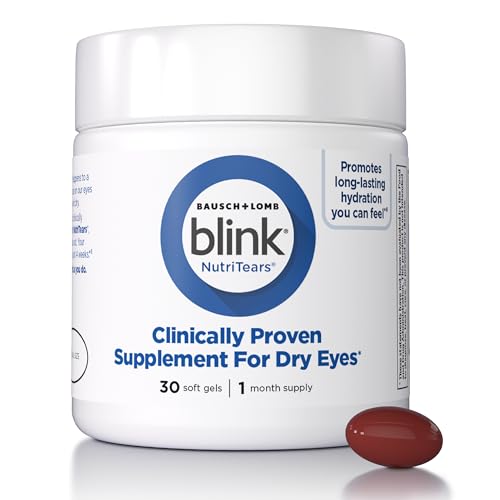
Best for: long-course users who want a once-daily routine Skip it if: you want relief in the next five minutes
NutriTears is the odd one out and that's the point. It's the only non-topical pick here, and the only one that asks nothing of you beyond a softgel with breakfast. For anyone facing months of dryness, a routine you'll actually keep has value that a better formula you forget to use does not.
Blink describes a blend of lutein, zeaxanthin, curcumin and vitamin D, aimed at supporting the eye surface and tear film, and states that in a clinical study eyes stayed hydrated 33% longer at day 28 versus baseline. That's their figure and their study, with the asterisks their listing carries. Note the timeline embedded in it: day 28. The bottle holds 30 softgels at one per day, so a single bottle roughly covers the window in which the claim is made.
It's the most expensive pick here and it's also the one buyers choose most often across this group. The unit is small at 2.52 x 2.91 x 2.56 in and 1.76 oz.
The trade-off is immediacy. Nothing about a softgel helps at 2am. If your eyes hurt tonight, this is not tonight's answer, and it's the priciest way to find that out.
Pros:
- Once-daily softgel, no dosing schedule
- 30 softgels covers the 28-day claim window
- The one buyers choose most often here
- Named actives: lutein, zeaxanthin, curcumin, vitamin D
Cons:
- Zero immediate relief
- Most expensive pick in this set
- Manufacturer's 33% figure is versus baseline, not versus drops
- Only one bottle before you're rebuying
3. Blink Triple Care Preservative Free Lubricating Eye Drops — Best upgrade
The longest stated duration of any drop here, in a 0.4 fl oz multi-dose bottle.

Best for: daytime dosing that needs to hold for hours Skip it if: you prefer single-use vials for hygiene
If Systane covers the night, this covers the day. Blink Triple Care carries the boldest duration claim in the set: the listing says 93% of users reported relief for up to 10 hours after application, based on a study Blink cites. No other drop here states a duration figure at all.
The formula is described as hyaluronic acid plus a lipid nano-emulsion with castor oil, positioned as a dual-action moisture seal that retains moisture and slows tear evaporation. Blink also calls it clinically proven 3-in-1 extended relief. All manufacturer language, all worth reading as marketing until your own eyes vote.
Specifications are thin here. The listing publishes weight at 18.1 g and dimensions of 1.34 x 4.13 x 1.73 in, and that's about it. No count, no released date, no warranty. It's the second-most expensive of the five.
The trade-off against the TheraTears vials is hygiene and portability. A multi-dose bottle gets handled repeatedly and travels as one unit you can lose. A vial box splits the risk. And it's the slower seller of the two Blink products in this set.
Pros:
- 10-hour relief claim, longest here
- Preservative-free per the product name
- Named actives: hyaluronic acid and castor oil
- Compact 1.34 x 4.13 x 1.73 in bottle
Cons:
- Thinnest specification list of any pick here
- No dose count published
- Second-highest price position in the set
- Multi-dose bottle, so repeated handling
4. TheraTears Dry & Tired Eye Drops — Best minimal setup
Thirty preservative-free single-use vials, which is the cleanest way to dose in public.

Best for: carrying doses in a pocket or bag Skip it if: you dose more than four times a day
The vial format is the argument. Thirty single-use vials at 4.75 x 2.13 x 2.94 in means you tear off two, drop them in a jacket pocket, and leave the rest at home. No tip touching anything, no bottle to contaminate, no bottle to leak into a bag.
TheraTears states the vials are preservative-free and intended for sensitive eyes, which makes this and the Systane ointment the only two picks here explicitly described that way. The brand also claims twice the hydrating ingredient of its original formula, and positions the drops against eye strain and screen fatigue. Their listing cites a doctor-recommended brand survey; I'd note that's survey data the manufacturer commissioned, and leave it there.
It's the second-cheapest pick and the released date on the listing is 2026, marking it as a newer entry.
The trade-off is arithmetic. Thirty vials sounds generous until you're dosing four or five times daily through a heavy course, at which point it's under a week. A bottle stretches further for the same money. Choose vials for hygiene, not for value.
Pros:
- 30 single-use vials, no contamination risk
- Preservative-free per the listing
- Second-cheapest of the five picks
- Small 4.75 x 2.13 x 2.94 in carton travels well
Cons:
- 30 doses runs out fast on heavy dosing
- No stated duration of relief
- Vials generate more waste per dose
- No weight or volume published
5. SPLASH TEARS Splash Refresh Soothing Eyes Drops for Tired — Best budget pick
The cheapest pick and the largest bottle at 0.5 fl oz, aimed squarely at mild end-of-day tiredness.

Best for: mild end-of-day tiredness on a low dose Skip it if: your dryness is severe or constant
This is the cheapest of the five and it carries the largest stated volume at 0.5 fl oz. If you're testing whether a lubricating drop helps you at all before committing to something pricier, the low entry cost is a genuine advantage.
Splash positions it as a moisturising eye lubricant for tired, uncomfortable and irritated eyes, gentle enough for regular use without heaviness or residue, with one or two drops per application. Chamomile appears as a named ingredient. The listing shows a 2026 release and dimensions of 3.7 x 1.1 x 1.85 in.
Note what the language does and doesn't promise. "Refreshed", "soothing sensation", "before and after a long day". That's comfort framing, not severe-dryness framing, and it reads differently from the Systane tube's reference to severe dry eye relief.
The trade-offs stack up. There's no preservative-free statement, which matters if you're dosing many times daily. No duration claim. No named lubricant active beyond chamomile. And it's the slowest seller of the five. You're buying the lowest price and the biggest bottle, and paying for it in published detail.
Pros:
- Cheapest pick in this set
- Largest stated volume at 0.5 fl oz
- Compact 3.7 x 1.1 x 1.85 in bottle
- Chamomile named as an ingredient
Cons:
- No preservative-free claim on the listing
- No stated duration of relief
- Slowest seller of the five
- Comfort framing rather than severe dryness
Why preservative-free matters when you dose all day
Preservative-free means the formula contains no antimicrobial additive to keep a multi-dose container sterile between uses. That's the definition, and it's a real distinction rather than a label flourish.
The relevance is frequency. A drop used twice daily and a drop used eight times daily are different exposures to the same additive, and heavy dosers are exactly the people who notice. Two picks here state preservative-free on the listing: the Systane ointment and the TheraTears vials. Blink Triple Care carries it in the product name itself, which makes three of five.
That leaves Splash Refresh as the one product in this comparison with no preservative statement I can point to. That's not a criticism of the formula, which I have no data on. It's an absence in the published information, and absences matter when you're choosing eye drops for dry eyes you'll use dozens of times a week.
The practical rule: the more often you dose, the more weight this criterion earns. Occasional users can reasonably ignore it.
How long does one package actually last?
This is the number nobody puts on the front of the box.
- TheraTears: 30 vials, one dose each. At four doses a day, that's roughly a week. At twice daily, about two weeks.
- NutriTears: 30 softgels at one per day. Exactly 30 days, no arithmetic needed.
- Blink Triple Care: 0.4 fl oz multi-dose bottle, no count published. Weeks rather than days, but you can't calculate it from the listing.
- Splash Refresh: 0.5 fl oz, the largest volume here, again with no dose count.
- Systane: 3.5 g tube, one small application per night, no count published.
Notice the pattern. The only two products where you can predict your reorder date are the ones sold by count. Volume figures feel precise and aren't, because a drop's size depends on the dropper tip and your hand.
If you're budgeting a multi-month course, the countable options are easier to plan around. If you just want the dryness to stop, buy on format first and worry about reordering later.
What the listings don't tell you
Four gaps, all worth knowing before you click.
Nobody publishes a warranty. Not one of these five states one, which is normal for consumables and still worth saying out loud so you don't go looking.
Duration figures come from the manufacturers. Blink's 10-hour claim and the 33% hydration figure for NutriTears both trace to studies the brands cite themselves. I've attributed both rather than asserting either.
Two picks publish almost nothing. Blink Triple Care lists weight and dimensions and stops. TheraTears lists size, dimensions and a release year. Compare that to the Systane tube, which publishes model number, weight, colour, count and a 2008 release date. More published detail isn't better performance, but it does let you verify more before buying.
Availability is limited across the board. Every one of these five shows only a couple of sellers, so your options for cross-checking a listing are thin.
None of this changes the ranking. It changes how confidently you should read the marketing above each Add to Cart button.
The verdict
The Systane Nighttime Lubricant Eye Ointment wins because it answers the hardest part of the problem. Daytime dryness has a dozen fixes. The eight hours you're asleep have one format, and this 3.5 g preservative-free tube is the only one here that uses it. That it sits mid-priced rather than premium makes it an easy first purchase.
Two conditions flip it.
If you can't tolerate blurred vision at bedtime, or you're regularly up in the night and need to see, buy Blink Triple Care instead and dose it as late as you can. Its 10-hour relief claim is the longest stated by any drop in this comparison, and it's preservative-free, so it survives frequent use.
If your course runs for months and you want one habit instead of a dosing schedule, BLINK NutriTears is the pick. One softgel a day, 30 in the bottle, with a manufacturer-cited 33% longer hydration figure at day 28. It gives you nothing tonight, which is the price of admission.
The runner-up's precise advantage over the winner is clarity. Blink Triple Care leaves your vision unchanged and can be used at any hour, in any situation, as many times as you need. Systane can't, and doesn't try to.
FAQ
Are the best eye drops for dry eyes accutane users buy worth the money?
The best eye drops for dry eyes accutane users reach for earn their cost mainly through frequency of use. If dryness interrupts your sleep or your screen work daily, even the premium picks here work out to pennies per dose. The cheapest option, Splash Refresh at 0.5 fl oz, is a reasonable way to find out whether lubricating drops help you at all.
Is an oral supplement like NutriTears worth it over drops?
An oral supplement is worth it only if your timeline is long. Blink cites a clinical figure of 33% longer hydration at day 28, which tells you the mechanism needs weeks, not minutes. The bottle holds 30 softgels at one daily. For a multi-month course, that routine has real value. For tonight's discomfort, drops or ointment win outright.
Can I use ointment and drops together during the day?
Using ointment and drops together works best when you split them by time rather than stacking them. Ointment blurs vision, so the Systane 3.5 g tube belongs at bedtime only. Use a drop like Blink Triple Care during waking hours, where its stated 10-hour relief and clear formula suit driving, screens and reading. Confirm any combination with your prescriber first.
Systane ointment or Blink Triple Care: which should I buy first?
Buy Systane ointment first if your worst symptoms hit overnight and on waking, because it's the only overnight format among these five picks and it's mid-priced rather than premium. Buy Blink Triple Care first if daytime dryness dominates, or if blurred vision at bedtime is unacceptable to you. Its 10-hour claim is the longest stated by any drop here.
What's the most common mistake buying dry eye drops?
The most common mistake is buying on bottle volume. A 0.5 fl oz bottle isn't better than a 0.4 fl oz bottle in any way you'll notice, because volume doesn't tell you dose count or how long each application holds. Buy on format and duration instead: overnight versus daytime first, then preservative status if you dose heavily.
Start with the format that matches the hour you suffer most. For most people on a long course, that's the overnight gap, which makes the Systane 3.5 g ointment the sensible default and a cheap one to test. Add a daytime drop only once you know whether the nights are handled. And do the obvious thing before any of it: tell the doctor managing your course what your eyes are doing, because a product listing can describe a lubricant but it can't examine you.
Last updated: September 7, 2026. Product availability re-checked.
This page contains affiliate links. As an Amazon Associate we earn from qualifying purchases, at no extra cost to you.