Best Eye Drops for MGD: TheraTears Leads
MGD is an oil problem, not a water problem, and most drop labels never mention oil at all. Here's how six picks compare on format, preservatives and lipid content, and which one belongs in your bag.
The best eye drops for meibomian gland dysfunction here are the TheraTears Dry Eye Drops, because the 1 Fl Oz bottles arrive as a 2 pack and the formula is built around the electrolytes the brand says appear in natural tears. If you want an oil ingredient inside the drop itself, Blink Triple Care Preservative Free Lubricating Eye Drops is the better buy, with hyaluronic acid and castor oil in an 18.1 g bottle. Pick wrong here and you spend weeks topping up water in an eye that is short on oil. The burning comes back by mid-afternoon, every afternoon.
Best eye drops for meibomian gland dysfunction at a glance
| Pick | Format | Preservative-free? | Price |
|---|---|---|---|
| Best overall TheraTears Dry Eye Drops |
1 Fl Oz bottle 2 pack |
No | Check Price |
| Best upgrade Blink Triple Care Preservative Free Lubricating Eye Drops |
0.4 fl oz bottle 18.1 g |
Yes, per label | Check Price |
| Most versatile TheraTears Dry & Tired Eye Drops |
30 single-use vials | Yes, per label | Check Price |
| Best for families Refresh OPTIVE Gel Drops Lubricant Eye Gel |
0.33 Fl Oz gel bottle | No, uses Purite | Check Price |
| Best budget pick ProCIV Tea Tree Oil Eyelid Wipes |
30 wrapped wipes | Not a drop | Check Price |
| Best premium ZOXY Manuka Honey Eye Drops |
0.68 FL OZ bottle | Not stated | Check Price |
Why three picks were cut before I ranked the rest
I started from a wide pull of dry eye listings and cut hard on three grounds before ranking anything.
First cut: anything with no published size or count. A drop bottle whose volume is unstated can't be compared to a 1 Fl Oz bottle or a 30 count vial box, and volume is the one number that separates a two-week supply from a two-month one. Second cut: allergy and redness relief formulas. Vasoconstrictors and antihistamines target a different complaint, and they don't belong in a lineup aimed at an oil-layer problem. Third cut: anything sold as a warm compress mask or a supplement. Useful, but not the same purchase.
What survived is a set of six with published formats and a claimed mechanism. Four are drops in a bottle. One is a box of 30 single-use vials. One is a box of 30 pre-moistened wipes, and it earns its place because lid hygiene sits next to drops in this routine rather than replacing them.
A note on the search itself. Amazon's results for best eye drops for meibomian gland dysfunction ignore the diagnosis, and none of these six listings names the condition. So I've ranked them on format, stated ingredients and how each one fits a routine, and left the diagnosis to your eye doctor.
What actually decides eye drops for meibomian gland dysfunction?
Most guides to eye drops compare how fast a drop feels soothing. That's the wrong test. Comfort in the first ten seconds tells you almost nothing about whether the drop is still working two hours later.
MGD is a problem with the oil layer that sits on top of your tears. When the glands along the lid margin clog, the oil thins out, tears evaporate faster, and the eye dries out even when it's producing plenty of fluid. So the question isn't "does this feel wet". It's whether the drop does anything about evaporation, and how it fits into a routine you'll actually follow.
That gives three criteria worth weighing:
- Does the formula address oil or evaporation at all? Blink names castor oil and a lipid nano-emulsion. Most others don't mention oil.
- Can you dose it as often as you need to? Multi-dose bottles win on convenience. Preservative-free vials win when your eyes react to preservatives.
- Does it pair with lid hygiene? Warm compresses and lid cleaning do the mechanical work. Drops manage symptoms in between.
Rank those three and the field sorts itself quickly.
1. TheraTears Dry Eye Drops — Best overall
The most sensible default in this set: two 1 Fl Oz bottles, a formula the brand has published details about since 2018, and the fastest-selling listing of the six.

Best for: steady daily use where a 2 pack outlasts one bottle Skip it if: you need single-use vials for sensitive eyes
Volume is what puts this first. Two bottles at 1 Fl Oz each is more total liquid than any other drop in this lineup, and MGD is a condition you manage for months rather than days. The whole package weighs 3 oz and measures 4.25 x 1.87 x 2.5 in, so one bottle lives at your desk and the spare stays in the cupboard.
TheraTears says the formula contains OxyLytes, which it describes as the five vital electrolytes found in natural tears, and that an ophthalmologist developed it over 18 years of research. Treat that as the brand's account of its own product. What I can verify is the format, the volume and the fact that this listing sells faster than the other five here, which tells you it's a well-established purchase rather than an experiment.
The trade-off is that this is a preserved multi-dose bottle. Nothing on the listing describes an oil or lipid component, so it's replacing water rather than shoring up the oil layer, and if you're dosing six or eight times a day, preservative exposure becomes a fair concern.
Pros:
- Two 1 Fl Oz bottles, most total volume in this set
- Fastest-selling of the six listings here
- Published formula details dating to 2018
- Compact 4.25 x 1.87 x 2.5 in carton
Cons:
- Preserved multi-dose bottle, not vials
- No stated oil or lipid ingredient
- Sits in the higher price positions of this set
- Only two sellers list it
2. Blink Triple Care Preservative Free Lubricating Eye Drops — Best upgrade
The only drop here that names an oil ingredient, which is exactly the layer MGD disrupts.

Best for: anyone who wants a lipid ingredient in the drop itself Skip it if: you want the largest total volume for the money
Read the ingredient claims across these six and this one stands apart. Blink describes a formula combining hyaluronic acid with natural castor oil, plus a lipid nano-emulsion, and says the oil is there to prevent tear evaporation. Evaporation is the mechanism at the heart of MGD, so that's the most relevant claim in the whole set, even though it remains the manufacturer's claim rather than something I can measure.
The bottle holds 0.4 fl oz and weighs 18.1 g, in a slim 1.34 x 4.13 x 1.73 in package that fits a shirt pocket better than a wide carton. The listing says it's preservative free, which is unusual for a multi-dose bottle and worth knowing if preservatives have bothered you before. Blink also cites a clinical study, reporting that 93% of users felt better with relief lasting up to 10 hours. That figure is the brand's, from a study I can't see.
Where it loses to the winner is straightforward arithmetic: 0.4 fl oz is well under the 2 Fl Oz you get from the TheraTears 2 pack, and this sits in the mid price positions rather than the cheapest. You're paying for the formula, not the quantity.
Pros:
- Names hyaluronic acid and castor oil, unique here
- Preservative free per the listing, in a multi-dose bottle
- Slim 1.34 x 4.13 x 1.73 in bottle for a pocket
- Brand cites a clinical study on duration
Cons:
- 0.4 fl oz is a fifth of the winner's total volume
- Duration and 93% figures are unverifiable brand claims
- Listing publishes no warranty or expiry guidance
- Only two sellers list it
3. TheraTears Dry & Tired Eye Drops — Most versatile
Thirty preservative-free single-use vials, which is the cleanest format for anyone dosing repeatedly through a screen-heavy day.

Best for: screen-heavy days and preservative sensitivity Skip it if: you dose many times a day and hate opening vials
The count is the story: 30 single-use vials in a 4.75 x 2.13 x 2.94 in box, and it lands as the second-cheapest pick here. TheraTears says these vials are preservative-free and made for sensitive eyes, and that the formula carries twice the hydrating ingredient found in its original drops. If your eyes have flared after weeks of a preserved bottle, this is the format that removes that variable entirely.
The brand also aims this one at eye strain and screen fatigue, which lines up with how MGD symptoms usually present: fine in the morning, gritty and burning by late afternoon when blink rate drops at a monitor. A vial in a jacket pocket is easy, and there's no cap to contaminate.
Two honest limits. Thirty vials go quickly if you're dosing four or more times daily, so a box may not last a fortnight. And this listing shows a 2026 release date, making it the newest arrival among the TheraTears options here, with less published detail than the original formula. It also sells far slower than the winner. Against Blink, it gives up the lipid ingredient in exchange for the vial format.
Pros:
- 30 preservative-free single-use vials
- Second-cheapest pick in this lineup
- Brand claims double the hydrating ingredient of the original
- No cap or nozzle to contaminate
Cons:
- 30 vials empty fast at four-plus doses a day
- No stated oil or lipid component
- Newest listing here, with the least published detail
- Sells markedly slower than the winner
4. Refresh OPTIVE Gel Drops Lubricant Eye Gel — Best for families
A gel-weight formula in a 0.33 Fl Oz bottle that Refresh says is safe to use as often as needed.
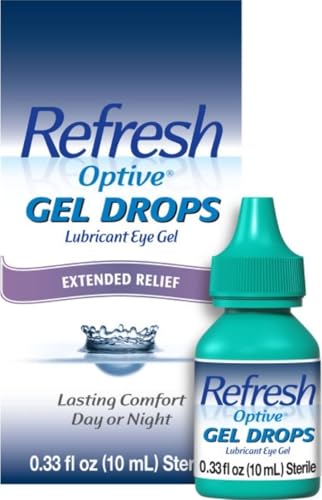
Best for: a shared bathroom bottle that can be used as often as needed Skip it if: blurring after a drop would derail your work
Thickness is what you're buying. Refresh describes this as its most comprehensive gel formula and says it feels like a drop but works like a gel for lasting comfort. A heavier formula stays on the eye surface longer, which matters when the oil layer isn't holding your tears in place. The bottle is small and light: 0.33 Fl Oz, 9.64 g, 3.5 x 1.13 x 1.75 in.
The reason it earns the family label is the preservative. Refresh names Purite, describing it as a preservative that eliminates bacteria, is gentle enough for use as needed, and breaks down into natural tear components in the eye. That combination of a multi-dose bottle and permission to use it freely suits a household where more than one person reaches for the same bottle. It's also the second-oldest listing here, dating to 2016, so the formula has been on shelves a while.
Gel has a cost, though, and it's real: heavier formulas can blur vision briefly after instillation. If you dose at your desk between emails, that pause is annoying. This is a bedside bottle more than a workday one. It also holds the smallest published volume of the four bottles in this set.
Pros:
- Gel-weight formula for longer surface contact
- Purite preservative, described as gentle for frequent use
- Tiny 3.5 x 1.13 x 1.75 in bottle at 9.64 g
- On the market since 2016
Cons:
- Gel formulas can blur vision briefly after dosing
- 0.33 Fl Oz is the smallest bottle volume here
- Not preservative-free, unlike two other picks
- No oil or lipid ingredient named
5. ProCIV 30PCS Tea Tree Oil Eyelid Wipes — Best budget pick
Not a drop at all, and that's the point: 30 wipes that clean the lid margin where the blocked glands sit.
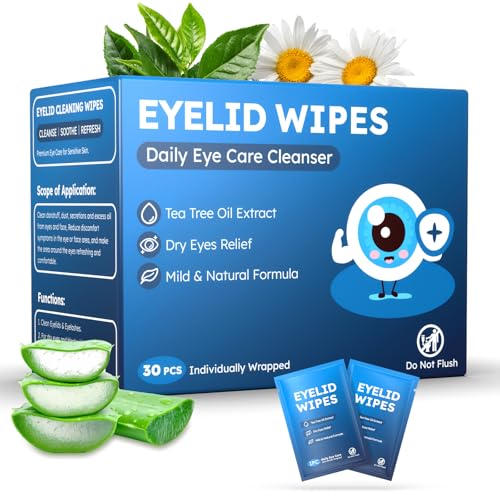
Best for: adding lid hygiene alongside whichever drop you pick Skip it if: you expected a bottle of drops
Drops sit on the eye. The clogged glands sit in the lid margin, a few millimetres away, and nothing you drip into your eye reaches them. That gap is why this is the cheapest pick here and still one of the most useful. You get 30 individually wrapped pre-moistened wipes, and ProCIV says each is infused with tea tree oil, chamomile, green tea and aloe vera extract, formulated alcohol-free for all skin types.
The stated purpose is removing oil and debris from around the eyes that contribute to irritation, which is straightforward lid hygiene. ProCIV also says the wipes are extra large, lint-free, made from pure cotton and naturally degradable. Individually wrapped sachets travel well and stay sanitary, which matters for anything touching an eyelid.
Be clear about what this isn't. It provides no lubrication and won't relieve grittiness on its own, so it can't be your only purchase. It's listed under makeup cleansing wipes rather than eye health, and 30 wipes at once-daily use is a month. Tea tree oil can also sting sensitive skin, and the listing gives no dilution figure to judge that by. Pair it with one of the drops above rather than choosing between them.
Pros:
- Cheapest pick of the six
- 30 individually wrapped pre-moistened wipes
- Alcohol-free formula with chamomile, green tea, aloe
- Targets the lid margin that drops can't reach
Cons:
- Provides no lubrication whatsoever
- Tea tree oil can sting sensitive skin
- No dilution or concentration figure published
- Listed under cleansing wipes, not eye health
6. ZOXY Manuka Honey Eye Drops — Best premium
The largest single bottle here at 0.68 FL OZ, built around a honey-based formula that no other pick attempts.

Best for: curiosity about a honey-based soothing formula Skip it if: you want the most established formula in this set
If bottle size is your priority, note the number: 0.68 FL OZ, more than any other single bottle in this comparison, at 13.6 g in a compact 1 x 2 x 2 in package. ZOXY says the drops are designed to mimic natural tears and restore moisture, and that the manuka honey is sourced from Australia and New Zealand, carrying natural enzymes and antioxidants. Honey has a long folk history in eye care, and this is the only pick in the lineup taking that route.
The listing pitches it as compact and convenient for travel, working or relaxing, and the 1 x 2 x 2 in footprint backs that up. It's a genuinely small object for the volume it holds.
Now the caveats, and they're substantial. This is the most expensive pick in the set and the slowest seller of the six by a wide margin, so it has the least track record here. The listing publishes no size field, no preservative status and no released date, which means you can't tell whether it's safe for frequent dosing the way you can with Blink or the TheraTears vials. Honey-based drops can also sting on contact. Against the winner, you're paying more for a less documented formula.
Pros:
- 0.68 FL OZ, largest single bottle here
- Very small 1 x 2 x 2 in package at 13.6 g
- Only honey-based formula in this comparison
- Brand names Australian and New Zealand sourcing
Cons:
- Most expensive pick with the least published detail
- Slowest-selling listing of the six by a wide margin
- No preservative status stated, so dosing frequency is unclear
- Honey formulas can sting on contact
Preservative-free vials or a multi-dose bottle?
This is the format question that trips up most people shopping eye drops for meibomian gland dysfunction, and it comes down to how often you dose.
Preservatives exist to stop bacteria growing in an opened bottle. That's necessary, but the same chemistry can irritate an eye surface that's already inflamed, and frequent dosing multiplies the exposure. Two picks here address it directly. TheraTears Dry & Tired uses 30 single-use vials with no preservative at all. Blink Triple Care claims preservative-free status in a multi-dose bottle, which is the harder engineering problem and the more convenient result. Refresh takes a third route with Purite, which it describes as breaking down into natural tear components in the eye.
The practical split:
- Dosing once or twice a day? A preserved bottle is fine, and the TheraTears 2 pack gives you the most liquid.
- Dosing four or more times a day? Go preservative-free. Blink's bottle or the 30 count vials.
- Sharing a bottle at home? Refresh, which the brand says is safe to use as often as needed.
Does a lipid or oil ingredient matter here?
For this condition specifically, yes, and it's the sharpest line through the group. MGD means the oil layer on your tears has thinned, so tears evaporate before they should. A pure water-and-electrolyte drop tops up the water. It doesn't rebuild the layer keeping that water in place.
Only Blink Triple Care names an oil in its formula: castor oil, plus a lipid nano-emulsion and hyaluronic acid, with the stated purpose of sealing in moisture and preventing evaporation. That's the manufacturer's claim, and I can't verify how well it performs. But it's the only pick in the set that describes a mechanism aimed at the actual problem.
The others are honest about being lubricants. TheraTears talks about restoring the eyes' natural balance with electrolytes. Refresh talks about gel weight and lasting comfort. ZOXY talks about mimicking natural tears. All reasonable goals, none of them targeting the oil layer.
Which is why I'd frame it this way: if you've been diagnosed with MGD and you're choosing one drop, the lipid claim deserves the extra weight. If you're managing general dryness that happens to include some evaporative component, volume and format matter more, and the winner takes it.
What the listings don't tell you about MGD
Five things you'll want to know that no product page in this category covers.
None of these listings mentions the condition. Search for eye drops for meibomian gland dysfunction and Amazon returns dry eye products, because that's how the shelf is organised. Every pick here is labelled as a lubricant, a gel or a wipe. Read every claim as being about dryness generally.
Drops don't unblock glands. Warm compresses, lid massage and in-office procedures do the mechanical work. Drops manage symptoms between those. That's exactly why the wipes made the list.
Expiry after opening matters. Preserved bottles typically carry a discard-after-opening window, and none of these listings publishes one. Check the carton when it arrives.
Contact lens compatibility isn't stated. Not one of the six specifies whether it can go in with lenses in. If you wear lenses, ask before you dose.
Nobody publishes a warranty. Reasonable for a consumable, but it means you're relying on the return window rather than any product guarantee.
The verdict
The best eye drops for meibomian gland dysfunction in this lineup are the TheraTears Dry Eye Drops, and the reason is unglamorous: two 1 Fl Oz bottles is the most liquid on offer here, from the fastest-selling listing of the six, with a published formula that dates to 2018. MGD is managed over months, not days, and running dry mid-week is the failure mode that actually gets people to abandon a routine.
Two conditions flip that recommendation. First, if your eye doctor has told you the oil layer is the issue and you want the drop itself to address evaporation, take Blink Triple Care instead. Its castor oil and lipid nano-emulsion claim is the only one in this set aimed at that mechanism, and it's preservative free in a 0.4 fl oz multi-dose bottle. Second, if preservatives have irritated you before or you dose more than four times daily, take the TheraTears Dry & Tired vials. Thirty preservative-free single-use doses at the second-cheapest position here removes the variable completely.
Blink's exact advantage over the winner is the ingredient list, not the volume. You're trading roughly four-fifths of the total liquid for the only lipid claim in the group. Whichever drop you land on, add the ProCIV wipes. Lid hygiene is the part no bottle can do.
FAQ
Are expensive eye drops for meibomian gland dysfunction worth the money?
Expensive eye drops for meibomian gland dysfunction earn their position only when the formula does something extra. Blink Triple Care sits mid-range here and names castor oil and hyaluronic acid, which is a real difference. ZOXY is the most expensive pick with the least published detail: no size field, no preservative status. Pay for a stated mechanism, not for packaging.
Is a preservative-free formula worth it for daily use?
A preservative-free formula is worth it once you dose four or more times a day, because preservative exposure adds up on an already irritated eye surface. TheraTears Dry & Tired gives you 30 single-use vials. Blink claims preservative-free status in a 0.4 fl oz multi-dose bottle. At once or twice daily, a preserved bottle is perfectly reasonable.
Can I use these eye drops with contact lenses in?
Using these eye drops with contact lenses is something none of the six listings addresses. Not one publishes lens compatibility, so don't assume it. Gel formulas like Refresh OPTIVE are generally the ones to be most careful with, given their thickness. Check the carton when it arrives, and ask your eye doctor before dosing over lenses.
TheraTears Dry Eye Drops or Blink Triple Care: which should I buy?
TheraTears Dry Eye Drops or Blink Triple Care splits on volume against ingredients. TheraTears gives you two 1 Fl Oz bottles, the most liquid here, from the fastest-selling listing. Blink gives you 0.4 fl oz plus the only named oil in the set, castor oil with hyaluronic acid. Diagnosed MGD leans Blink. General daily dryness leans TheraTears.
What's the biggest mistake people make buying dry eye products?
The biggest mistake people make is treating drops as the whole routine. MGD starts in the lid margin, where blocked glands sit, and no drop reaches that. Warm compresses and lid cleaning do the mechanical work, which is why the ProCIV pack of 30 wipes belongs alongside your drops rather than instead of them. Buy both.
Start with the TheraTears 2 pack and the ProCIV wipes together. That combination costs you the least in decision-making and covers both halves of the routine: something on the eye surface for the burning, something on the lid margin for the cause. Give it three or four weeks of consistent use before you judge it, because gland function doesn't change overnight. If you're still gritty by mid-afternoon, switch the drop to Blink Triple Care and keep the wipes. That's the one substitution in this set with a stated reason behind it, and it's the sensible second move.
Last updated: September 7, 2026. Product availability re-checked.
This page contains affiliate links. As an Amazon Associate we earn from qualifying purchases, at no extra cost to you.