Best Halal Fiber Supplement for Athletes Compared
A halal-aware roundup of seven fiber supplements, ranked by dose, format and set position, with a specific buyer profile attached to each pick.
The best halal fiber supplement for athletes is SHIFAA Nutrition's chicory-root gummy, a gelatin-free 60-count bottle delivering 4g per serving with a clear halal claim on the label. If you can accept a non-halal-marked bottle in exchange for a bigger dose, Metamucil's 120-count gummies push 5g per serving and hold the fastest sales position in this set. Everything below adjusts for training load, dosing preference and whether the halal claim has to be explicit.
Best halal fiber supplement for athletes at a glance
| Pick | Fiber per serving | Format | Price |
|---|---|---|---|
| Best overall SHIFAA Nutrition Halal Fiber Gummies |
4g claim | Gummy, 60 count | Check Price |
| Best premium Metamucil Fiber Gummies for Adults |
5g claim | Gummy, 120 count | Check Price |
| Best for families YUM-V'S Sugar Free Fiber Gummies |
4g claim | Gummy, 60 count x 2 | Check Price |
| Most versatile Physician's Choice GLP-1 Fiber |
5g claim | Gummy, 60 count | Check Price |
| Best upgrade Micro Ingredients 5-in-1 Psyllium |
Blend, not stated | Capsule, 240 count | Check Price |
| Best budget pick Vitamatic Extra Strength 7g Fiber |
7g claim | Gummy, 60 count | Check Price |
| Best minimal setup GoodMeds Psyllium Husk 520mg |
520mg per capsule | Capsule, 200 count | Check Price |
How I cut the shortlist down to seven
The first cut was easy: any listing whose ingredient panel included pork gelatin was out. That knocked most mainstream fiber gummies straight off the board, because gelatin is the default gel-forming agent in the category. What survived came in two shapes, pectin-based gummies and vegetarian capsules, and both are compatible with a halal diet even when the label does not carry a certification mark.
The second cut was harder. Three reasons decided it:
- No halal claim and no gelatin substitute named. If the listing was silent on both, it was cut.
- Fiber dose too low to matter. A 2g gummy is a rounding error against a daily target above 30g, so entries at that dose were dropped.
- Missing serving size or count. Two listings did not publish either; a fiber supplement you cannot dose is not a fiber supplement.
What survived is a set of seven: four pectin gummies, two vegetarian capsules and one psyllium blend. Two of the seven print an explicit halal claim on the listing: SHIFAA Nutrition and YUM-V'S. The other five are gelatin-free by construction, which is a reasonable proxy but not a certification. That gap is the whole reason this roundup exists.
Halal certification: what the listings actually promise
Only two of these seven products state halal on the listing itself. That is the important number, and it is worth understanding before you buy any of the rest.
SHIFAA Nutrition names halal in the product title. YUM-V'S lists halal in the ingredient-quality bullet alongside kosher and vegetarian. The other five products in the set either use pectin as the gel base or come in a vegetarian capsule shell, which means no animal-derived gelatin, but the listing does not attest to a formal halal audit.
For an athlete whose halal observance is strict, that distinction is not academic. A gelatin-free product is not automatically halal-certified: the manufacturing environment, the alcohol content of any flavourings and the source of any glycerin all matter. If the label does not say so, you are relying on the ingredient panel plus a phone call to the manufacturer. Two of the seven remove that step for you, and that is why one of them is the winner.
1. SHIFAA Nutrition Halal Fiber Gummies — Best overall
A gelatin-free chicory-root gummy that names halal on the label, which is exactly what the category is missing.

Best for: an athlete who wants a halal-labelled gummy at a moderate dose Skip it if: you want the highest fiber-per-serving in the set
SHIFAA's advantage inside this set is narrow but decisive: the halal claim is printed on the product itself, not inferred from the absence of gelatin. The bottle holds 60 gummies at a 4g soluble fiber claim per serving, drawn from chicory root, which is an inulin source that feeds gut bacteria rather than bulking stool. That matters for endurance athletes whose training load already stresses digestion, because inulin is gentler in transit than psyllium once you are moving. The brand states the gummies are non-GMO, gelatin-free, vegan and produced in a GMP-certified facility. Dimensions are 5 x 3 x 3 in and the whole bottle weighs 0.5 lb, which is small enough for a gym bag but not for a jersey pocket. Its trade-off against the rest of the set is the price position, sitting at the top end of the seven picks, and a slower sales pace than the two big-name gummies. You are paying for the halal claim, and if that claim is what you came for, that is not a bad trade.
Pros:
- Halal named in the product title
- Chicory root, gentler than psyllium in transit
- Gelatin-free and vegan
- Compact 5 x 3 x 3 in bottle
Cons:
- Highest price position among the gummies
- Slowest sales pace of the seven
- Only 4g per serving, not the highest here
2. Metamucil Fiber Gummies for Adults — Best premium
The largest bottle in the set at 120 count with a 5g plant-based fiber claim, moving faster off the shelf than anything else here.

Best for: a training partner who wants 5g of fiber and the largest bottle here Skip it if: you need an explicit halal claim on the label
Metamucil is the buyers' default here, moving the fastest of any pick in the set, and it earns that position with the largest count and the highest gummy dose above SHIFAA. Each serving claims 5g of plant-based fiber blended from inulin and Fibersol soluble corn fiber, an orange flavour without added sugar, and the bottle holds 120 gummies against SHIFAA's 60. For an athlete taking a serving with breakfast and another after training, that difference matters: it is roughly two months of daily use versus one. The catch is halal certification. Metamucil does not claim it, and while the fiber blend itself is plant-based, the gel base, the flavour system and the manufacturing environment are not attested for halal compliance on the listing. Compared with the SHIFAA pick, you are trading a printed halal claim for double the count and a gram more per dose. Its trade-off is that halal-strict shoppers cannot use it without additional verification.
Pros:
- 5g fiber per serving, higher than most here
- 120-count bottle, largest in the set
- No sugar added
- Fastest sales pace in the set
Cons:
- No halal claim on the listing
- Highest price position of the seven
- Orange flavour only, no variety
3. YUM-V'S Sugar Free Fiber Gummies — Best for families
A two-pack of gelatin-free berry gummies that lists halal alongside kosher and vegetarian, formulated for sugar-restricted diets.

Best for: a household sharing one bottle across adults and kids Skip it if: you train alone and do not need a two-pack
YUM-V'S is the second product in the set that names halal on the listing, and it does so alongside kosher, vegetarian and gluten-free, which is a stronger certification story than the halal-only claim on SHIFAA. Each serving is 4g of soluble prebiotic fiber, matching SHIFAA on dose, and the format is a berry-flavoured pectin gummy with no added sugar and no artificial sweeteners. The listing calls it suitable for diabetics, which is not medical guidance you should act on without a doctor, but the sugar-free formulation is genuine. The two-pack of 60-count bottles is the reason this earns the family pick: a household with two adults training and a child taking fiber gets a fair split from a single purchase. Bottle dimensions are 2.64 x 5.08 x 5.44 in per bottle. Its trade-off against SHIFAA is subtle: the halal claim sits in a bullet rather than the product title, so it reads as one certification among several rather than the headline promise.
Pros:
- Halal, kosher, vegetarian and gluten-free claims
- Two-pack of 60 gummies
- Sugar-free with no artificial sweeteners
- Pectin-based, gelatin-free
Cons:
- Halal claim less prominent than SHIFAA's
- Two bottles is more than a solo athlete needs
- Berry flavour only
4. Physician's Choice Fiber Gummies for GLP-1 Support — Most versatile
A raspberry-lemon chicory-root gummy at 5g per serving, marketed for GLP-1 users and third-party tested.

Best for: an athlete on a GLP-1 or a sugar-restricted plan Skip it if: you specifically want a halal-marked bottle
Physician's Choice earns the versatile label because its formula fits more edge cases than the rest of the gummies here. The claim is 5g of chicory-root prebiotic fiber per two-gummy serving, no added sugar, no sugar alcohols, no artificial sweeteners, and the brand markets it explicitly for GLP-1 medication users who often struggle with constipation. For an athlete cutting weight on a GLP-1 protocol under medical supervision, that overlap is meaningful. Physician's Choice states the product is developed with doctors and third-party tested in a cGMP-certified facility, which is a stronger quality attestation than most in this set carry. The 60-count bottle weighs 0.56 lb. What it lacks is the halal certification. The formula is vegan and plant-based, which puts it in the gelatin-free bucket by construction, but the listing does not carry a halal mark. Its trade-off in this set is straightforward: better dose and testing than SHIFAA, but no halal claim, so it wins on versatility and loses on certification.
Pros:
- 5g fiber per serving from chicory root
- No added sugar or artificial sweeteners
- Third-party tested, cGMP facility
- GLP-1 friendly formulation
Cons:
- No halal certification claim
- Mid-tier price position
- Raspberry lemon flavour only
5. Micro Ingredients Psyllium Husk 5-in-1 — Best upgrade
A vegetarian capsule stacking psyllium, prebiotics, probiotics, postbiotics and five digestive enzymes into one bottle.

Best for: a lifter who wants psyllium, prebiotics and enzymes in one capsule Skip it if: you cannot swallow a three-capsule serving
Micro Ingredients is the only pick in the set that treats fiber as a hub, not a standalone. The 5-in-1 formula combines psyllium husk, inulin, FOS, acacia and chia seed for the fiber layer, then adds 40 strains of probiotics and postbiotics and five enzymes: amylase, protease, lipase, papain and bromelain. That last group matters if you eat high-protein around training, because protease and papain support protein breakdown. The vegetarian capsule shell keeps it compatible with a halal diet by construction, though the listing does not carry a halal certification mark. Each bottle holds 240 capsules at a 3-capsule serving, which is 80 daily doses, and the entry price position makes that one of the better value ratios here. The catches are two: the serving is three capsules, which is more than most people want to swallow before breakfast, and the total fiber grams per serving are not printed as a single figure on the listing, so you cannot directly compare the dose against the gummies. Its trade-off is complexity for coverage.
Pros:
- Vegetarian capsule, gelatin-free
- Psyllium plus prebiotics, probiotics, enzymes
- 80-day supply at 3 capsules daily
- Non-GMO, gluten-free, third-party tested
Cons:
- Fiber grams per serving not stated
- Three capsules per serving
- No halal certification on the listing
6. Vitamatic Extra Strength 7g Fiber — Best budget pick
The highest gummy dose in the set, 7g of FOS from beet, at the cheapest price position here.
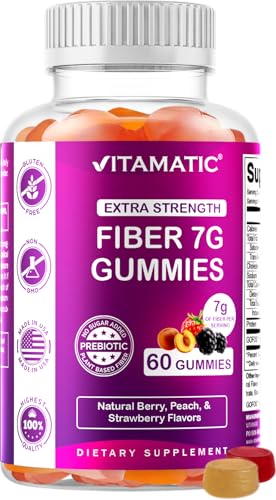
Best for: the highest fiber-per-gummy at the lowest price position here Skip it if: you want a halal claim printed on the bottle
Vitamatic wins on the specification athletes actually care about: dose. Each serving claims 7g of prebiotic fiber from FOS sourced from beet, which is the highest number in this roundup, and it costs less than any other product here. The gummies are pectin-based rather than gelatin-based, which puts them in the halal-compatible bucket, but the listing does not carry a halal certification mark. The bottle holds 60 gummies at 3.5 oz and comes in a mixed berry, peach and strawberry assortment, made in a GMP-certified facility in the USA. For an athlete whose main constraint is hitting a fiber target on training days when appetite drops, the 7g figure covers roughly a quarter of a 30g daily target in one two-gummy serving, more than any other gummy on this list. Its trade-off against the SHIFAA winner is the missing halal claim: if that claim is non-negotiable for you, Vitamatic drops out. If your halal observance is satisfied by a plant-based pectin gummy without gelatin, this is the best value in the set.
Pros:
- 7g fiber per serving, highest in this set
- Cheapest price position
- Three flavours in the bottle
- Pectin-based, gelatin-free
Cons:
- No halal claim on the listing
- FOS can cause bloating at high doses
- 60-count bottle, smaller than Metamucil
7. GoodMeds Psyllium Husk 520mg Capsules — Best minimal setup
A no-frills psyllium husk capsule with 200 in the bottle and no added binders.

Best for: travel days when a gummy jar is a hassle Skip it if: you want the fiber gram total printed clearly on the label
GoodMeds is the simplest formulation in the set: psyllium husk at 520mg per capsule, no binders, no fillers, in a 200-count bottle that weighs 3.2 oz and measures 4 x 2 x 2 in. That form factor is why it earns the minimal-setup pick. A capsule jar travels through airports without melting, dissolving or leaking, and it does not need to be refrigerated. The listing does not state the capsule shell material explicitly, which is the caveat for halal-observant buyers: vegetarian capsules are common in this category, but you would want to confirm with the brand before buying if that matters. Psyllium is the fiber that produces the most bulking action in transit, so it suits an athlete whose issue is stool consistency rather than gut-flora feeding. Its trade-off against the Micro Ingredients capsule is stark: GoodMeds does one thing, and Micro Ingredients does five. The trade-off against every gummy in the set is that the fiber gram total per serving is not printed on the listing at all, only the milligram figure per capsule.
Pros:
- Single-ingredient psyllium husk
- 200 capsules per bottle
- Compact 4 x 2 x 2 in bottle
- No binders or fillers
Cons:
- Fiber grams per serving not stated
- Capsule shell not specified on listing
- No halal claim printed
Gummy or capsule for a training schedule?
The format question is the second-biggest decision in this category after the halal certification question, and the answer depends on when and where you take the serving.
Gummies win when you take fiber with a meal at home. They are pleasant, they do not need water, and they work as a small habit at the end of breakfast or dinner. Every gummy in this set uses pectin, not gelatin, which keeps them halal-compatible. Their weakness is heat and travel: a jar of gummies in a hot gym bag turns into a single fused block, and airport security has occasionally treated jelly-textured supplements as liquids.
Capsules win when you travel, train early or take fiber at odd hours. They do not fuse, they do not stain, and they carry no flavour system that might include alcohol-based extracts. Their weakness is serving size: Micro Ingredients asks for three capsules, and most people who dislike swallowing capsules dislike them one at a time.
For an athlete whose training schedule includes travel to competitions or camps, a capsule beats a gummy on portability. For everyone else, a gummy is the easier habit to keep.
How much fiber does an athlete actually need daily?
There is no athlete-specific fiber target published by any major sports nutrition body, and the standard adult range of 25g to 38g per day is the number most guides fall back on. That range assumes a mixed diet with vegetables and whole grains covering the majority of the intake.
A fiber supplement fills the gap, it does not carry the total. Consider the doses in this set:
- Vitamatic at 7g per serving covers roughly a quarter of a 30g target
- Metamucil and Physician's Choice at 5g per serving cover roughly a sixth
- SHIFAA and YUM-V'S at 4g per serving cover roughly an eighth
The practical answer is that a supplement should top up food, not replace it. An athlete eating a high-protein diet with limited vegetables might genuinely need 5g to 10g of supplemental fiber to hit target. An athlete eating oats, fruit, beans and salad already gets most of the way there and needs a smaller top-up. Start low, and if you increase, do it gradually across a week to avoid the bloating that comes with a sudden jump in fermentable fiber.
What the listings quietly leave out
Product listings in this category are consistently silent on three things that matter to an athlete:
- Total fiber grams per bottle. Only the per-serving figure is printed, so you have to multiply. A 60-gummy bottle at 4g per serving with a two-gummy serving is 30 servings and 120g total fiber; a 240-capsule bottle without a stated fiber gram figure is genuinely opaque.
- Alcohol content of flavour systems. Halal observance often extends to flavour carriers. None of the listings in this set specify the flavour extract solvents, and the halal-marked products are the only ones that have implicitly cleared that question with a certifier.
- Interaction with pre-workout timing. Fiber slows gastric emptying, which is the opposite of what you want in the hour before training. None of the listings mention timing. The safe default is to take fiber with the meal furthest from your session.
These are not defects, they are category norms. Knowing them lets you dose intelligently. The winner in this set does not fix all three, but it fixes the one most halal-observant athletes actually asked for, which is the certification.
The verdict
The best halal fiber supplement for athletes is SHIFAA Nutrition's chicory-root gummy, and the reason is narrow and honest: it is one of only two products in this set that names halal on the listing, and it names it in the product title where a shopper cannot miss it. That does not make it the highest-dose product, or the cheapest, or the fastest-selling. It makes it the one that answers the question in the keyword without asking you to phone a manufacturer to confirm.
If your halal observance is satisfied by a plant-based pectin gummy without gelatin, the picture flips. Vitamatic delivers 7g per serving at the cheapest price position in the set, and Metamucil pairs 5g per serving with the largest count. Physician's Choice adds third-party testing and a GLP-1 friendly formulation. Micro Ingredients bundles fiber with enzymes and probiotics for the athlete who wants one bottle to do more work.
The cutoff is simple: if the printed halal claim matters, SHIFAA or YUM-V'S. If gelatin-free is enough, the field opens up to five more options ranked on dose, format and price position.
FAQ
Is a halal fiber supplement necessary if I already eat a halal diet?
A halal fiber supplement matters because the supplement industry defaults to bovine or porcine gelatin in gummy formats. Even when the fiber itself is plant-based, the gel carrier often is not. Choosing a product that either names halal on the label or uses pectin instead of gelatin keeps your supplement stack consistent with the rest of your diet.
What is the difference between soluble and insoluble fiber for training?
The difference between soluble and insoluble fiber shows up in transit. Soluble fibers like inulin and chicory root ferment in the gut, feed beneficial bacteria and produce short-chain fatty acids. Insoluble fibers like psyllium husk add bulk and hold water. For an athlete, soluble fiber tends to feel gentler mid-training and insoluble fiber tends to be more reliable for regularity.
Should I take fiber before or after a workout?
Take fiber well away from a workout. Fiber slows gastric emptying and can cause bloating during exertion, which is the opposite of what you want during a session. The safe default is to dose fiber with the meal furthest from your training window, usually breakfast if you train in the evening or dinner if you train in the morning.
Is SHIFAA Nutrition or YUM-V'S the better halal-labelled pick?
Choosing between SHIFAA Nutrition or YUM-V'S comes down to bottle count and prominence of the claim. SHIFAA names halal in the product title and comes as a single 60-count bottle. YUM-V'S names halal in an ingredient bullet alongside kosher and vegetarian, and ships as a two-pack. Solo athletes usually prefer SHIFAA; households sharing a bottle usually prefer YUM-V'S.
Is 7g of fiber per serving worth it over 4g?
The value of 7g of fiber per serving depends on your baseline diet. If you already eat oats, beans, fruit and vegetables daily, a 4g top-up is usually enough. If your diet is protein-heavy with limited plant intake, the 7g dose in Vitamatic covers more of the gap in fewer gummies. Increase dose gradually to avoid bloating from fermentable fiber.
Pick a bottle, take the first serving with your next non-training meal, and give it ten days before you decide it works. Fiber is one of the few supplements where the response curve is honest: bowel regularity either improves or it does not, and you know within a fortnight. SHIFAA's halal claim solves the certification question that this whole category usually leaves open, which is why it leads the ranking even though it is not the highest-dose or the cheapest option. For most halal-observant athletes, printed certification is worth more than a gram of fiber, and that is the trade this pick makes in your favour.
Last updated: September 7, 2026. Product availability re-checked.
This page contains affiliate links. As an Amazon Associate we earn from qualifying purchases, at no extra cost to you.